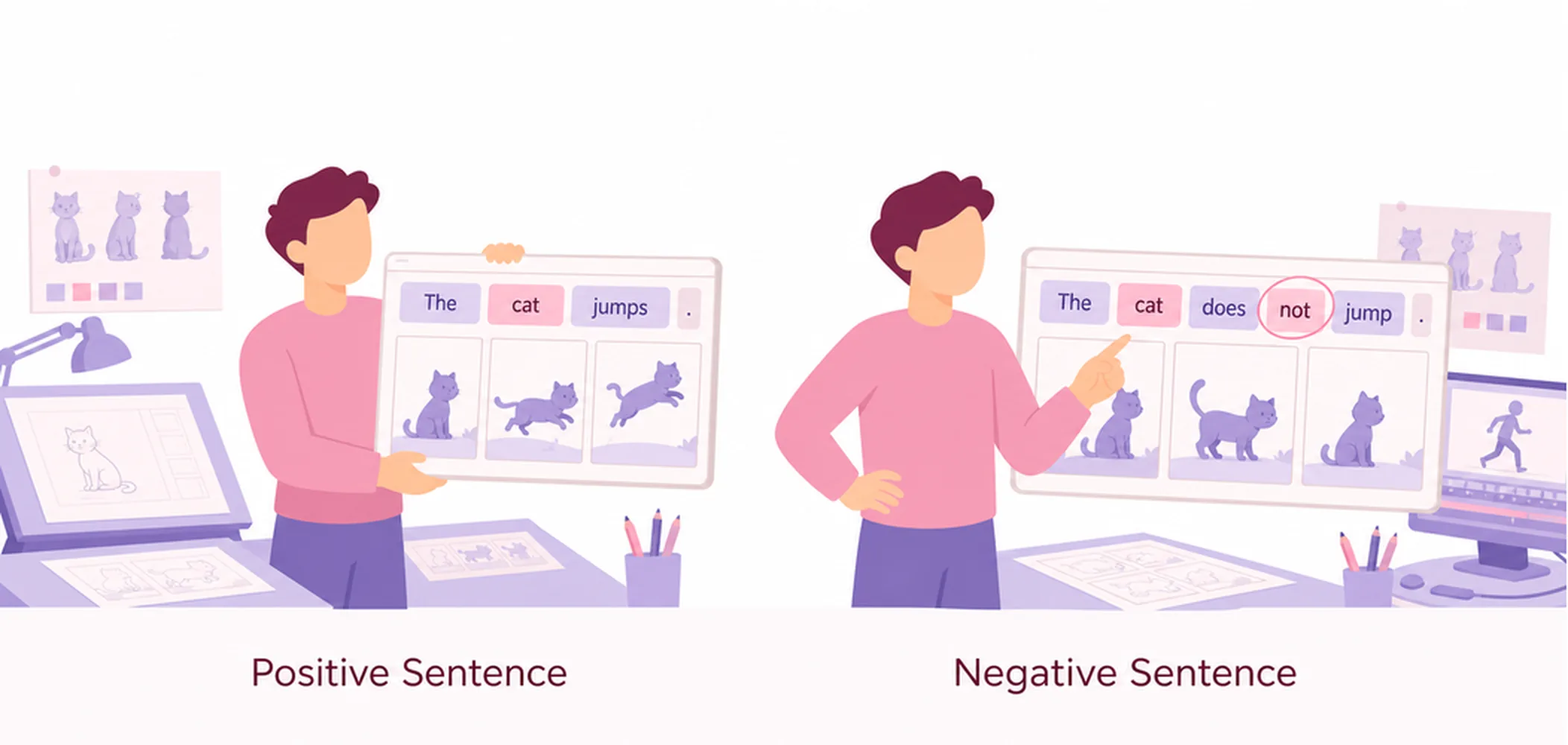
What is a negative sentence?
A negative sentence tells us what is NOT true. In English, we use the word "not" or "don't" to make sentences negative. Negative sentences are the opposite of positive sentences. For example: "I like coffee" is positive, but "I don't like coffee" is negative.
Step 1: Use "do not" or "does not" for simple present
To make a negative sentence in the simple present, add "do not" (I/you/we/they) or "does not" (he/she/it) before the main verb. You can also use the short forms: "don't" and "doesn't". The main verb must stay in the base form (the infinitive without "to"). For example: "I don't like pizza" or "She doesn't play tennis."
Step 2: Use "did not" for simple past
To make a negative sentence in the simple past, use "did not" (or "didn't") before the main verb in base form. The past tense ends (like -ed) are not used in negative sentences with "did". For example: "I didn't go to school yesterday" or "We didn't see that movie."
Step 3: Use "am/is/are not" for the verb "to be"
The verb "to be" is different. Use "am not," "is not," or "are not" to make it negative. You can also use short forms: "I'm not," "he's not," "they're not." For example: "I am not happy" or "They are not here."
Step 4: Remember "not" in other verb tenses
For other tenses like present continuous or past continuous, put "not" after the auxiliary verb. For example: "I am not working today" or "She was not sleeping." The pattern is: auxiliary verb + not + main verb.
How to Choose the Right Negative Form
| Question | Answer | Negative Form | Example |
|---|---|---|---|
| Was the action in progress at a specific past moment? | Yes | Past Continuous | She was not watching TV when he called. |
| No — Did another action interrupt it? | Past Continuous | They were not sleeping at midnight. | |
| Did it happen before another past event? | Yes — Was it ongoing up to that earlier event? | Past Perfect Continuous | He had not been working there long before he quit. |
| Yes — No | Past Perfect | She had not finished dinner before they arrived. | |
| No | Past Simple | I did not go to school yesterday. |
| Question | Answer | Negative Form | Example |
|---|---|---|---|
| Is the action happening right now or temporarily? | Yes | Present Continuous | She is not listening to music right now. |
| No | Continue to next question below | ||
| Does it connect past experience or result to now? | Yes — Has it been ongoing until now? | Present Perfect Continuous | I have not been sleeping well lately. |
| Yes — No | Present Perfect | They have not visited Paris yet. | |
| No | Present Simple | He does not eat meat. | |
| Question | Answer | Negative Form | Example |
|---|---|---|---|
| Is it a pre-arranged plan or fixed appointment? | Yes | Going to / Present Continuous | She is not going to attend the meeting tomorrow. |
| No | Continue to next question below | ||
| Is it a spontaneous decision or prediction? | Yes — Will it be in progress at a future moment? | Future Continuous | I will not be working at 8pm tonight. |
| Yes — No | Future Simple (will) | I will not help you with that. | |
| No — Will it be completed before a specific future point? | Future Perfect | They will not have finished the project by Friday. | |
| No — No | Future Simple (will) | He will not call you back. | |
Examples




What to Remember
- Use "do not" or "don't" with I, you, we, they in negative sentences.
- Use "does not" or "doesn't" with he, she, it in negative sentences.
- The main verb must stay in base form after do not/does not.
- Negative sentences tell what is NOT true, opposite of positive sentences.
- Short forms (don't, doesn't) are more common in speaking and informal writing.