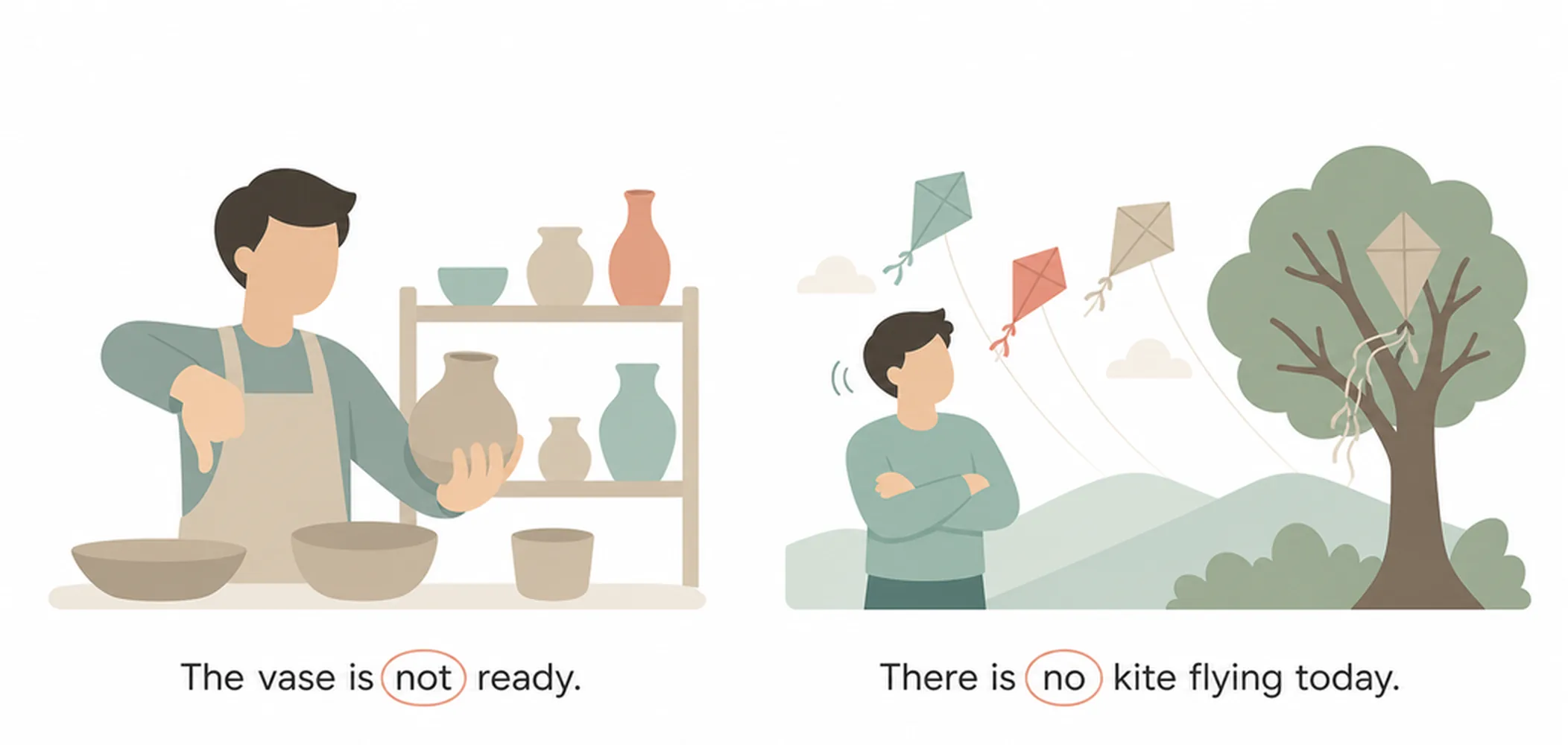
The Key Difference
Both 'not' and 'no' make sentences negative, but they work in different ways. 'Not' is an adverb that negates verbs, adjectives, and other words. 'No' is a determiner that negates nouns directly. Understanding which one to use will help you speak and write more naturally.
When to Use 'Not'
'Not' comes after an auxiliary verb (like 'is', 'do', 'have') or before an adjective or adverb. Use 'not' to say that something is not true about an action or quality. In short answers, we often say 'No, I am not' or 'No, it is not'.
When to Use 'No'
'No' comes directly before a noun to say that something does not exist or is absent. You can also use 'no' as a short answer to a yes/no question. 'No' is simpler and more direct than using 'not' with a noun.
Not vs No — Side-by-Side Comparison
| Category | NOT | NO |
|---|---|---|
| Form | Adverb | Determiner (adjective) or pronoun |
| When to use | Used to negate verbs, adjectives, adverbs, or entire clauses. Typically placed after an auxiliary verb or before the word it negates. | Used before a noun (or noun phrase) to indicate the absence or zero quantity of something. Can also stand alone as a one-word answer. |
| Position in sentence | After auxiliary verbs (is not, do not, will not) or directly before adjectives, adverbs, and infinitives. | Directly before a noun or noun phrase, or used alone as a complete short answer. |
| What it negates | Verbs, adjectives, adverbs, infinitives, participles, and whole clauses. | Nouns and noun phrases (countable and uncountable). Replaces the article (a/an/the) before the noun. |
| Positive example | "She is happy." → "She is not happy." | "There are problems." → "There are no problems." |
| Negative example | "I did not sleep well last night." "This is not the right answer." |
"There is no time left." "He has no idea what happened." |
| Question example | "Is she not coming to the party?" "Did you not receive my message?" |
"Is there no way to fix this?" "Have you no shame?" (formal/literary) |
| Key signal words | am/is/are/was/were not; do/does/did not; will/would/can/could/should not; not yet; not enough; not only | no one, nobody, nothing, nowhere (compounds); no + singular noun; no + plural noun; no + uncountable noun |
| Common mistakes | ❌ "I not like it." ✅ "I do not like it." — not cannot replace an auxiliary verb. | ❌ "I have no understood." ✅ "I have not understood." — no cannot negate a verb directly. |
| Key Difference: Use not to negate a verb, adjective, or adverb — it modifies the action or description in a sentence (e.g., "She is not ready"). Use no to negate a noun — it acts like a determiner meaning "zero" or "none of" and replaces the article before the noun (e.g., "There is no coffee left"). A quick test: if you can place the word directly before a noun and it makes sense, use no; if it follows an auxiliary verb or negates a description, use not. | ||
Examples

She is not happy with the decision.
Negating adjective · 'Not' with verb

She does not like coffee.
Negating verb · Everyday usage

We are not ready yet.
Negating adjective · Common phrase
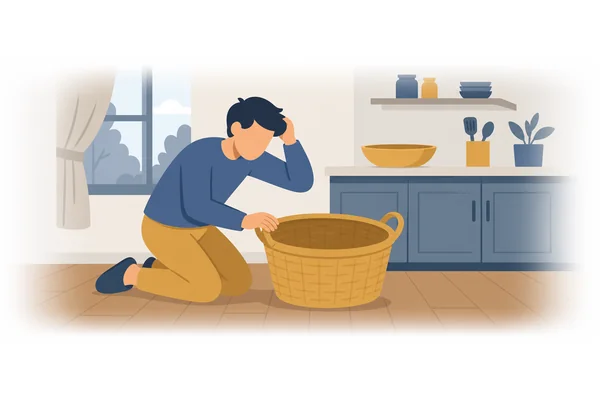
There are no apples in the basket.
Negating noun · Describing absence

I have no time to help you.
Negating noun · Polite refusal

Do you want tea? No, thank you.
Short answer · Conversational
When to use it
Short Answers
Use 'no' when answering yes/no questions directly. This is the most natural way to say 'no' in conversation.
"Are you busy?" "No, I'm free."
Describing Absence
Use 'no' when saying something doesn't exist or isn't available. This is common in descriptions.
"There is no milk in the fridge."
Negating Actions
Use 'not' when saying someone doesn't do something or a state isn't true.
"He does not speak French." or "The weather is not nice today."
Common Mistakes
✕
Wrong
I have not time to finish this.
✓
Correct
I have no time to finish this.
'No' is used before nouns, not 'not'. We say 'no time', not 'not time'.
✕
Wrong
There are not books on the shelf.
✓
Correct
There are no books on the shelf.
Before a noun, use 'no', not 'not'. 'No books' is correct.
✕
Wrong
She no likes swimming.
✓
Correct
She does not like swimming.
'Not' negates the verb, not 'no'. We need an auxiliary verb: 'does not'.
KEY TAKEAWAYS
What to Remember
- Use 'not' as an adverb to negate verbs, adjectives, and adverbs in sentences.
- Place 'not' after auxiliary verbs like 'is', 'do', 'have', or 'will'.
- Use 'no' as a determiner directly before nouns to make them negative.
- In short answers, use 'No' plus a subject and auxiliary verb together.
- 'No' and 'not' both make sentences negative but work differently with words.