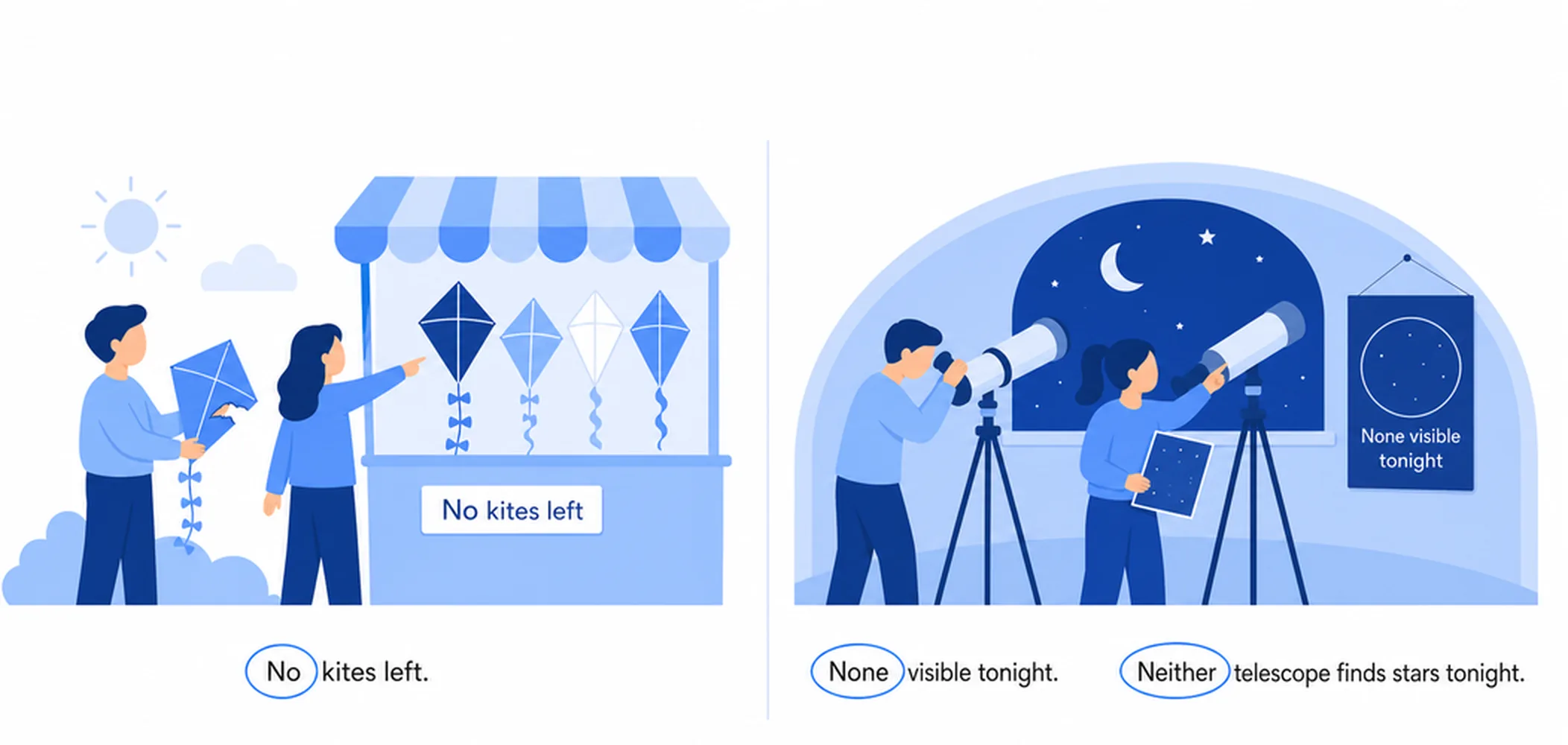
Understanding No, None, and Neither
No, none, and neither are all negative words in English, but we use them in different situations. No is an adjective that comes before a noun. None is a pronoun that stands alone without a noun. Neither means 'not one or the other' when choosing between two things. Learning when to use each one will help you speak and write more correctly.
No vs None vs Neither: Quick Comparison
No is used with a noun (no time, no money, no problem). None is used alone, without a noun (I have none). Neither is used when talking about two people or things—it means 'not this one and not that one' (Neither option is good).
How to Remember the Difference
No = use with a noun (no + noun). None = use alone. Neither = use for two choices. Try this: 'I have no time' (noun), 'I have none' (alone), 'Neither option works' (two choices).
No vs None vs Neither: Side-by-Side Comparison
| Category | No | None | Neither |
|---|---|---|---|
| Form | Determiner (adjective); always precedes a noun | Pronoun; stands alone, replacing a noun or noun phrase | Determiner or pronoun; used specifically with exactly two items |
| Word Type | Determiner | Pronoun | Determiner / Pronoun / Conjunction |
| What Follows It | Must be followed directly by a noun (singular or plural): no idea, no students | Followed by nothing (stands alone) or by of + noun phrase: none of the students | Followed by a singular noun (as determiner) or used alone / with of the two: neither option, neither of them |
| Number of Items It Refers To | Any number (one or more) | Any number (one or more); often refers to a group or quantity | Exactly two items only |
| When to Use | Use to modify a noun directly; expresses zero quantity or absence of something | Use as a pronoun when the noun has already been mentioned or is understood; expresses zero out of a group | Use when referring to not one nor the other of two specific things or people |
| Positive Example | There is no milk in the fridge. | I checked the fridge, but none was left. | Neither answer is correct. |
| Negative Example | She has no experience in this field. (not: She doesn't have no experience — double negative) | None of the applicants passed the test. | Neither of the two candidates was selected. |
| Question Example | Is there no way to fix this? | Did none of them respond? | Did neither of the two witnesses speak? |
| Subject–Verb Agreement | Verb agrees with the noun that follows: no student is / no students are | Traditionally singular; increasingly accepted as plural in informal use: none of them is/are | Traditionally singular: neither is available; with neither…nor, verb agrees with the nearest subject |
| Can Replace a Noun? | No — always needs a noun after it | Yes — replaces the noun entirely | Yes (as pronoun) — replaces a two-item noun phrase |
| Used in Correlative Pairs? | No | No | Yes — neither…nor: Neither tea nor coffee was served. |
| Key Signal Words | no + noun; zero quantity; absence | none of the…; stands alone; replaces noun | neither…nor; two choices only; not one, not the other |
| 🔑 Key Difference: No is a determiner that must precede a noun and expresses absence or zero quantity for any number of items. None is a pronoun that replaces a noun or noun phrase and stands on its own, often used when the noun is already known from context. Neither is exclusively used when referring to exactly two items, meaning "not one and not the other," and can also function as part of the correlative conjunction pair neither…nor. | |||
Examples

I have no time to help you today.
Adjective + Noun · Everyday usage

There is no coffee left in the kitchen.
Adjective + Noun · Describing a shortage

No students passed the test yesterday.
Adjective + Noun · Plural usage

Do you have any apples? No, I have none.
Pronoun · Standing alone, answering a question
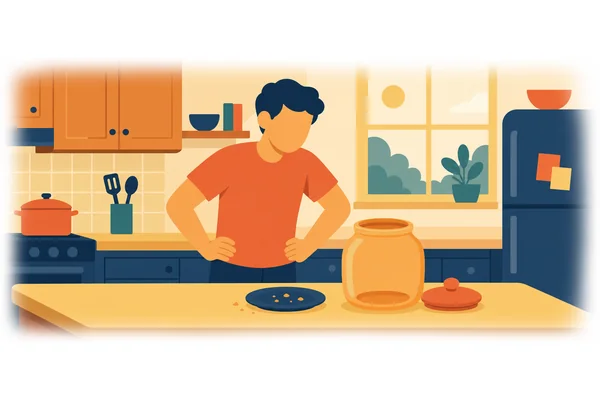
How many cookies are left? None. They are all gone.
Pronoun · Answering 'how many' questions

I asked ten people for help, but none could come.
Pronoun · Referring to a group

You can choose pizza or salad. Neither is healthy if you add too much salt.
Pronoun · Talking about two options

Neither option is perfect, but both are good.
Adjective + Noun · Two-item comparison

A: Did you like the movie? B: Neither. I didn't watch it.
Pronoun · Short answer about two opinions
When to use it
Saying Something Doesn't Exist
Use no + noun when you want to say something is not there or is not available.
"There is no sugar in my coffee."
Answering Questions
Use none when answering a question alone, without repeating the noun.
"How many eggs do you have? None."
Choosing Between Two Things
Use neither when talking about two options and you mean 'not this and not that'.
"I like neither red shoes nor blue shoes. I prefer black."
Signal words
no + noun
none (alone)
neither (two choices)
not any
not one
Common Mistakes
✕
Wrong
I have none time to study.
✓
Correct
I have no time to study.
Use 'no' + noun, not 'none' + noun. None stands alone without a noun.
✕
Wrong
Do you have any books? No, I have no.
✓
Correct
Do you have any books? No, I have none.
Use 'none' as a pronoun when standing alone. 'No' needs a noun after it.
✕
Wrong
You can pick tea or coffee. Neither are my favorite.
✓
Correct
You can pick tea or coffee. Neither is my favorite.
Neither (with two items) uses a singular verb 'is', not 'are'.
KEY TAKEAWAYS
What to Remember
- Use no as an adjective directly before a noun to make it negative.
- Use none as a pronoun when you don't need a noun after it.
- Use neither to mean 'not one or the other' when choosing between two options.
- No cannot stand alone; it must come before a noun or noun phrase.
- Neither is only for two choices, not for three or more options.