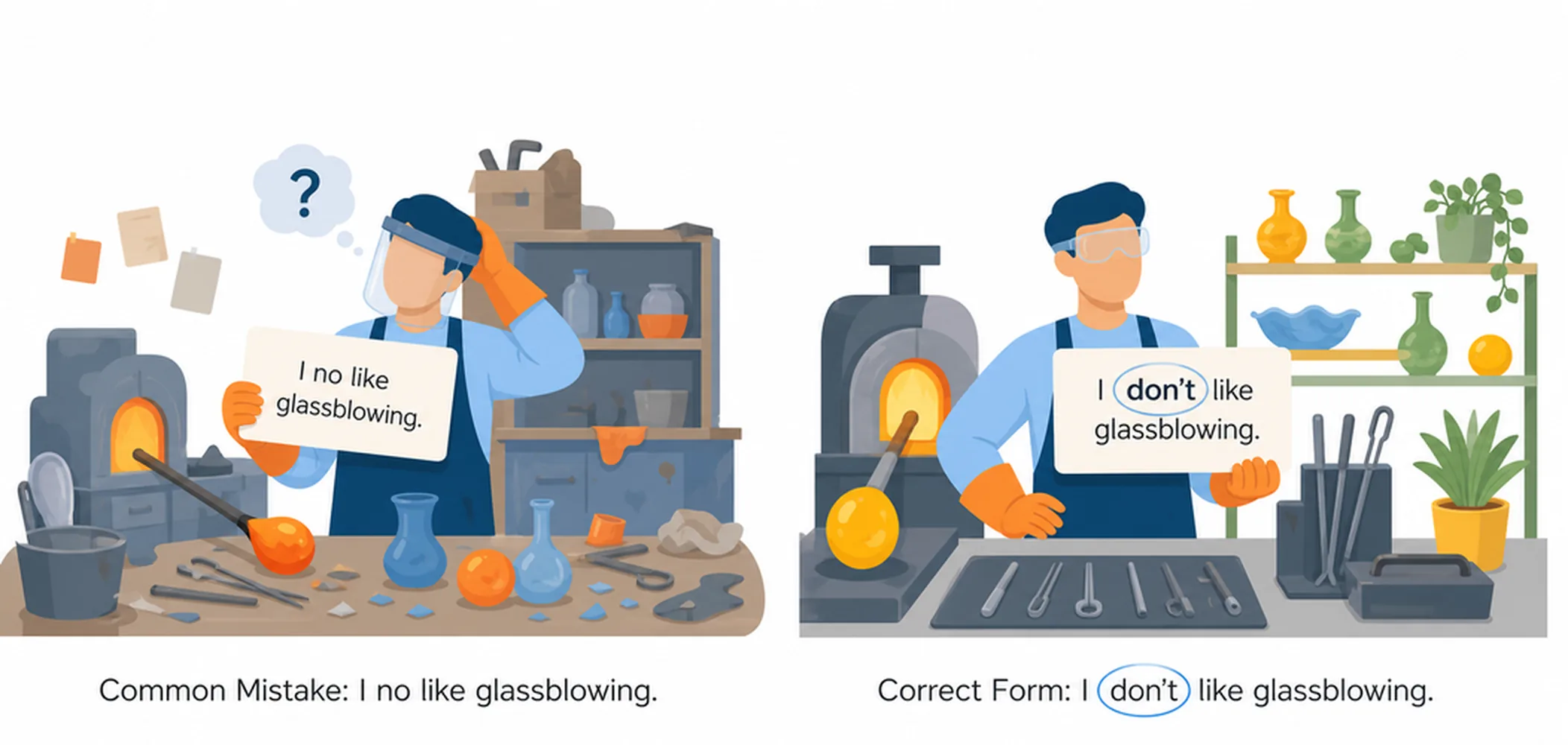
Why Learners Make Mistakes with Negatives
Negative sentences are tricky because English uses different negative words for different situations. Many learners make mistakes because they forget to use the auxiliary verb (do, does, did) or they mix up the word order. This guide shows you the most common errors and how to fix them.
Common Negative Mistakes vs. Correct Forms
| Error Type | Incorrect (Common Mistake) | Correct Version | Explanation |
|---|---|---|---|
| Missing Auxiliary (Present Simple) | She not like coffee. He not play football. |
She does not / doesn't like coffee. He does not / doesn't play football. |
In the present simple, you must include the auxiliary do/does before "not". You cannot attach "not" directly to a main verb. |
| Missing Auxiliary (Past Simple) | They not went to the party. I not called him. |
They did not / didn't go to the party. I did not / didn't call him. |
The auxiliary did carries the past tense. The main verb returns to its base (infinitive) form. Never use the past form of the main verb alongside "did". |
| Wrong Word Order | I know not the answer. She speaks not English. |
I do not / don't know the answer. She does not / doesn't speak English. |
Modern English requires the structure: Subject + auxiliary + not + base verb. Placing "not" after the main verb is archaic (Shakespearean) and incorrect in everyday English. |
| Double Negative | I don't know nothing. She didn't see nobody. We don't have no money. |
I don't know anything. / I know nothing. She didn't see anybody. / She saw nobody. We don't have any money. / We have no money. |
Standard English allows only one negative element per clause. Use either a negative auxiliary (don't/didn't) or a negative pronoun/determiner (nothing/nobody/no), not both together. |
| Incorrect Negation of "to be" | He don't be tired. They don't be at home. |
He is not / isn't tired. They are not / aren't at home. |
Be is its own auxiliary. It does not need "do/does/did". Simply place "not" directly after the correct form of be. |
| Negation with Modal Verbs | You don't can do that. She doesn't must leave. We don't should worry. |
You cannot / can't do that. She must not / mustn't leave. We should not / shouldn't worry. |
Modal verbs (can, must, should, will, may, might, etc.) are already auxiliaries. Add "not" directly after the modal. Never combine "do/does/did" with a modal. |
| Negation in Present Continuous | He doesn't working now. They don't playing outside. |
He is not / isn't working now. They are not / aren't playing outside. |
The continuous uses be + -ing. The negative is formed by inserting "not" after the auxiliary be, not by using "do/does/did". |
| Negation in Present Perfect | I didn't seen that film. She didn't been there. |
I have not / haven't seen that film. She has not / hasn't been there. |
The present perfect uses have/has + past participle. Negate with "have not" or "has not". Using "did not" shifts the tense to simple past and requires the base verb form. |
| Confusing "no" and "not" | I have no got any time. She is no happy. No is correct. |
I have not got any time. / I have no time. She is not happy. It is not correct. / No, it is not correct. |
"Not" negates verbs and adjectives (placed after an auxiliary). "No" functions as a determiner before nouns (no time, no money) or as a standalone response. They are not interchangeable. |
| Negative Infinitive Word Order | He told me to not go. She tried to not cry. |
He told me not to go. She tried not to cry. |
With negative infinitives, "not" comes before "to", giving the structure not to + base verb. Splitting the infinitive by inserting "not" between "to" and the verb is non-standard. |
| Incorrect Negative Question Tags | She is tall, isn't it? They went home, didn't they not? You can swim, can't you not? |
She is tall, isn't she? They went home, didn't they? You can swim, can't you? |
Question tags mirror the auxiliary of the main clause and use the correct subject pronoun. Negative tags already contain "not" — adding "not" a second time creates a double negative error. |
| Key Difference Summary: The most fundamental rule for forming negatives in English is to identify the correct auxiliary verb (do/does/did for simple tenses; be for continuous and passive; have/has/had for perfect tenses; or a modal verb) and place "not" immediately after it. Never attach "not" directly to a main verb, never combine "do" with another auxiliary, and never use two negative words in the same clause. When no auxiliary exists in the affirmative sentence (e.g., present/past simple with main verbs), introduce do/does/did to carry the negation, returning the main verb to its base form. | |||
Formula
✖ Negative
Subject
+
do/does/did + not
+
base form verb
She does not like apples.
? Question
Do/Does/Did
+
Subject
+
not
+
base form verb
Doesn't he speak Spanish?
Examples

I don't like coffee.
Present simple negative · Everyday usage

She doesn't work on Sundays.
Third person singular · Routine or habit

They didn't arrive on time.
Past simple negative · Completed action

We are not ready yet.
Negative with 'be' verb · State or condition
When to use it
Daily Conversations
Use negatives to say what you don't like, don't do, or didn't do.
I don't eat meat. She doesn't like chocolate.
Written English
Negatives are common in email, essays, and stories to explain facts or feelings.
They did not finish the work. The door is not open.
Questions & Answers
Use negatives to ask 'don't/doesn't' questions or respond with negative answers.
Doesn't she work here? No, she doesn't.
Signal words
don't
doesn't
didn't
not
never
no one
nothing
isn't
aren't
wasn't
weren't
Common Mistakes
✕
Wrong
I not like pizza.
✓
Correct
I don't like pizza.
You need the auxiliary 'do' + 'not' for simple present negatives. 'Not' alone cannot form a negative.
✕
Wrong
She don't go to school.
✓
Correct
She doesn't go to school.
Use 'doesn't' (does + not) for third person singular (he, she, it), not 'don't'.
✕
Wrong
He did not went to the party.
✓
Correct
He did not go to the party.
After 'did not', use the base form of the verb (go), not the past tense (went).
✕
Wrong
I don't no English.
✓
Correct
I don't know English.
'No' is not a verb. Use 'know' (the verb). 'No' is only an adjective or adverb.
✕
Wrong
They not are happy.
✓
Correct
They are not happy.
With 'be' verbs (am, is, are, was, were), put 'not' after the verb, not before.
✕
Wrong
We didn't went there yesterday.
✓
Correct
We didn't go there yesterday.
After 'didn't', always use the base form of the verb, never the past tense form.
✕
Wrong
Don't he speak French?
✓
Correct
Doesn't he speak French?
In questions with third person singular, use 'Doesn't', not 'Don't'. This is the auxiliary form for 'he, she, it'.
KEY TAKEAWAYS
What to Remember
- Always use an auxiliary verb (do, does, did) when making simple present or past negative statements.
- Place the auxiliary verb immediately after the subject, before the main verb in negative sentences.
- Use "not" after the auxiliary verb, never before it: "I do not like" is correct, "I not like" is wrong.
- With "be" verbs, add "not" directly after: "is not," "are not," "was not," "were not."
- Modal verbs take "not" directly after them: "cannot," "should not," "will not," without needing a separate auxiliary verb.