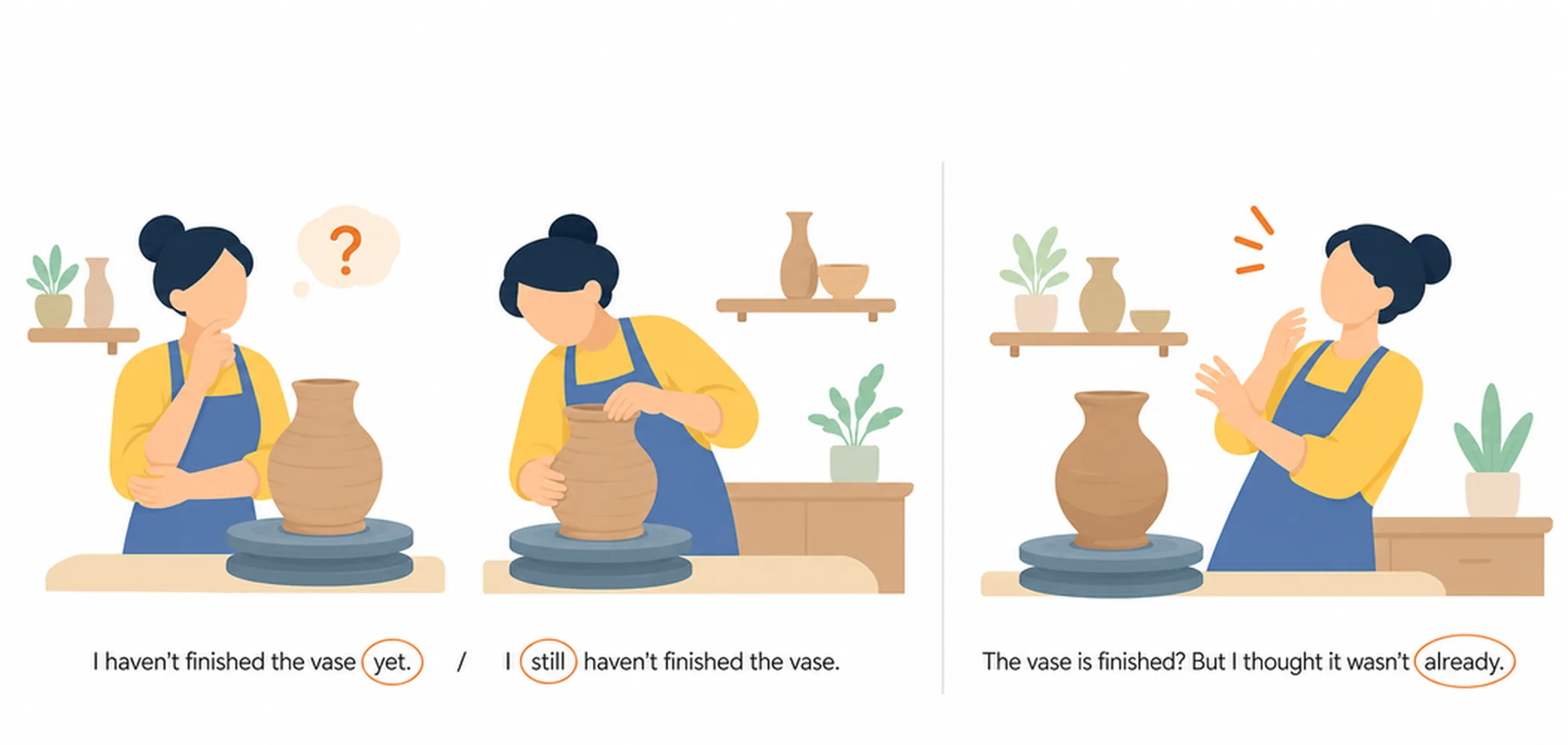
Understanding Already, Yet, and Still
These three adverbs help us talk about time and changes. They often appear in negative sentences, and each one has a different meaning. Understanding when to use each one will help you speak and write more naturally in English.
Already in Negative Sentences
In standard English, already does not typically appear in negative sentences. Instead, we use "yet" or "still" in negative constructions to talk about something that has not happened by a certain time.
When we want to express that something happened earlier than expected or to show surprise that something occurred sooner than anticipated, we use "already" in positive sentences. However, in negative sentences, we replace "already" with "yet" or "still" to indicate that the action has not occurred up to the present moment.
| Example | Explanation |
|---|---|
| I haven't already finished my homework. | This structure is not used in standard English. |
| I haven't finished my homework yet. | We use "yet" in negative sentences to show that something has not happened by now. |
| I still haven't finished my homework. | We use "still" in negative sentences to emphasize that an action continues to not be complete. |
Yet and Still in Negative Sentences
Yet appears at the end of negative sentences and means we are waiting for something to happen. It shows something has not happened, but we expect it will. Still in negative sentences means a situation continues to not happen, or continues as before. Still usually comes after the auxiliary verb. Example with yet: The package hasn't arrived yet. Example with still: He still doesn't understand the lesson.
Already vs. Yet vs. Still in Negative Sentences
| Aspect | Already | Yet | Still |
|---|---|---|---|
| Meaning in Negatives | Expresses surprise or concern that something has happened sooner than expected — or in negatives, that it has happened at all at an early stage | Indicates that something expected has not happened up to the present moment but may happen in the future | Emphasises that a situation or action that was true before continues to be true now — often with surprise or impatience |
| Sentence Position | Typically placed before the main verb or at the end of the sentence; in negative sentences it often comes before the negative auxiliary (e.g. already can't) to express shock | Almost always placed at the end of the sentence in negatives and questions | Placed between the subject and the negative auxiliary verb (e.g. subject + still + haven't), or before the main verb |
| Expectation / Attitude Conveyed | Conveys surprise — the speaker did not expect the situation to occur so soon, or is shocked it is happening | Neutral expectation — the speaker expected the action to happen and notes it has not happened; no strong emotion attached | Conveys impatience, frustration, or emphasis — the speaker expected the situation to have changed or ended by now but it has not |
| Positive Example | She has already finished her homework. (It happened sooner than expected.) |
Have you finished your homework yet? (Yet is rarely used in positive affirmatives; primarily used in negatives and questions.) |
She is still working on her homework. (The action is continuing without interruption.) |
| Negative Example | You can't be tired already! (The speaker is surprised tiredness has set in so soon.) |
She hasn't finished her homework yet. (It was expected but hasn't happened — neutral observation.) |
He still hasn't called me. (The speaker expected a call by now and is frustrated it hasn't come.) |
| Question Example | Is it already midnight? (Surprised the time has come so quickly.) |
Have you finished your homework yet? (Asking whether the expected action has happened.) |
Are you still waiting for him? (Surprised the waiting is continuing after so long.) |
| Key Signal Words / Tenses Used With | Present perfect, present simple, modals; signals unexpectedly early | Present perfect (mainly); signals up to now, but possibly soon | Present continuous, present perfect, present simple; signals continuation beyond expected point |
Examples





What to Remember
- Use already in negatives to show something happened sooner or earlier than expected.
- Position already between the auxiliary verb and main verb in negative sentences.
- Use yet in negatives to ask if something has happened or to say it hasn't happened.
- Use still in negatives to say something continues to not happen or hasn't changed.
- Yet typically appears at the end of negative questions and statements, not in the middle.