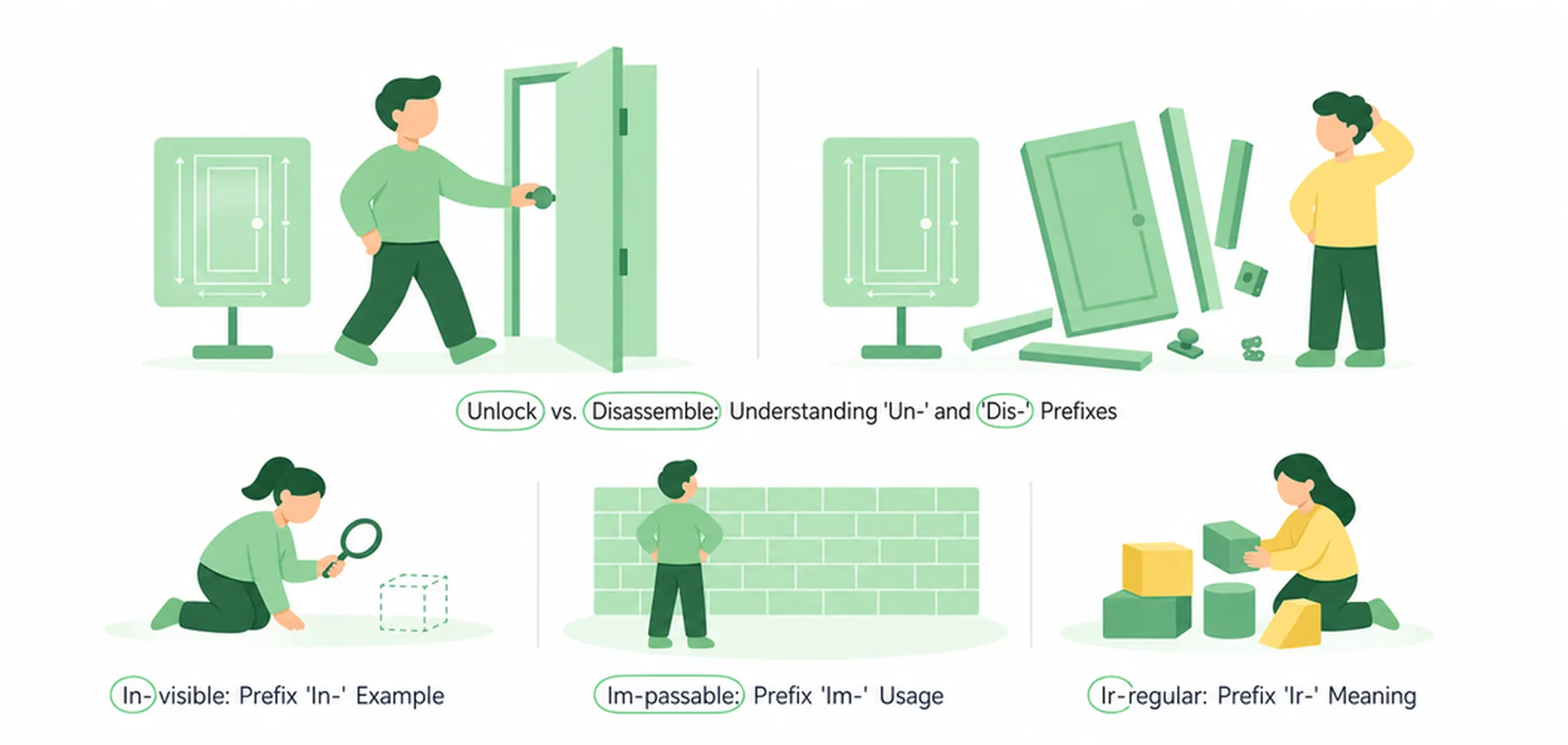
What are negative prefixes?
A prefix is a small word part that we add to the beginning of a word to change its meaning. Negative prefixes make words mean the opposite. For example, 'happy' means feeling good, but 'unhappy' means the opposite — not feeling good. In English, we use five main negative prefixes: un-, dis-, in-, im-, and ir-. Each one works with different types of words.
Which prefix do I use?
The prefix un- is the most common. We use it with many adjectives and verbs: unkind, unhappy, unlock, unfair. The prefix dis- usually goes with verbs and nouns: disagree, dishonest, disorder. The prefixes in-, im-, and ir- are used with adjectives. We use 'in-' with most words (invisible, informal), 'im-' when the word starts with m or p (impossible, impolite), and 'ir-' when the word starts with r (irregular, irresponsible). Remember: these negative prefixes change the meaning, but the word type stays the same.
How to use negative prefixes
Just add the negative prefix directly to the beginning of the word — there are no other changes. The word 'kind' + 'un-' = 'unkind'. The word 'agree' + 'dis-' = 'disagree'. This is a simple way to learn new words and express opposites without learning completely new vocabulary.
Negative Prefixes at a Glance
| Prefix | Word Types | Spelling Rule / Trigger | Examples | Note |
|---|---|---|---|---|
| un- | Adjectives, adverbs, verbs | Most common prefix; no spelling change to root word | unhappy, undo | Default choice for native English words |
| dis- | Adjectives, nouns, verbs | No spelling change to root; often signals reversal of action | disagree, dishonest | Common with Latinate verbs; can mean reversal, not just negation |
| in- | Adjectives (mainly Latinate) | Base form before most consonants and all vowels | incorrect, inactive | Parent form of im-, il-, and ir-; assimilates before certain letters |
| im- | Adjectives (Latinate) | Used before roots starting with b, m, or p | impossible, immature | Assimilated form of in-; the n changes to m for easier pronunciation |
| ir- | Adjectives (Latinate) | Used before roots starting with r | irregular, irresponsible | Assimilated form of in-; always creates a double r |
Examples






What to Remember
- A prefix is a word part added to the beginning of a word to change its meaning to the opposite.
- The prefix un- is the most common negative prefix and works with many adjectives and verbs.
- The prefix dis- usually goes with verbs and some nouns to make them negative.
- The prefixes in-, im-, and ir- are used with adjectives, with im- before words starting with 'm' or 'p'.
- Use only one negative prefix per word; adding two negative prefixes creates confusion, not emphasis.