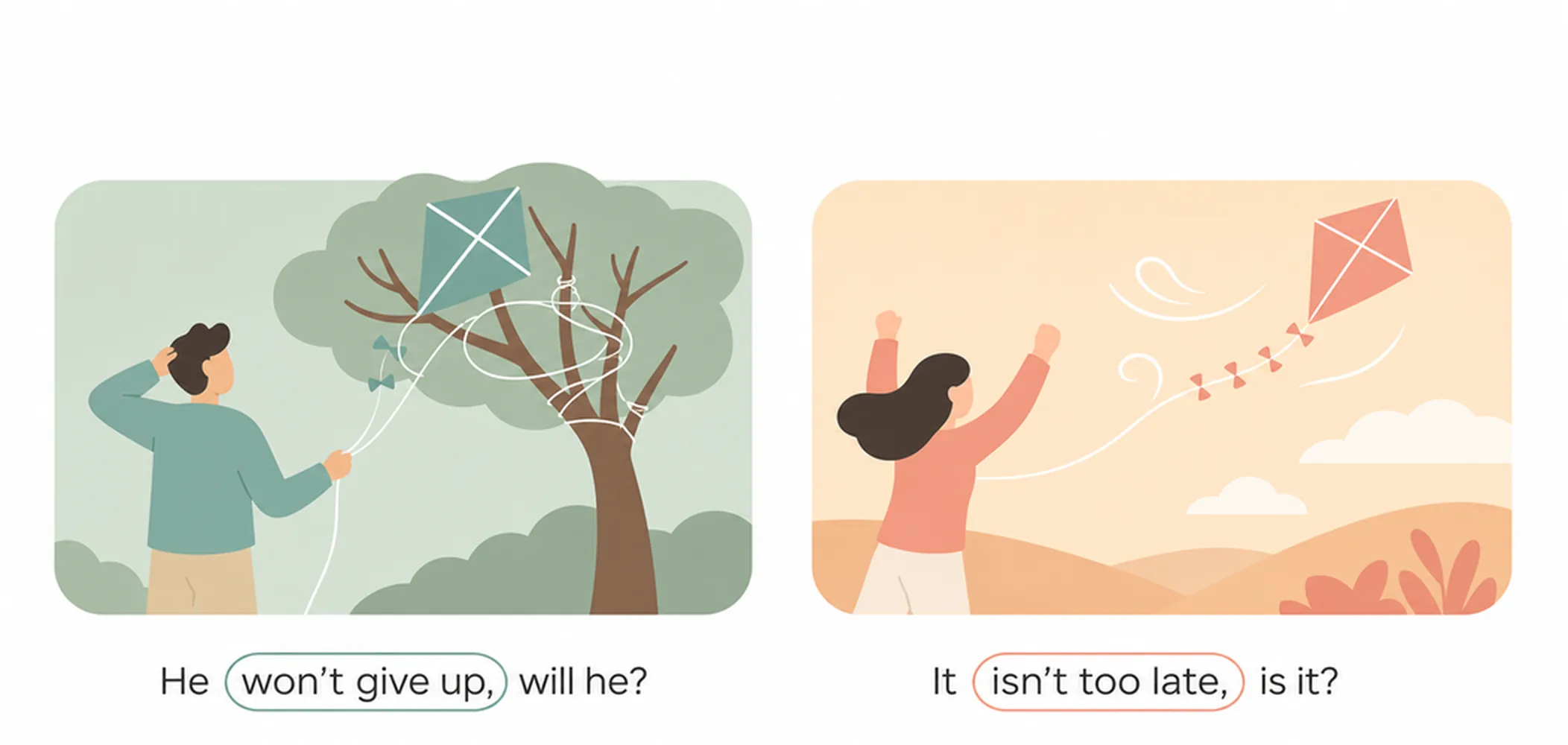
What are Question Tags?
A question tag is a short question we add to the end of a statement. We use it to ask for agreement or confirmation. Question tags are very common in spoken English. The tag repeats the auxiliary verb (or 'be') from the main sentence, but changes the positive or negative form.
Negative Statement + Positive Tag
When the main statement is negative, the question tag is positive. This is the opposite form. We use this pattern to confirm something we believe is true. The negative statement shows our expectation, and the positive tag invites the listener to agree. For example: "You don't like coffee, do you?" Here, we expect the answer is yes (the person doesn't like coffee).
How to Form the Tag
To form the positive tag after a negative statement: 1) Take the auxiliary verb (do, does, did, is, are, was, were, have, has, can, will, etc.) from the main sentence. 2) Change it to positive (remove the 'not'). 3) Add the correct subject pronoun (he, she, it, they, etc.). The tag is written with a question mark and usually separated by a comma.
Negative Statement vs. Positive Tag: Side-by-Side
| Category | Simple Present (do / does) |
Simple Past (did) |
Present Continuous (is / am / are) |
Present Perfect (have / has) |
Modal Verbs (can / will / would etc.) |
To Be (Present) (is / am / are) |
|---|---|---|---|---|---|---|
| Statement Form | Subject + don't / doesn't + base verb | Subject + didn't + base verb | Subject + isn't / aren't / am not + verb-ing | Subject + haven't / hasn't + past participle | Subject + can't / won't / wouldn't etc. + base verb | Subject + isn't / aren't / am not + complement |
| Tag Form | do / does + subject pronoun + ? | did + subject pronoun + ? | is / am / are + subject pronoun + ? | have / has + subject pronoun + ? | Positive modal + subject pronoun + ? | is / am / are + subject pronoun + ? |
| Negative Statement Example | She doesn't like coffee. | They didn't call us. | He isn't working today. | You haven't finished yet. | She can't drive a car. | They aren't ready. |
| Positive Tag Added | She doesn't like coffee, does she? | They didn't call us, did they? | He isn't working today, is he? | You haven't finished yet, have you? | She can't drive a car, can she? | They aren't ready, are they? |
| Auxiliary Verb Shift | doesn't → does (negative to positive) | didn't → did (negative to positive) | isn't → is (negative to positive) | haven't → have (negative to positive) | can't → can (negative to positive) | aren't → are (negative to positive) |
| Subject Pronoun in Tag | She → she Noun replaced by pronoun |
They → they Pronoun stays the same |
He → he Pronoun stays the same |
You → you Pronoun stays the same |
She → she Noun replaced by pronoun |
They → they Pronoun stays the same |
| Special Note / Watch Out | Use does for he/she/it; use do for I/you/we/they. | Did is used for all subjects — no change for person or number. | Am not in a statement → tag uses are: "I'm not late, am I?" | Use has for he/she/it; use have for I/you/we/they. | Won't → will; wouldn't → would; shouldn't → should, etc. | Match is/am/are to the original subject in the statement. |
| Tone & Expectation | Rising tone = genuine question; falling tone = seeking confirmation. | Rising tone = genuine question; falling tone = seeking confirmation. | Rising tone = genuine question; falling tone = seeking confirmation. | Rising tone = genuine question; falling tone = seeking confirmation. | Rising tone = genuine question; falling tone = seeking confirmation. | Rising tone = genuine question; falling tone = seeking confirmation. |
| Key Signal Words | never, rarely, hardly, seldom, not | never, not, ago, yesterday, last | right now, currently, at the moment, not | yet, ever, never, just, already, not | can't, won't, wouldn't, shouldn't, mustn't | not, never (with to be in present) |
|
🔑 Key Difference — The Core Rule of Negative Statement + Positive Tag: When a statement is negative (contains don't, doesn't, didn't, isn't, can't, haven't, etc.), the question tag must be positive — the auxiliary verb flips from negative to its positive form, and the full noun subject is replaced by its subject pronoun. This is the direct opposite of a positive statement, which takes a negative tag. The rule applies consistently across all tenses and modal verbs: the tag always mirrors the auxiliary used in the statement (in its positive form) and echoes the subject as a pronoun. The purpose of such tags is to invite agreement, seek confirmation, or check an assumption — with rising intonation signalling a real question and falling intonation expressing expectation of agreement. |
||||||
Examples






What to Remember
- When the main statement is negative, the question tag is always positive.
- The tag repeats the auxiliary verb or 'be' from the main sentence.
- Use negative statement + positive tag to confirm something you believe is true.
- The tag changes form to be opposite to the main statement's form.
- Question tags ask for agreement or confirmation in spoken English conversations.