What is a Question Tag?
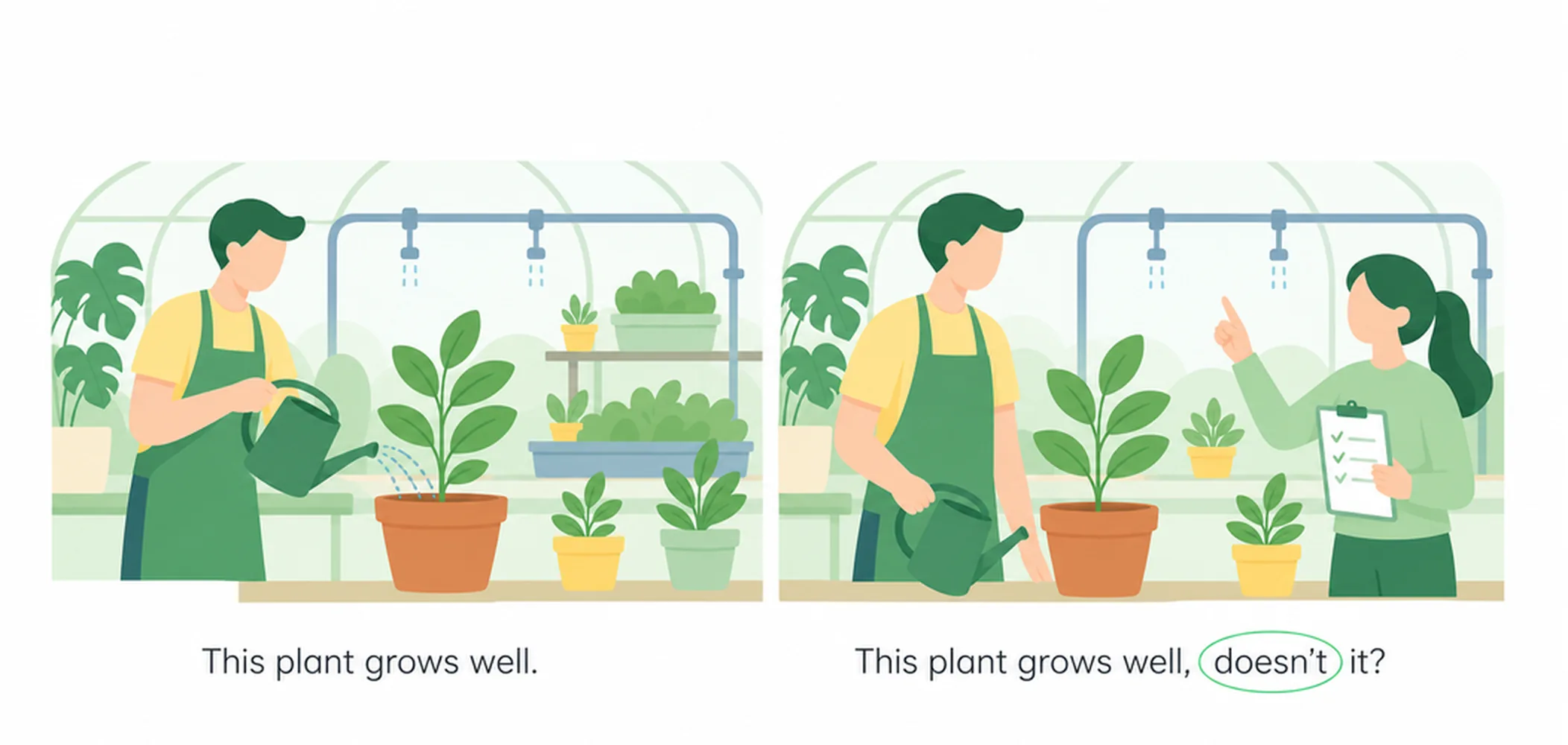
A question tag is a short question we add to the end of a statement. We use it when we think something is true, but we want to check if the other person agrees. Question tags turn statements into conversations. For example: 'You like coffee, don't you?' The statement is 'You like coffee,' and the tag is 'don't you?'
The Rule: Positive + Negative Tag
When the main sentence is POSITIVE, the question tag is NEGATIVE. This is the most common pattern. We use the same auxiliary verb (like 'do,' 'have,' 'will') in both the statement and the tag, but we make the tag negative. If there is no auxiliary verb in the statement, we add 'do' or 'does' in the tag.
How to Form It Step by Step
Step 1: Look at the auxiliary verb in your positive statement (is, are, have, will, can, etc.).
Step 2: Make it negative (isn't, aren't, haven't, won't, can't, etc.).
Step 3: Change the subject to a pronoun. The subject must change perspective:
- I → you
- you → I
- he → he (stays the same)
- she → she (stays the same)
- we → we (stays the same)
- they → they (stays the same)
- the dog → it
Step 4: Add the negative auxiliary and pronoun at the end as a question.
Important — When there is NO auxiliary verb: Use 'do' or 'does' in the negative form ('don't' or 'doesn't') in the tag instead of repeating the main verb.
Example: "You like pizza, don't you?" (not "you like-do you?")
The auxiliary becomes negative in the tag: I like → don't I; He likes → doesn't he.
Positive Statement to Negative Tag: Auxiliary Verb Reference
| Auxiliary: IS | |||
|---|---|---|---|
| Pronoun | Positive Statement | Negative Tag | Full Example |
| He / She / It | is | isn't it/he/she? | She is kind, isn't she? |
| "is" is only used with third-person singular subjects (he, she, it). The tag uses the same pronoun as the subject. | |||
| Auxiliary: ARE | |||
|---|---|---|---|
| Pronoun | Positive Statement | Negative Tag | Full Example |
| You | are | aren't you? | You are ready, aren't you? |
| We | are | aren't we? | We are late, aren't we? |
| They | are | aren't they? | They are happy, aren't they? |
| Special case — "I am": The tag for "I am …" is aren't I? (not "amn't I?") — e.g., I am right, aren't I? | |||
| Auxiliary: WAS | |||
|---|---|---|---|
| Pronoun | Positive Statement | Negative Tag | Full Example |
| I | was | wasn't I? | I was right, wasn't I? |
| He / She / It | was | wasn't he/she/it? | He was tired, wasn't he? |
| Auxiliary: WERE | |||
|---|---|---|---|
| Pronoun | Positive Statement | Negative Tag | Full Example |
| You | were | weren't you? | You were there, weren't you? |
| We | were | weren't we? | We were wrong, weren't we? |
| They | were | weren't they? | They were loud, weren't they? |
| Auxiliary: HAVE | |||
|---|---|---|---|
| Pronoun | Positive Statement | Negative Tag | Full Example |
| I | have | haven't I? | I have finished, haven't I? |
| You | have | haven't you? | You have met her, haven't you? |
| We | have | haven't we? | We have arrived, haven't we? |
| They | have | haven't they? | They have left, haven't they? |
| Auxiliary: HAS | |||
|---|---|---|---|
| Pronoun | Positive Statement | Negative Tag | Full Example |
| He / She / It | has | hasn't he/she/it? | He has gone, hasn't he? |
| Auxiliary: HAD | |||
|---|---|---|---|
| Pronoun | Positive Statement | Negative Tag | Full Example |
| I | had | hadn't I? | I had eaten, hadn't I? |
| You | had | hadn't you? | You had left early, hadn't you? |
| He / She / It | had | hadn't he/she/it? | She had slept, hadn't she? |
| We | had | hadn't we? | We had planned it, hadn't we? |
| They | had | hadn't they? | They had finished, hadn't they? |
Examples




What to Remember
- A question tag is a short question added to the end of a statement to check agreement.
- When the main sentence is positive, the question tag must be negative.
- Use the same auxiliary verb in the tag as in the main sentence.
- If there is no auxiliary verb, use "do," "does," or "did" in the tag.
- The subject pronoun in the tag matches the subject of the main sentence.