What Are Question Tags?
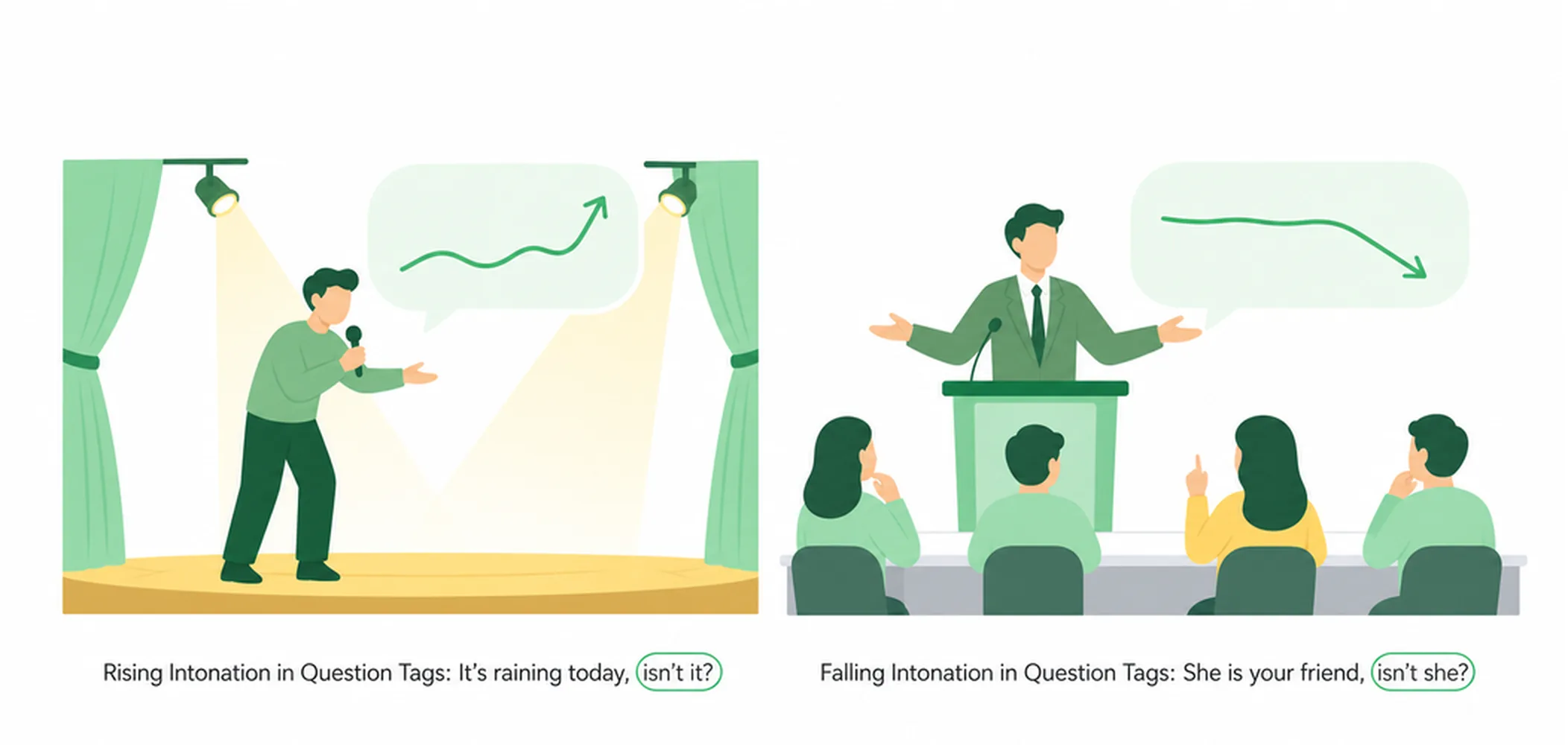
Question tags are short questions at the end of a sentence. They turn a statement into a question. For example: 'You like coffee, don't you?' We use question tags to check information or ask for agreement. The intonation—how your voice goes up or down—changes the meaning of the tag.
Rising vs Falling Intonation
Rising intonation means your voice goes UP at the end ↑. This sounds like a real question. You don't know the answer. Falling intonation means your voice goes DOWN at the end ↓. This sounds like you already know the answer. You want the listener to agree with you.
When to Use Each
Use RISING intonation when you genuinely want to know the answer. You are not sure. Use FALLING intonation when you are sure about the information and just want agreement or confirmation. This is very common in everyday conversation.
How to Practice
Record yourself saying question tags. Listen to your voice. Does it go up or down? Try both ways with the same sentence. Notice how the meaning changes. This will help you use intonation naturally.
Rising vs Falling Intonation: Side-by-Side Comparison
| Dimension | Rising Intonation (↑) | Falling Intonation (↓) |
|---|---|---|
| Voice Direction | The pitch of the voice moves upward at the end of the tag, creating an audible lift in tone. | The pitch of the voice moves downward at the end of the tag, creating a gentle drop in tone. |
| Speaker Certainty | The speaker is uncertain about the information in the main clause and genuinely does not know the answer. They are seeking confirmation or new information. | The speaker is fairly certain about the information in the main clause and already believes they know the answer. They are simply checking or inviting agreement. |
| Communicative Purpose | Used to ask a genuine question, request information, express doubt, or seek clarification. The tag functions much like a yes/no question. | Used to invite agreement, make conversation, express a shared assumption, or soften a statement. The tag functions more like a social comment than a real question. |
| Listener Expectation | The listener is expected to provide a definitive answer — either confirming or denying the statement. A real response is needed. | The listener is expected to agree or simply acknowledge the statement. A simple "yes" or nod is typically sufficient; disagreement may feel socially awkward. |
| Positive Example | "She passed her exam, didn't she↑?" — The speaker does not know the result and is asking. | "It's a beautiful day, isn't it↓?" — The speaker can see the weather and expects the listener to agree. |
| Negative Example | "He hasn't called yet, has he↑?" — The speaker is checking because they are unsure whether a call came in. | "You didn't enjoy the film, did you↓?" — The speaker noticed the listener's reaction and is confirming their impression. |
| Contextual Signals | Speaker lacks direct evidence; information was received second-hand; speaker was absent during the event; a real decision or action depends on the answer. | Speaker has direct evidence (they can see, hear, or feel it); shared knowledge exists between speaker and listener; the tag is used for politeness or to keep conversation flowing. |
| Emotional Tone | Can convey anxiety, curiosity, surprise, or uncertainty. The rising pitch signals that the speaker is genuinely open to either answer. | Can convey confidence, warmth, friendliness, or mild assertion. The falling pitch signals that the speaker has already formed an opinion. |
| Risk of Misuse | Using rising intonation when you clearly already know the answer can sound insincere or passive-aggressive (e.g., a teacher testing a student). | Using falling intonation when you genuinely need an answer can cause the listener to assume no real response is needed and ignore the question. |
| Key Difference: The essential distinction lies in the speaker's level of certainty and intent. Rising intonation (↑) signals genuine uncertainty — the speaker truly does not know and needs an answer, turning the tag into a real question. Falling intonation (↓) signals confident assumption — the speaker believes they already know and is simply seeking agreement or keeping the conversation natural, making the tag a social or rhetorical device rather than a true information-seeking question. | ||
Examples



What to Remember
- Question tags are short questions added to the end of statements to check information or ask for agreement.
- Use rising intonation when you genuinely don't know the answer and want real information.
- Use falling intonation when you're sure about the information and just want confirmation.
- The auxiliary verb in the tag must match the main verb in the statement.
- If the statement is positive, the tag is negative, and vice versa.