What are question tags?
Question tags are short questions at the end of a sentence. We use them to check information or ask for agreement. Most question tags follow a simple rule: if the main sentence is positive, the tag is negative. If the sentence is negative, the tag is positive. For example: "You like coffee, don't you?" But some question tags are irregular and don't follow this rule perfectly.
The irregular 'I am' question tag
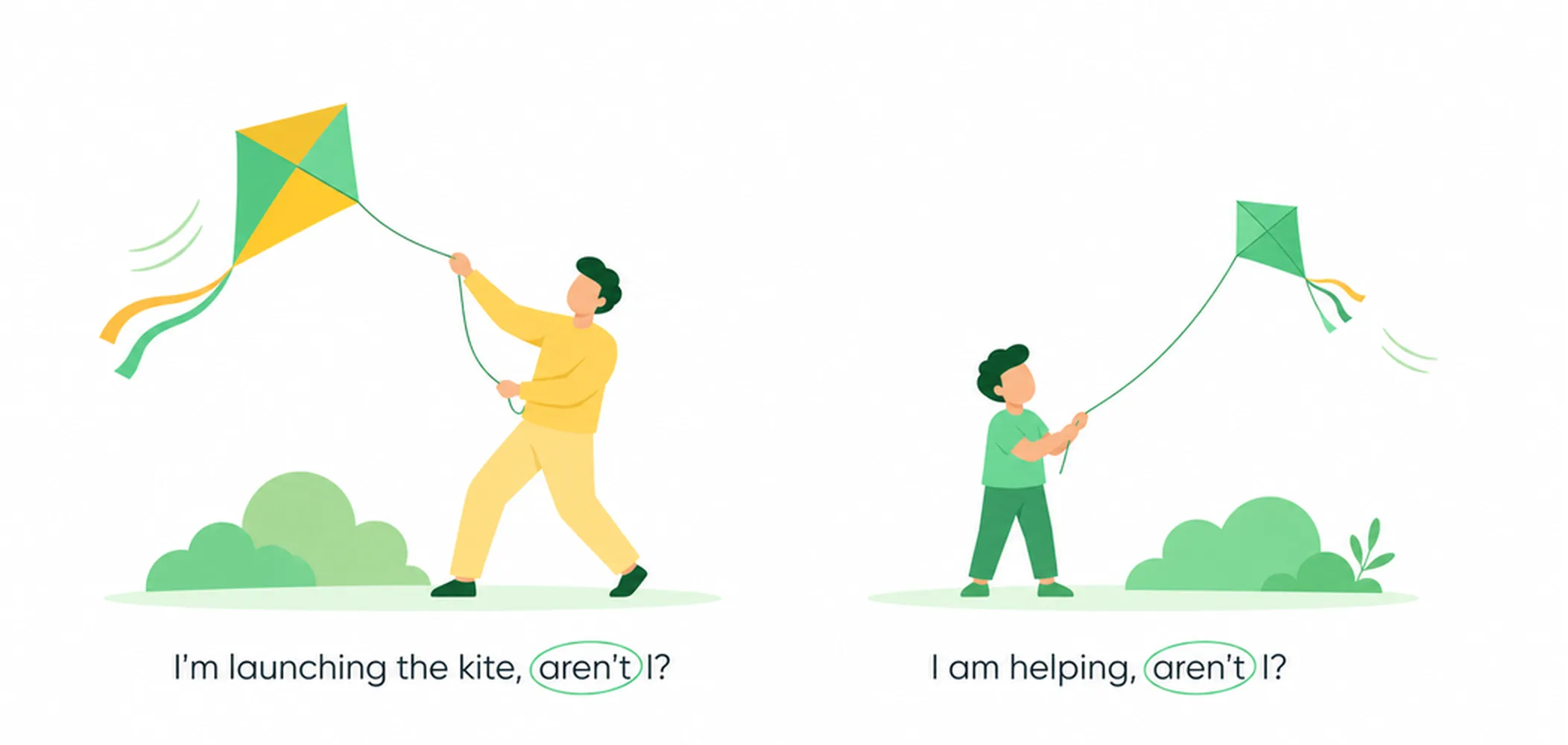
The most common irregular question tag in English is with the verb "be" in the first person positive. When you say "I am...", the negative question tag is "aren't I?" – not "am I not?" This is the only question tag where we use the contraction in this way. For example: "I am late, aren't I?" This happens because "am I not" sounds very formal and unnatural in spoken English.
Other irregular patterns with 'be'
Besides "aren't I?", most other question tags with "be" follow the regular pattern. "You are happy, aren't you?" is regular and correct. "He is here, isn't he?" is also regular. However, it's important to remember that "aren't I?" is special because it's the only irregular pattern you'll see frequently in everyday English. All other "be" verbs use the normal positive-to-negative or negative-to-positive rule.
Regular vs Irregular Question Tags: Side-by-Side Comparison
| Category | Regular Question Tag Pattern | Irregular "Aren't I?" Pattern |
|---|---|---|
| Subject | Any subject other than first-person singular "I" (e.g. you, he, she, it, we, they) | First-person singular: I |
| Main Clause Verb | Uses the same auxiliary or "be" verb as appears in the main clause (e.g. are, is, was, have, will, can) | Main clause uses am (i.e. "I am …") |
| Expected Regular Form | Reverse the subject and auxiliary, add not if positive main clause, drop not if negative main clause. aren't you? / isn't he? / haven't they? |
Logically expected form would be amn't I? — but this is considered non-standard or dialectal in most varieties of English and is avoided in standard usage. |
| Correct Irregular Form | No irregularity — the tag mirrors the auxiliary and pronoun used in the main clause exactly. | aren't I? — the verb shifts from am to are in the tag, while the pronoun remains I. This is the accepted standard form. |
| Positive Main Clause Example | You are happy, aren't you? She is late, isn't she? They can swim, can't they? |
I am happy, aren't I? I am right, aren't I? I am doing well, aren't I? |
| Negative Main Clause Example | You aren't tired, are you? He isn't coming, is he? They haven't left, have they? |
I'm not wrong, am I? (When the main clause is negative with I, the tag reverts to the standard am I? — the irregularity only applies to the positive main clause.) |
| Tag Formation Rule | Positive main clause → negative tag (auxiliary + n't + pronoun) Negative main clause → positive tag (auxiliary + pronoun) |
Positive main clause (I am) → negative tag uses aren't I? (NOT amn't I?) Negative main clause (I'm not) → positive tag uses am I? (standard form applies) |
| Why the Irregularity Exists | No irregularity to explain — the pattern is fully predictable and consistent across all other subjects and tenses. | Amn't is phonologically awkward in standard British and American English and fell out of mainstream use. Aren't I? emerged as the accepted substitute, borrowing are despite the mismatch with the first-person singular subject. |
| Register & Usage | Used freely in all registers — formal, informal, spoken, and written English. | Aren't I? is standard and widely accepted in both British and American English. Ain't I? exists in some dialects but is considered informal or non-standard. Amn't I? is used in some Scottish and Irish dialects. |
| Common Learner Error | Learners may use the wrong pronoun or auxiliary (e.g. You are happy, isn't it? — incorrect). | Learners may incorrectly say I am late, am I not? (overly formal) or I am late, isn't it? (wrong pronoun) instead of the correct I am late, aren't I? |
| Key Difference: In regular question tags, the tag verb always matches the auxiliary (or "be" form) used in the main clause — e.g. are → aren't you, is → isn't she, can → can't they. The sole exception occurs when the subject is I and the main clause uses am: instead of the non-standard amn't I?, standard English requires the irregular form aren't I? — where the verb shifts to are while the pronoun stays I. Importantly, this irregularity only affects the positive main clause; a negative main clause (I'm not …) takes the fully regular positive tag am I? | ||
Examples






What to Remember
- Question tags are short questions added at the end of sentences to check information or ask for agreement.
- The basic rule is: positive sentence = negative tag, negative sentence = positive tag.
- The most common irregular question tag is "aren't I?" not "am I?" after "I am."
- Question tags use the same auxiliary verb as the main sentence, matching its tense and form.
- The question tag's subject pronoun matches the main sentence's subject: "You like it, don't you?" not "doesn't he?"