Grammar A2 Question Tags

Question tags with have

Question tags with have

What Are Question Tags with 'Have'?

A question tag is a short question at the end of a statement. It is used to check if something is true or to ask for agreement. When the main verb in your sentence is 'have', you must use the correct question tag. The question tag must match the verb and tense in your main sentence.

Rules for Question Tags with 'Have'

When 'have' is used as an auxiliary verb (with a past participle), use 'have' in the question tag. When 'have' is the main verb and means 'possess' or 'own', the question tag depends on the structure. In modern English, we often use 'do/does' for the question tag when 'have' is the main verb.

Important: Positive and Negative Tags

Remember: if the main sentence is positive, the question tag is negative. If the main sentence is negative, the question tag is positive. The subject in the question tag is always a pronoun (he, she, they, you, etc.), not a noun.

Question Tag Formulas with 'Have'

Have as an Auxiliary Verb (Perfect Tenses)

When have/has/had acts as an auxiliary, it is repeated directly in the tag.

Pattern A – Positive Statement → Negative Tag

Subject have / has / had past participle , haven't / hasn't / hadn't subject pronoun ?
You have seen this film , haven't you ?

Pattern B – Negative Statement → Positive Tag

Subject haven't / hasn't / hadn't past participle , have / has / had subject pronoun ?
She hasn't called yet , has she ?

Have as a Main Verb (British English)

In British English, have as a main verb (possession) can be treated like an auxiliary — it is repeated directly in the tag.

Pattern C – Positive Statement → Negative Tag (British)

Subject have / has object / complement , haven't / hasn't subject pronoun ?
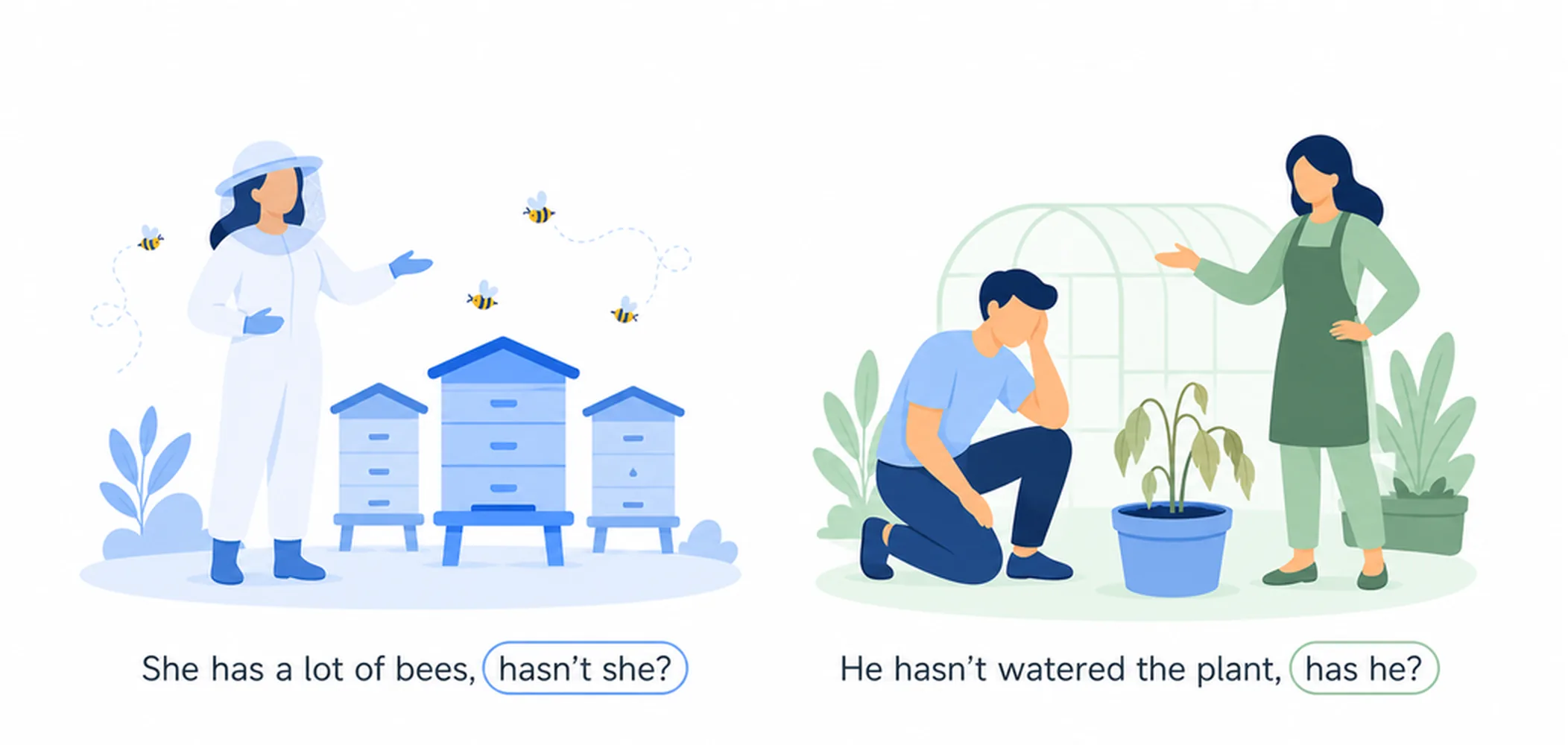
They have a large garden , haven't they ?

Pattern D – Negative Statement → Positive Tag (British)

Subject haven't / hasn't object / complement , have / has subject pronoun ?
He hasn't any siblings , has he ?

Examples

She has bought a new car, hasn't she?
Present Perfect · Auxiliary verb 'have'
They haven't arrived yet, have they?
Present Perfect negative · Auxiliary verb 'have'
I have been to Paris, haven't I?
Present Perfect · Auxiliary verb 'have'
You have finished, haven't you?
Present Perfect · Auxiliary verb 'have'
He hasn't done his work, has he?
Present Perfect negative · Auxiliary verb 'have'
They have lived here for five years, haven't they?
Present Perfect · Auxiliary verb 'have'
When to use it
Checking Information
Use question tags with 'have' when you think something is true and want to confirm it.
"You have been to London before, haven't you?"
Starting a Conversation
Use question tags to make small talk more friendly and natural.
"You haven't tried this restaurant, have you?"
Seeking Agreement
Use question tags when you expect the listener to agree with you.
"We have made good progress, haven't we?"
Signal words
have has haven't hasn't question tag past participle auxiliary verb
Common Mistakes
Wrong
She has finished, has she?
Correct
She has finished, hasn't she?
Positive statement needs a negative question tag. The tag must be negative.
Wrong
They haven't arrived, haven't they?
Correct
They haven't arrived, have they?
Negative statement needs a positive question tag. Two negatives are incorrect.
Wrong
You have seen it, don't you?
Correct
You have seen it, haven't you?
With the present perfect 'have seen', the question tag must use the auxiliary 'have', not 'do'.
Wrong
I have gone, have I?
Correct
I have gone, haven't I?
Positive sentence needs a negative tag. 'Have I?' is positive, so it's incorrect.
KEY TAKEAWAYS

What to Remember

  • Question tags are short questions at the end of statements used to check information or ask for agreement.
  • The question tag must match the verb form and tense used in the main sentence.
  • When 'have' is an auxiliary verb with a past participle, use 'have' in the question tag.
  • When 'have' is the main verb meaning 'possess', the question tag structure depends on modern or traditional English.
  • The question tag is usually negative when the main statement is positive, and vice versa.
← Previous
Question tags with modal verbs
Next →
Irregular question tags (I am, aren't I?)