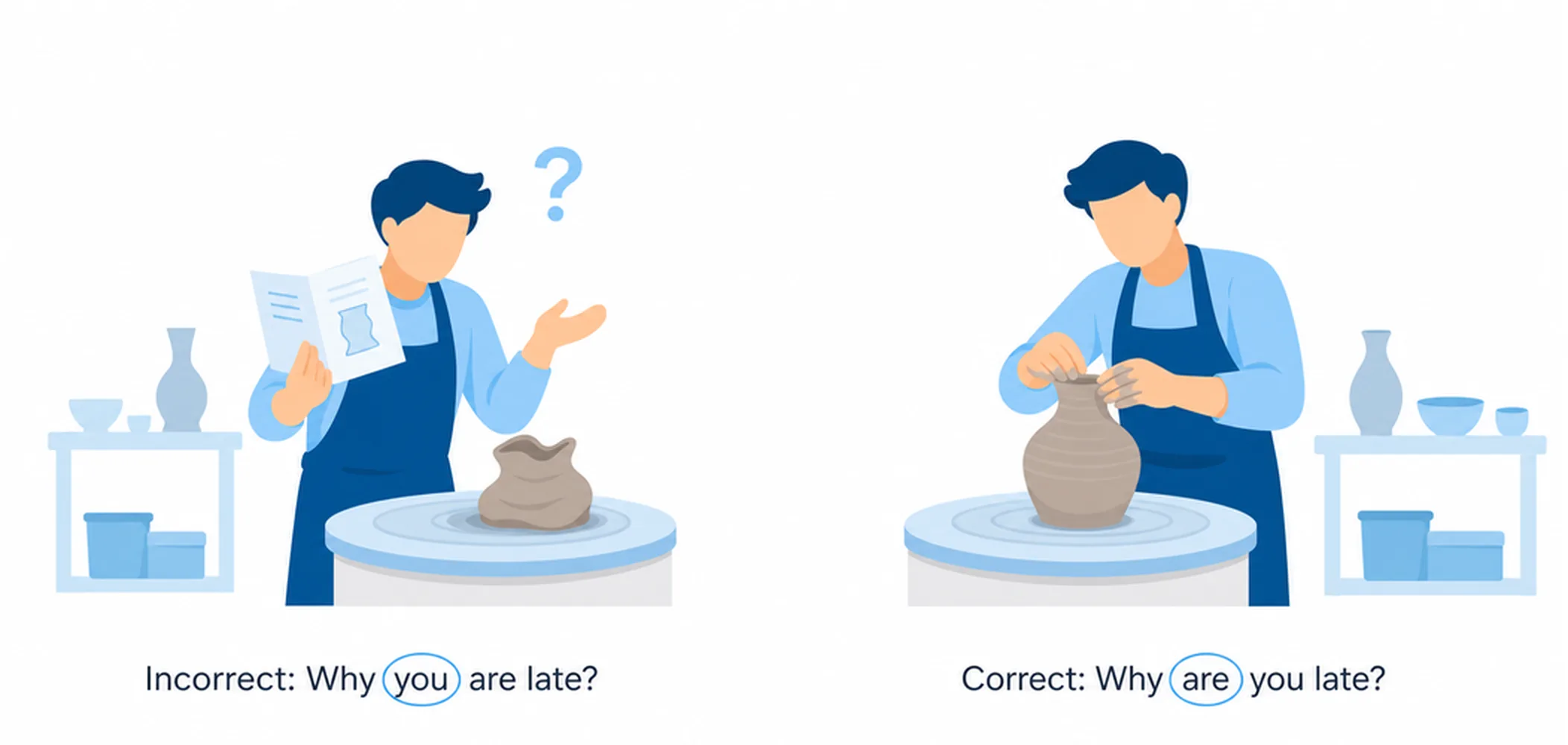
Why A2 Learners Make Question Mistakes
Questions in English follow strict word order rules that are very different from statements. Many A2 learners forget to use auxiliary verbs (do, does, did), or they place the question word in the wrong position. Some learners also use the wrong auxiliary for the tense. These small errors are very common because your native language may form questions differently. Understanding the patterns will help you ask questions correctly every time.
Wh- Questions vs Yes/No Questions: Key Differences
| Feature | Wh- Questions | Yes/No Questions |
|---|---|---|
| Form | Wh- word + auxiliary verb + subject + main verb (e.g. What do you eat?) |
Auxiliary verb + subject + main verb (e.g. Do you eat meat?) |
| When to Use | Use when you need specific information about a person, place, time, reason, manner, or thing. | Use when you want to confirm or deny a fact, and a simple "yes" or "no" is sufficient. |
| Expected Answer Type | An open, informative answer providing specific details. e.g. "She lives in Paris." |
A closed answer: simply Yes or No (often followed by a short form). e.g. "Yes, she does." |
| Question Word Usage | Always begins with a Wh- word: Who, What, Where, When, Why, Which, How. | No question word is used. Begins directly with an auxiliary or modal verb: Do, Does, Did, Is, Are, Can, Will, etc. |
| Word Order | Wh- word moves to the front; auxiliary verb comes before the subject. ❌ You go where? → ✅ Where do you go? |
Auxiliary verb inverts with the subject to the front of the sentence. ❌ You like coffee? → ✅ Do you like coffee? |
| Positive Example | "Where does she work?" "What time did they arrive?" |
"Does she work here?" "Did they arrive on time?" |
| Negative Example | "Why didn't he call?" "Who doesn't want to join?" |
"Didn't he call?" "Doesn't she know the answer?" |
| Question Example | "How do you spell your name?" | "Can you spell your name?" |
| Common Mistakes |
• Forgetting the auxiliary verb: ❌ Where you live? → ✅ Where do you live? • Wrong word order: ❌ What you are doing? → ✅ What are you doing? |
• Missing auxiliary verb: ❌ You speak English? → ✅ Do you speak English? • Using a Wh- word unnecessarily: ❌ Do what you eat? → ✅ Do you eat meat? |
| Key Signal Words | Who, What, Where, When, Why, Which, How, How much, How many, How long, How often | Do, Does, Did, Is, Are, Was, Were, Have, Has, Had, Can, Could, Will, Would, Should, Must |
| 🔑 Key Difference: The fundamental distinction lies in the type of information sought. Wh- questions ask for specific details and require an open, descriptive answer — the Wh- word replaces the missing piece of information. Yes/No questions ask for confirmation or denial of a statement and require only a closed "yes" or "no" response. Both types require subject-auxiliary inversion and an auxiliary verb — omitting this is the most common mistake learners make. | ||
Formula
? Question
Do/Does
+
Subject
+
main verb
+
?
Does she like coffee?
Examples

Do you like English?
Yes/No question · Present simple

Where did you go last weekend?
Wh- question · Past simple

Can they help us tomorrow?
Modal question · With 'can'

How many students are in your class?
Wh- question · Present simple with 'be'
When to use it
Asking for information
Use wh- questions to get specific information. The question word comes first, then auxiliary, then subject.
"What time does the train leave?" or "Where are you from?"
Asking yes/no answers
Use auxiliaries at the start to ask questions that need 'yes' or 'no' answers.
"Do you speak French?" or "Did they finish their homework?"
Asking about the subject
When the question word is the subject, do not use an auxiliary. Use the main verb directly.
"Who can help me?" or "Which students passed the test?"
Signal words
do
does
did
is
are
was
were
can
will
would
what
where
when
why
who
how
Common Mistakes
✕
Wrong
You like pizza?
✓
Correct
Do you like pizza?
Yes/No questions need an auxiliary (do/does) at the start. You cannot just use statement word order with a rising voice.
✕
Wrong
Where you are going?
✓
Correct
Where are you going?
In wh- questions, the auxiliary (are) must come before the subject (you). Wh- word, then auxiliary, then subject.
✕
Wrong
What you did yesterday?
✓
Correct
What did you do yesterday?
With past tense, use 'did' before the subject. Also, the main verb returns to base form (do, not did).
✕
Wrong
Does she can swim?
✓
Correct
Can she swim?
Modal verbs (can, will, must) act as auxiliaries. Do not use 'does' + modal. Use only the modal verb.
✕
Wrong
How many books you have?
✓
Correct
How many books do you have?
Even with 'how many,' you need the auxiliary 'do' before the subject in present tense.
✕
Wrong
Who did go to the party?
✓
Correct
Who went to the party?
When the wh- word is the subject, do not use 'did.' Use the past tense form of the main verb (went).
✕
Wrong
Is your name what?
✓
Correct
What is your name?
The question word always comes first in wh- questions. Never put it at the end (unless it's a short tag: 'Your name is...what?').
KEY TAKEAWAYS
What to Remember
- Use an auxiliary verb (do/does/did) in most yes/no questions and wh- questions.
- Place the question word at the beginning for wh- questions, then the auxiliary verb.
- In yes/no questions, put the auxiliary verb before the subject.
- Match the auxiliary verb tense to the main verb tense in your question.
- With "be" verbs, invert the verb and subject without needing do/does/did.