What are Questions with Prepositions?
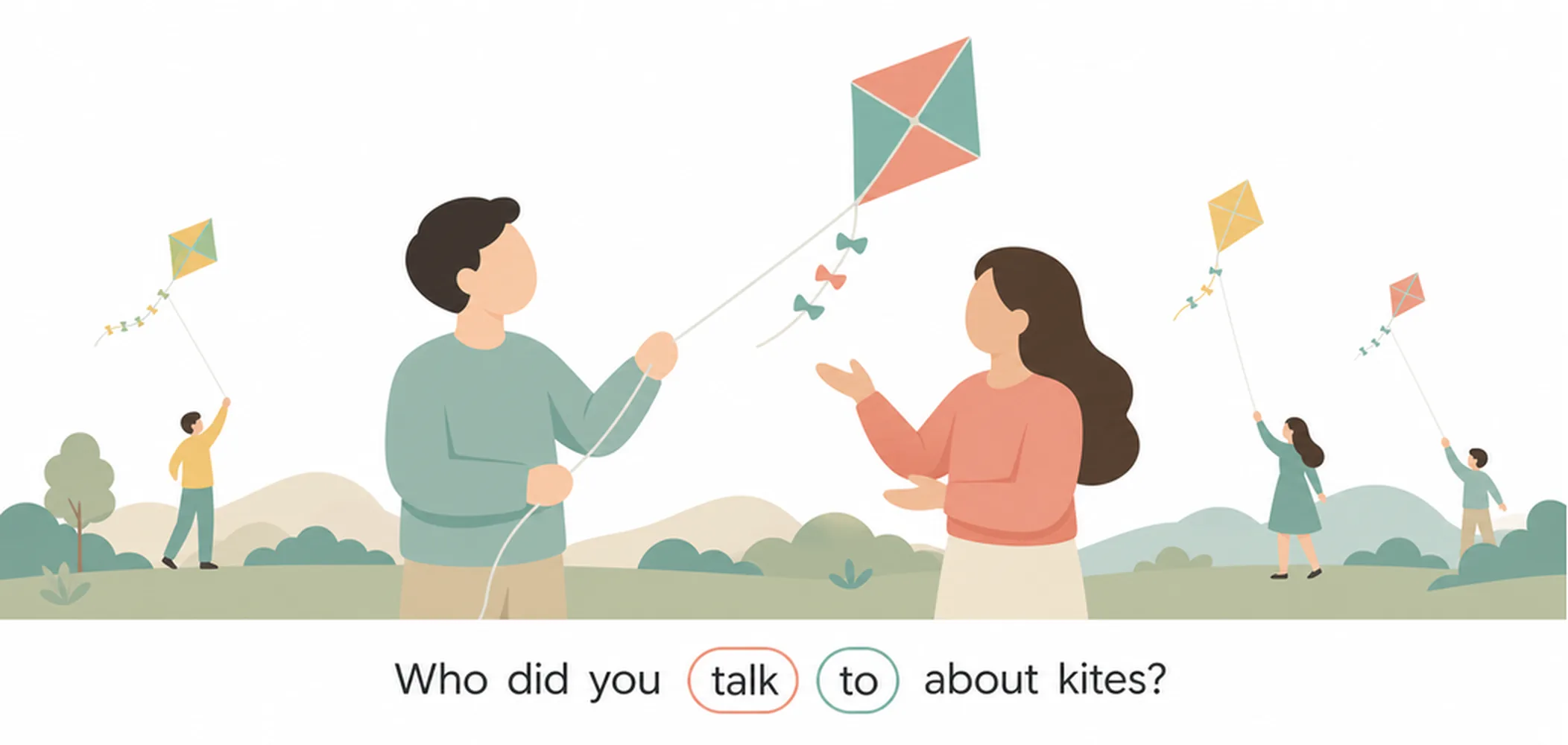
When we ask questions in English, we sometimes need to use prepositions like 'to', 'with', 'about', 'for', and 'from'. A preposition connects the question word to the rest of the sentence. For example, 'Who did you talk to?' uses the preposition 'to'. The preposition tells us about the relationship between the action and the person or thing we are asking about.
Two Ways to Ask Questions with Prepositions
In English, there are two ways to ask questions with prepositions. The first way is more common in spoken English: the preposition comes at the end of the sentence. Example: 'Who did you talk to?' The second way is more formal: the preposition comes at the beginning with the question word. Example: 'To whom did you talk?' Both are correct, but the first way is used much more often in everyday conversation.
How to Form Questions with Prepositions
To make a question with a preposition, follow these steps: (1) Choose your question word (who, what, where, which, etc.). (2) Add the auxiliary verb (did, does, do, will). (3) Add the subject. (4) Add the main verb. (5) Add the preposition at the end. Example: 'What are you looking for?' Here, 'for' is the preposition at the end of the question.
Informal vs Formal: Side-by-Side Comparison
| Category | Informal Register (Preposition at the end) |
Formal Register (Preposition at the beginning + "whom") |
|---|---|---|
| Form | Wh- word (who / what / which) + auxiliary verb + subject + verb + preposition | Preposition + whom / which / what + auxiliary verb + subject + verb |
| When to Use | Everyday conversation, texting, casual emails, speaking with friends or colleagues in relaxed settings. | Academic writing, formal letters, job interviews, official reports, and situations requiring a high level of politeness. |
| Example 1 | Who did you talk to? | To whom did you talk? |
| Example 2 | Who is she waiting for? | For whom is she waiting? |
| Example 3 | What are you looking at? | At what are you looking? |
| Example 4 | Which team did you play against? | Against which team did you play? |
| Example 5 | Who does this package belong to? | To whom does this package belong? |
| Pronoun Used | Who — used as an informal object pronoun in questions (e.g., Who did you see?) | Whom — the grammatically correct object pronoun required after a preposition in formal usage (e.g., To whom did you speak?) |
| Preposition Position | Placed at the end of the question (called a "stranded preposition"). This is very common in spoken English. | Placed at the beginning of the question, directly before the question word. This is called a "fronted preposition." |
| Naturalness in Speech | Sounds natural and fluent in everyday spoken English. Native speakers use this form constantly. | Can sound stiff or old-fashioned in casual speech, but is correct and expected in formal written contexts. |
| Common Prepositions Involved | to, for, with, about, at, from, on, against, into, through — placed after the verb at the end. | Same prepositions — moved to the front of the question before whom / which / what. |
| Grammar Rule Note | Technically, ending a sentence with a preposition was once considered incorrect. Today, it is fully accepted in informal English. | Follows the traditional grammar rule of not ending sentences with a preposition. Required in academic and formal writing. |
| 🔑 Key Difference: Both informal and formal questions ask for the same information — only the word order and pronoun choice differ. In informal speech, the preposition is "stranded" at the end and who is used (Who did you talk to?). In formal writing, the preposition moves to the front and is followed by whom (To whom did you talk?). Learners should recognise both forms but use the informal version in everyday conversation and the formal version in academic or professional writing. | ||
Examples






What to Remember
- A preposition connects the question word to the verb in questions like "Who did you talk to?"
- In spoken English, the preposition comes at the end of the question: "Who did you talk to?"
- In formal English, the preposition moves to the beginning: "To whom did you talk?"
- Common prepositions in questions are 'to', 'with', 'about', 'for', 'from', 'at', 'in', and 'on'.
- Use prepositions with wh- question words (who, what, where) to ask about relationships between people or things.