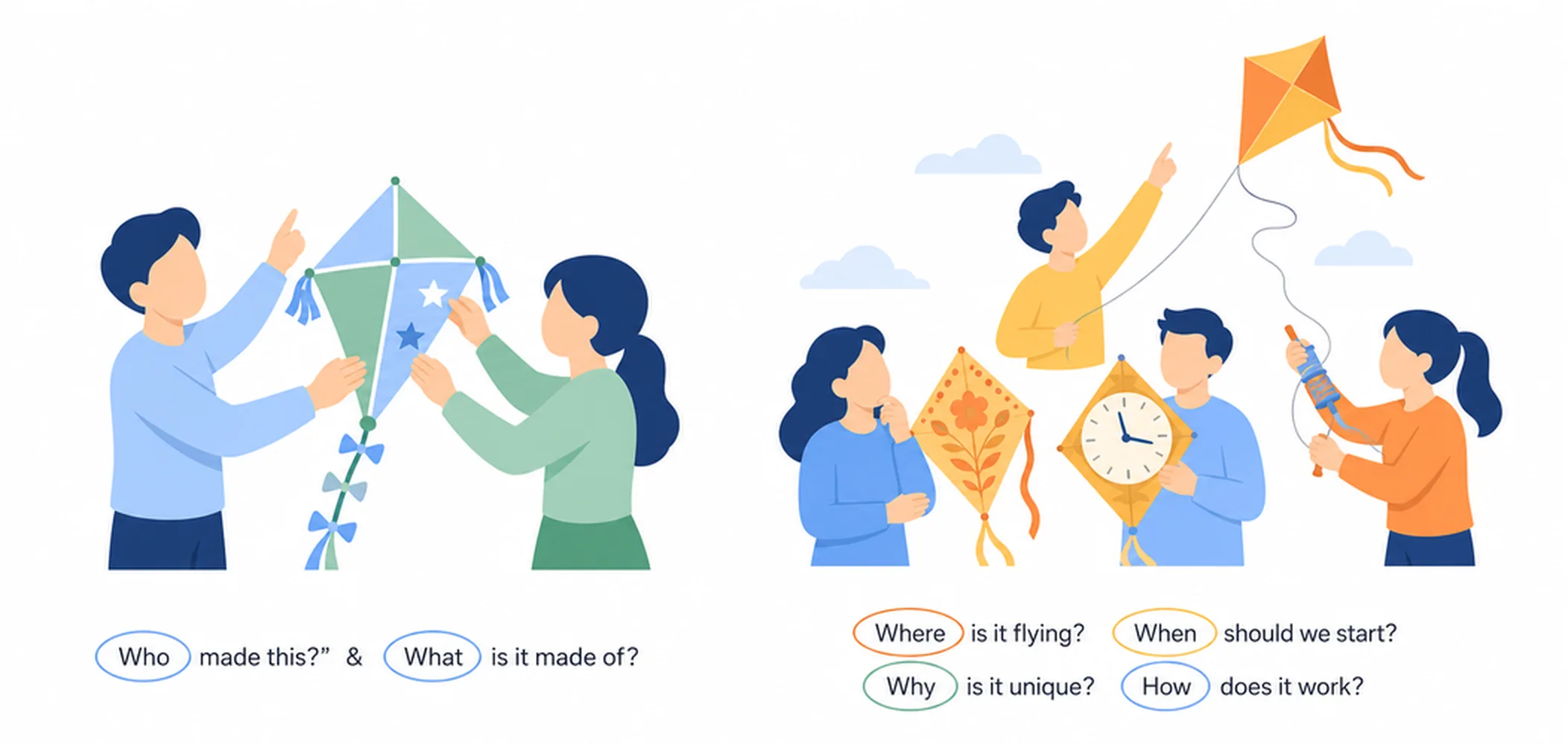
What are Wh- Questions?
Wh- questions are questions that ask for specific information. They start with question words: who, what, where, when, why, and how. Unlike yes/no questions, wh- questions need more detailed answers. For example, "Do you like coffee?" is a yes/no question, but "What do you like to drink?" is a wh- question that needs a specific answer.
How to Form Wh- Questions
The basic pattern is: Wh- word + auxiliary verb + subject + main verb + rest of sentence. For present simple: "Where do you live?" For past simple: "What did you eat?" For present continuous: "What are you doing?" The auxiliary verb (do, does, did, is, are) comes before the subject. This is the opposite of statements, where the subject comes first.
Understanding Each Wh- Word
| Wh- Word | Purpose | Example Question |
|---|---|---|
| Who | Asks about people | "Who is your best friend?" |
| What | Asks about things or actions | "What is your job?" |
| Where | Asks about place | "Where do you work?" |
| When | Asks about time | "When is your birthday?" |
| Why | Asks about reasons | "Why do you like this sport?" |
| How | Asks about manner or way | "How do you make coffee?" |
Learning when to use each word helps you ask the right questions and understand English better.
Wh- Questions vs Yes/No Questions
| Feature | Wh- Questions | Yes/No Questions |
|---|---|---|
| Form | Wh- word + auxiliary verb + subject + main verb (e.g., What do you eat?) |
Auxiliary verb + subject + main verb (e.g., Do you eat meat?) |
| When to Use | When you need specific information about a person, place, time, reason, manner, or thing | When you want to confirm or deny something and only need a simple yes or no response |
| Expected Answer Type | An open, informative answer with specific details (e.g., "She lives in London.") |
A closed answer: simply Yes or No (often followed by a short phrase) (e.g., "Yes, she does.") |
| Auxiliary Verb Usage | Auxiliary verb comes after the Wh- word and before the subject (What does he want?) |
Auxiliary verb is placed at the very beginning of the sentence, before the subject (Does he want coffee?) |
| Positive Example | "Where do you work?" "Who is calling?" "Why are they laughing?" |
"Do you work here?" "Is someone calling?" "Are they laughing?" |
| Negative Example | "Why didn't you call me?" "When won't she be available?" |
"Didn't you call me?" "Won't she be available?" |
| Question Example | "How did you solve the problem?" "What time does the train leave?" |
"Did you solve the problem?" "Has the train left yet?" |
| Key Signal Words | Who (person), What (thing/idea), Where (place), When (time), Why (reason), How (manner/degree), Which (choice), Whose (possession) | Do/Does/Did, Is/Are/Was/Were, Have/Has/Had, Can/Could, Will/Would, Should/Shall/May/Might |
| Word Order | Wh- word → Auxiliary → Subject → Verb What + does + she + do? |
Auxiliary → Subject → Verb Does + she + work here? |
| Subject as Wh- Word | When who or what is the subject, no auxiliary is needed: "Who called you?" / "What happened?" |
Does not apply — there is no Wh- word acting as the subject in Yes/No questions |
| Complexity / Information Level | Higher — requires the speaker to provide detailed, context-specific information | Lower — requires only confirmation or denial; minimal information exchanged |
| 🔑 Key Difference: The fundamental distinction is the type of information requested. Wh- questions begin with a question word (who, what, where, when, why, how) and demand an open, descriptive answer because the speaker does not know a specific detail. Yes/No questions begin with an auxiliary verb and require only a confirmation or denial, because the speaker is verifying whether something is true or false. In terms of structure, Wh- questions place the question word first followed by the inverted auxiliary-subject order, whereas Yes/No questions simply invert the auxiliary verb and subject with no question word present. | ||
Examples






What to Remember
- Wh- questions ask for specific information and need detailed answers, unlike yes/no questions.
- Wh- question word order is: question word + auxiliary verb + subject + main verb.
- Common wh- question words are who, what, where, when, why, and how.
- Use "do/does" for present simple wh- questions and "did" for past simple wh- questions.
- Never use statement word order in wh- questions; always invert the subject and auxiliary verb.