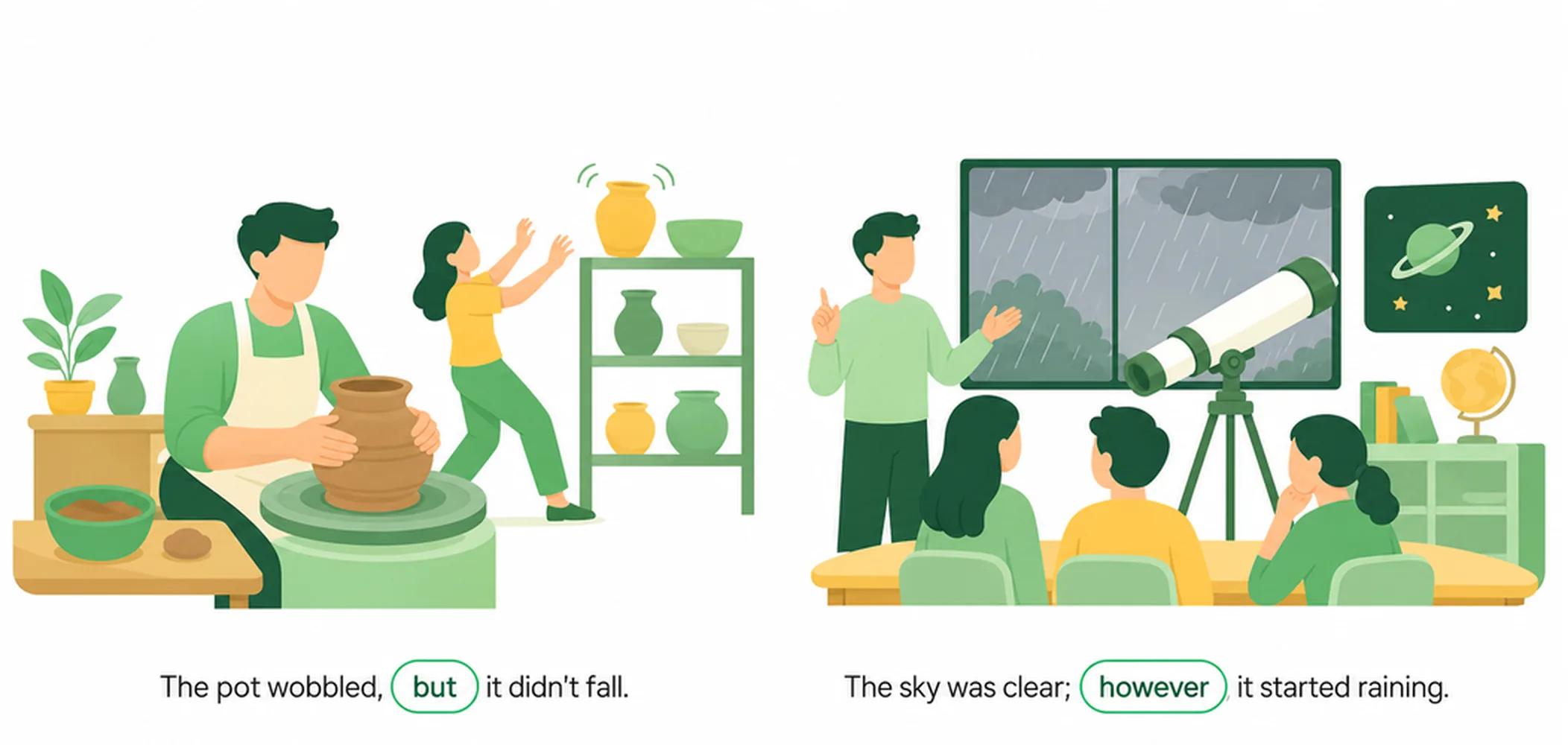
But vs However: Key Difference
Both 'but' and 'however' show contrast between ideas, but they work differently in sentences. 'But' is a coordinating conjunction that connects two independent clauses within one sentence. 'However' is a conjunctive adverb that connects two separate sentences or clauses with stronger emphasis. Understanding when to use each will help you write clearer, more professional English.
But vs However: Side-by-Side Comparison
| Dimension | But | However |
|---|---|---|
| Word Type | Coordinating conjunction | Conjunctive adverb (transitional adverb) |
| Position in Sentence | Always placed in the middle of a sentence, directly connecting two independent clauses. Cannot start a formal sentence (though common in informal writing). | Flexible — can appear at the beginning of a sentence, in the middle, or at the end. Most commonly used at the start of a new sentence or clause. |
| Punctuation Required | When joining two independent clauses, a comma is placed before but: "I wanted to go, but it rained." | When starting a new sentence, followed by a comma: "However, I stayed home." When used mid-sentence, surrounded by commas: "I stayed home, however, and rested." |
| Formality Level | Informal to neutral. Common in everyday speech, casual writing, and informal texts. | Neutral to formal. Preferred in academic writing, business communication, essays, and professional documents. |
| Typical Use Context | Spoken language, casual emails, fiction, everyday writing. Used to create a quick, direct contrast within a single sentence. | Academic papers, reports, formal essays, business writing. Used to introduce a contrasting idea — often at the start of a new sentence — after the first idea has been fully stated. |
| Positive Example | "She studied hard, but she still failed the exam." | "She studied hard. However, she still failed the exam." |
| Negative Example | "He didn't want coffee, but he didn't want tea either." | "He didn't want coffee. However, he didn't want tea either." |
| Question Example | "You said you were tired, but did you finish the report?" | "You said you were tired. However, did you manage to finish the report?" |
| Key Signal Words / Companions | Yet, although, still, even though (similar coordinating or subordinating connectors used in informal contrast) | Nevertheless, nonetheless, on the other hand, in contrast, yet (formal transitional phrases used in similar registers) |
| Can It Begin a Sentence? | Traditionally discouraged at the start of a formal sentence, though widely accepted in informal and creative writing. | Yes — this is one of its primary uses. Starting a sentence with however is grammatically correct and stylistically encouraged in formal writing. |
| Sentence Structure It Creates | Joins two clauses into one compound sentence: [Clause 1], but [Clause 2]. | Connects two separate sentences or independent clauses: [Sentence 1]. However, [Sentence 2]. |
| 🔑 Key Difference: But is a coordinating conjunction that links two clauses within a single sentence and is best suited to informal, everyday writing. However is a conjunctive adverb that introduces a contrasting idea — most often at the start of a new sentence — and is preferred in formal, academic, or professional contexts. While both express contrast, choosing between them depends on sentence structure, punctuation rules, and the level of formality required. | ||
Formula
✔ Positive
Independent clause
+
,
+
but
+
independent clause.
I like coffee, but I prefer tea in the afternoon.
Examples

I wanted to go to the party, but I had to work late.
Connecting clauses · Informal

The weather was cold, but we decided to go for a walk anyway.
Everyday usage · Coordinating conjunction

She studied hard, but she didn't pass the exam.
Spoken English · Simple contrast

The project was expensive. However, the results were excellent.
Formal writing · Between sentences
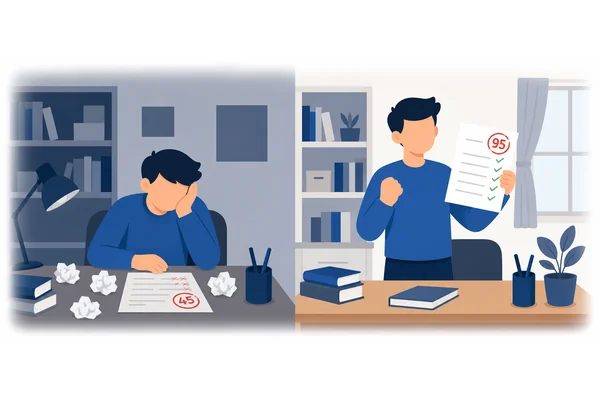
He failed the first test. However, he passed the second one with a high score.
Professional context · Strong contrast

The restaurant was busy. However, the service was very fast.
Written English · Two separate sentences
When to use it
Casual conversation
Use 'but' when speaking naturally and quickly. It's the most common choice in daily English.
"I love this restaurant, but the prices are too high."
Formal writing
Use 'however' in academic essays, business emails, and professional reports for a more formal tone.
"The data showed improvement. However, further testing is needed."
Emphasizing contrast
Use 'however' when you want to show stronger contrast or put more emphasis on the second idea.
"The plan was difficult. However, the team succeeded brilliantly."
Signal words
but
however
comma before but
period before however
punctuation difference
independent clauses
conjunctive adverb
Common Mistakes
✕
Wrong
The weather was cold, however we went outside.
✓
Correct
The weather was cold, but we went outside. OR The weather was cold. However, we went outside.
Use 'but' to connect clauses in one sentence, or use a semicolon/period before 'however' to separate sentences properly.
✕
Wrong
She is smart. But she didn't understand the question.
✓
Correct
She is smart, but she didn't understand the question. OR She is smart. However, she didn't understand the question.
'But' connects two independent clauses in ONE sentence with a comma. Starting a new sentence with 'but' is informal; 'however' is better here.
✕
Wrong
He wanted to go to university, however his family didn't have money.
✓
Correct
He wanted to go to university, but his family didn't have money. OR He wanted to go to university. However, his family didn't have money.
Use a comma + 'but' within one sentence, or a period + 'however' between two sentences. A comma + 'however' creates a comma splice.
KEY TAKEAWAYS
What to Remember
- Use 'but' as a coordinating conjunction to connect two independent clauses in one sentence.
- Use 'however' as a conjunctive adverb to connect two separate sentences or independent clauses.
- 'But' requires a comma before it when joining two independent clauses; 'however' needs semicolons.
- 'However' creates stronger emphasis on contrast than 'but' and sounds more formal.
- Don't use 'however' immediately after the subject like 'but'; place it after commas instead.