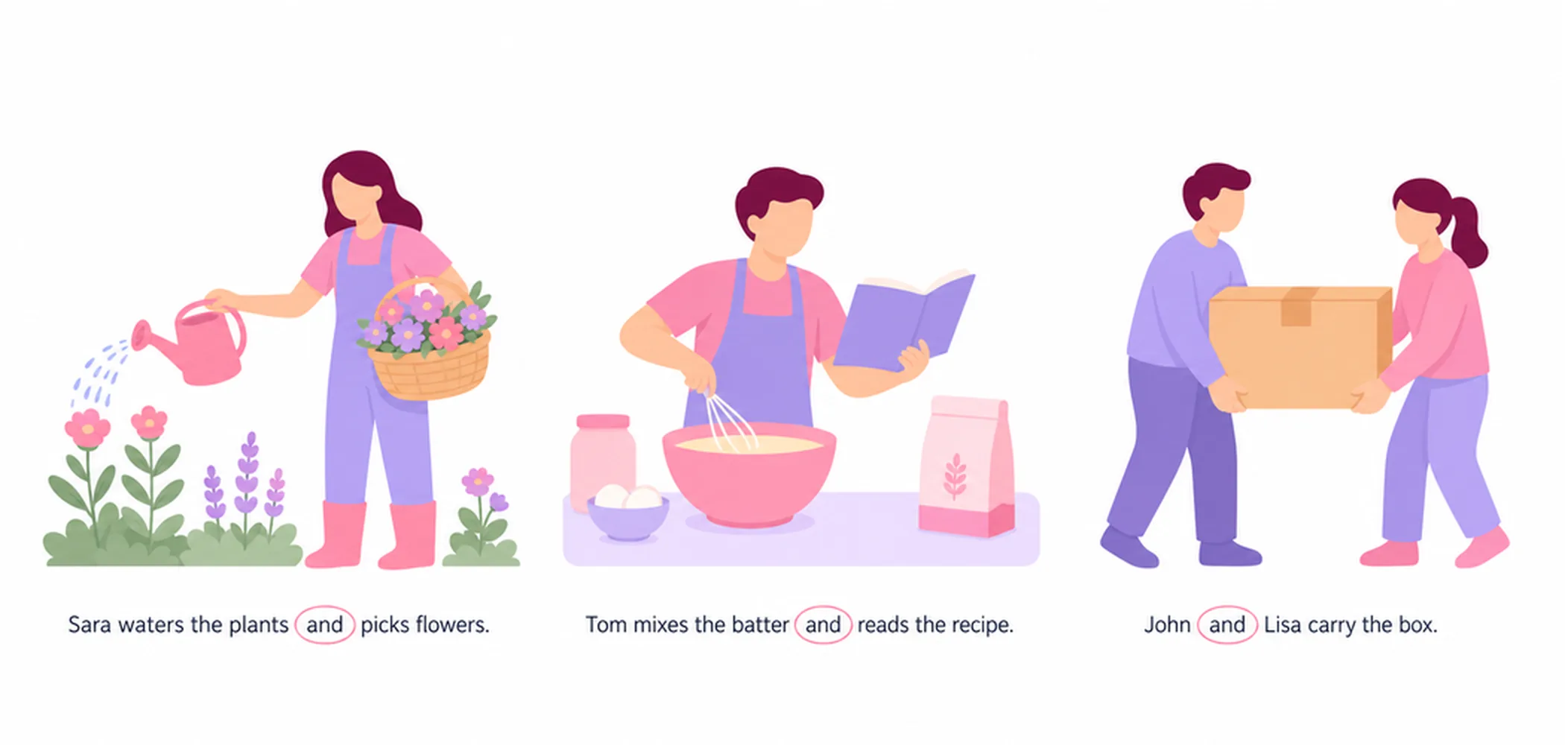
What is 'And'?
'And' is a coordinating conjunction that connects words, phrases, or clauses of equal importance. It is one of the most common words in English and is used to add information, combine ideas, or show that things happen together. When you use 'and', both parts of the sentence have the same grammatical weight and importance.
How to Use 'And'
You can use 'and' to connect: single words (nouns, verbs, adjectives), phrases, or independent clauses. When connecting two independent clauses with 'and', you must use a comma before 'and'. For single words or short phrases, you usually do not need a comma. 'And' shows that the connected ideas are equally important and often happen at the same time or are related to each other.
Common Patterns
'And' is very flexible. You can use it at the beginning of a sentence in informal writing or speech for emphasis. You can also use 'and' multiple times in a list (called polysyndeton) to create a particular rhythm or effect in your writing. In formal writing, lists often use commas between items and 'and' before the last item only.
And — Usage at a Glance
| Usage Type | Punctuation Rule | Example | Note |
|---|---|---|---|
| Connecting two words | No comma before and | She bought milk and bread. | Joins two nouns, verbs, or adjectives of equal weight |
| Connecting two phrases | No comma needed | He ran to the store and back to the car. | Both phrases share the same subject |
| Connecting two independent clauses | Comma before and | I finished the report, and she submitted it. | Each clause has its own subject and verb; comma is required |
| List of three or more items | Oxford comma optional before and | We need eggs, flour, and sugar. | Oxford comma (before and) recommended for clarity |
| Starting a sentence | No comma after And unless a pause is needed | And that was the end of the story. | Acceptable in informal and creative writing for emphasis |
| Showing result or consequence | Comma before and when clauses are long | She studied hard, and she passed the exam. | And implies the second event followed from the first |
Examples






What to Remember
- 'And' is a coordinating conjunction that connects words, phrases, or clauses of equal grammatical importance.
- Use 'and' to connect single words, phrases, or independent clauses without changing sentence structure.
- When 'and' connects two independent clauses, always place a comma before 'and'.
- Both parts connected by 'and' must have the same grammatical weight and function.
- Avoid starting sentences with 'and' in formal writing, though it is acceptable in informal contexts.