Grammar B1 Coordinating Conjunctions

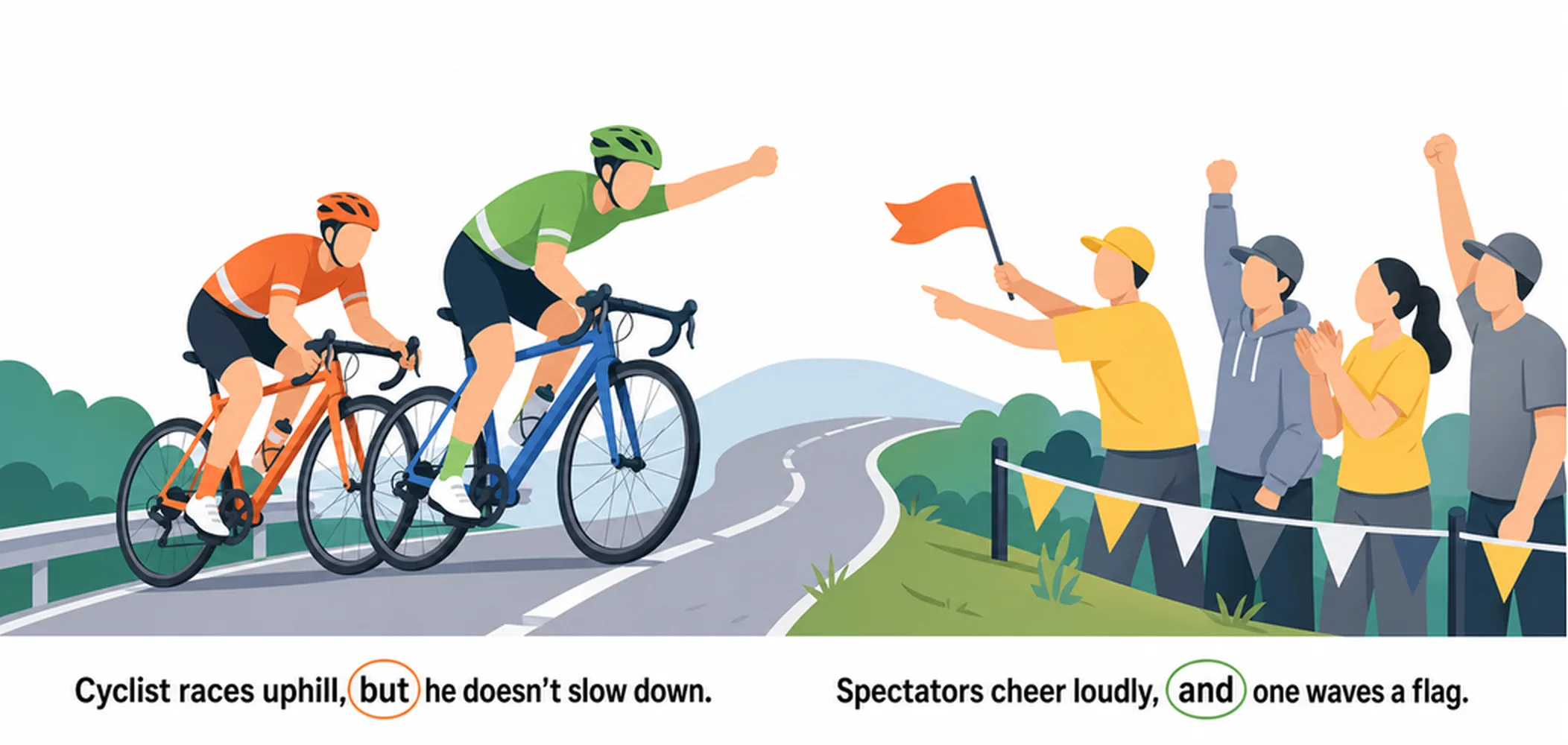
Coordinating conjunctions — compound sentences

Coordinating conjunctions — compound sentences

What Are Coordinating Conjunctions?

Coordinating conjunctions are words that connect two independent clauses of equal importance. An independent clause is a sentence that can stand alone. The seven coordinating conjunctions are: for, and, nor, but, or, yet, and so. You can remember them with the acronym FANBOYS. When you use a coordinating conjunction, you create a compound sentence that shows the relationship between two related ideas.

How to Form Compound Sentences

To form a compound sentence with a coordinating conjunction, place a comma before the conjunction and then add the second independent clause. The pattern is: Independent clause + comma + coordinating conjunction + independent clause. Each part of the sentence must have its own subject and verb. If you forget the comma, your sentence becomes a comma splice, which is a common mistake.

Understanding Each Coordinating Conjunction

Each coordinating conjunction shows a different relationship between ideas. 'And' adds information, 'but' and 'yet' show contrast, 'or' and 'nor' offer choices, 'for' explains a reason, and 'so' indicates a result. Choose the conjunction that best explains how your two ideas are connected. Using the correct conjunction helps your reader understand your meaning more clearly.

FANBOYS Quick Reference Table

Conjunction FANBOYS Letter Relationship Example Note
for F Reason / cause She wore a coat, for it was cold outside. Formal; always preceded by a comma
and A Addition Tom washed the dishes, and Sara dried them. Most common coordinating conjunction
nor N Negative addition He doesn't smoke, nor does he drink. Subject and auxiliary invert after nor
but B Contrast I wanted to go, but I was too tired. Shows an opposing or unexpected idea
or O Alternative / choice You can take the bus, or you can walk. Can also imply a consequence
yet Y Contrast / surprise The task was hard, yet they finished on time. Stronger sense of surprise than but
so S Result / effect It started to rain, so we went inside. Second clause is the outcome of the first
Formula
✔ Positive
Independent clause + + + comma + + + coordinating conjunction (and, but, or, so, etc.) + + + independent clause
She studied hard, so she passed the exam.
Formula
Clause 1 + , + for + Clause 2 + (reason)
I stayed home, for I was feeling ill.

Examples

I wanted to go swimming, but the weather was too cold.
Showing contrast · B1 Everyday
You can have tea or coffee with breakfast.
Offering a choice · Common usage
She finished her work early, so she left the office at five.
Showing result/consequence · Casual speech
My brother likes basketball, and my sister prefers volleyball.
Adding related information · Everyday
He didn't pass the test, nor did he attend the review class.
Double negative · More formal
We should hurry, for the train departs in ten minutes.
Giving a reason · Slightly formal
When to use it
Academic Writing
Coordinating conjunctions help connect related ideas in essays and reports, making your writing flow smoothly between thoughts.
"The data shows improvement, yet further research is necessary to confirm the hypothesis."
Daily Conversation
Use them naturally when talking about choices, reasons, or contrasting ideas with friends and colleagues.
"I'd like to go out for dinner, but I'm quite tired after work."
Storytelling
Connect events and explain consequences in narratives, making your story more interesting and logical.
"She knocked on the door, but nobody answered, so she decided to leave a note."
Signal words
and but or nor yet so for
Common Mistakes
Wrong
She likes pizza and she likes pasta.
Correct
She likes pizza and pasta.
Avoid repeating the subject when items are similar. Use 'and' to join only the objects.
Wrong
I went to the store but I forgot the milk.
Correct
I went to the store, but I forgot the milk.
Always use a comma before a coordinating conjunction connecting independent clauses.
Wrong
He was tired so he continued working.
Correct
He was tired, so he continued working.
Missing comma before 'so' creates a comma splice. Add a comma for proper punctuation.
Wrong
Neither he nor she are coming to the party.
Correct
Neither he nor she is coming to the party.
'Neither...nor' requires singular verb agreement when subjects are singular.
KEY TAKEAWAYS

What to Remember

  • Coordinating conjunctions (for, and, nor, but, or, yet, so) connect two independent clauses.
  • Use the acronym FANBOYS to remember all seven coordinating conjunctions easily.
  • Always place a comma before the coordinating conjunction when joining independent clauses.
  • A compound sentence shows the relationship between two equally important, related ideas.
  • Without a comma before the conjunction, you create a run-on sentence error.
← Previous
So vs therefore — difference and usage
Next →
Coordinating conjunctions — common mistakes