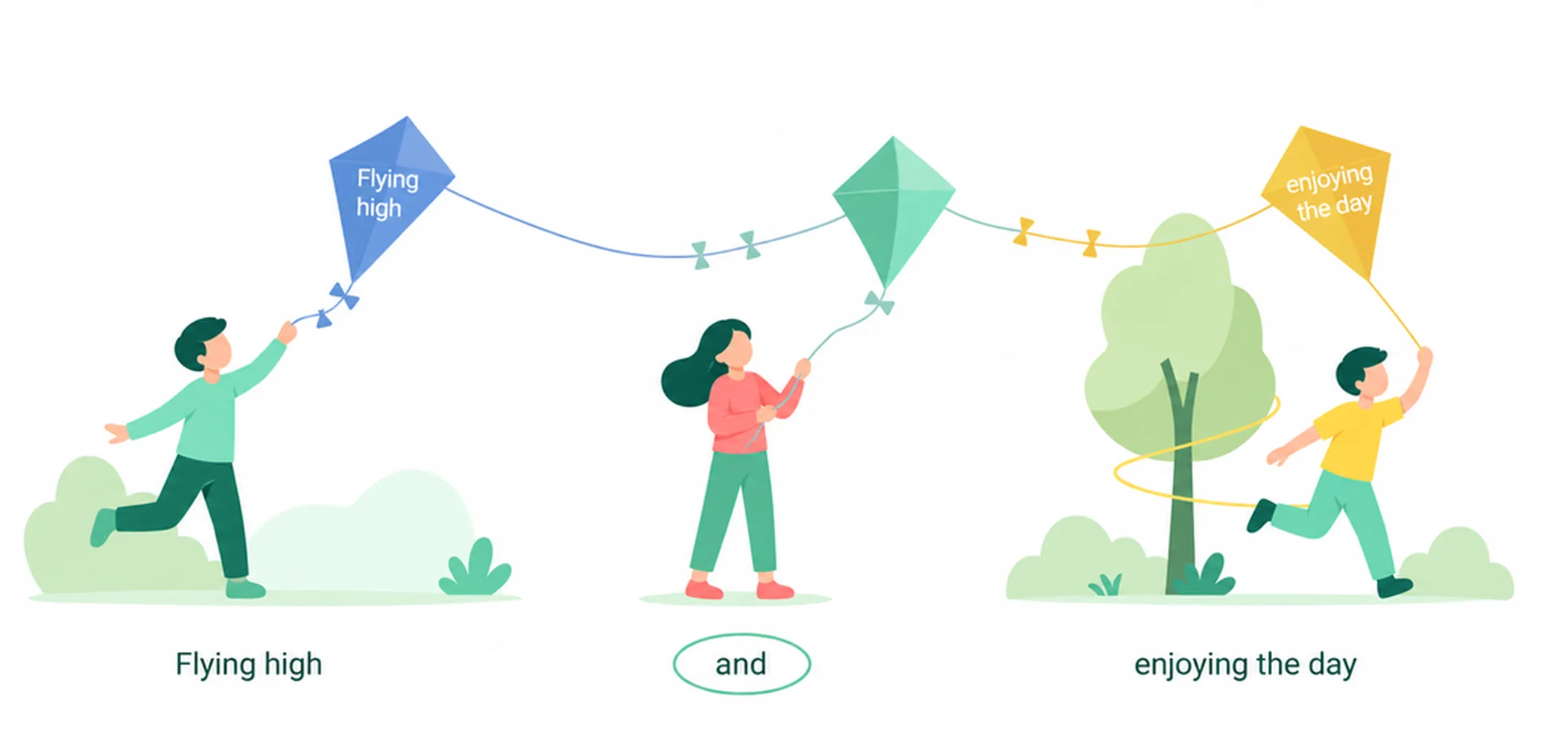
What Are Conjunctions?
Conjunctions are small words that connect words, phrases, and clauses together. They help us join ideas and make our sentences flow more smoothly. Without conjunctions, we would have to write many short, separate sentences. Conjunctions are essential for expressing relationships between ideas, such as cause and effect, contrast, choice, or addition.
Why Do We Use Conjunctions?
Conjunctions allow us to combine related ideas into one sentence instead of writing multiple short ones. They show how ideas are connected and help us communicate more clearly and naturally. For example, instead of saying 'I like coffee. I like tea.' we can say 'I like coffee and tea.' This makes our writing more organized and easier to read. Conjunctions are used constantly in everyday English, both in speaking and writing.
Main Types of Conjunctions
There are three main types of conjunctions: coordinating conjunctions (and, but, or, nor, yet, so), subordinating conjunctions (because, although, if, when, while), and correlative conjunctions (either...or, both...and). Each type has a different purpose and connects different parts of a sentence. In this lesson, we focus on understanding what conjunctions are and how they work in general.
Types of Conjunctions at a Glance
| Coordinating Conjunctions | Subordinating Conjunctions | Correlative Conjunctions | |
|---|---|---|---|
| Form | A single connecting word placed between two equal elements | A single word or short phrase that introduces a dependent (subordinate) clause | A pair of words used together, with each part placed near the element it connects |
| Purpose | Joins two grammatically equal elements — words, phrases, or independent clauses — giving each equal weight | Links a dependent clause to a main clause, showing how the two are related in meaning (time, cause, condition, etc.) | Connects two balanced, parallel elements using a two-part structure to emphasise relationship or contrast |
| What They Connect | Two independent clauses, two nouns, two verbs, two adjectives, or two phrases of equal grammatical rank | A dependent (subordinate) clause to an independent (main) clause; the dependent clause cannot stand alone | Two words, phrases, or clauses that are parallel in structure and logically related |
| Key Signal Words | for, and, nor, but, or, yet, so (remembered by the acronym FANBOYS) | because, although, while, since, if, unless, when, after, before, until, even though, as soon as | either…or, neither…nor, both…and, not only…but also, whether…or, as…as, no sooner…than |
| Positive Example | "She studied hard, and she passed the exam." | "She passed the exam because she studied hard." | "Not only did she study hard, but she also passed with top marks." |
| Negative Example | "He wanted to help, but he didn't know how." | "Although he wanted to help, he didn't know how." | "Neither the teacher nor the students knew the answer." |
| Question Example | "Do you want tea or coffee?" | "Do you know when the meeting starts?" | "Whether you stay or go, will you let me know?" |
| Clause Independence | Both clauses or elements joined are grammatically independent and equal in status | Creates one independent clause and one dependent clause; the dependent clause relies on the main clause for meaning | Both elements must be grammatically parallel (matching in structure), though neither part of the pair works alone |
| Punctuation Note | When joining two independent clauses, use a comma before the conjunction: "I was tired, so I went to bed." | Use a comma after the dependent clause when it comes first: "Because it rained, we stayed inside." No comma needed when the main clause comes first. | A comma is often placed before the second part of the pair when it introduces a clause: "Not only did she sing, but she also danced." |
| 🔑 Key Difference: Coordinating conjunctions connect two equal, independent parts using a single word (FANBOYS). Subordinating conjunctions link an unequal pair — one dependent clause to one independent clause — showing a logical relationship such as cause, time, or condition. Correlative conjunctions always work in matched pairs and require the elements they connect to be parallel in grammatical structure. The simplest test: if you can swap it for "and" or "but" between two equal parts, it is coordinating; if it introduces a clause that cannot stand alone, it is subordinating; if it comes in a recognisable two-part pair, it is correlative. | |||
Examples






What to Remember
- Coordinating conjunctions (and, but, or, nor, for, yet, so) connect words, phrases, and independent clauses.
- Use a comma before a coordinating conjunction when connecting two independent clauses together.
- Coordinating conjunctions show relationships like addition, contrast, choice, cause, and effect between ideas.
- Do not use commas when coordinating conjunctions connect only words or short phrases.
- The mnemonic FANBOYS helps remember the seven main coordinating conjunctions: For, And, Nor, But, Or, Yet, So.