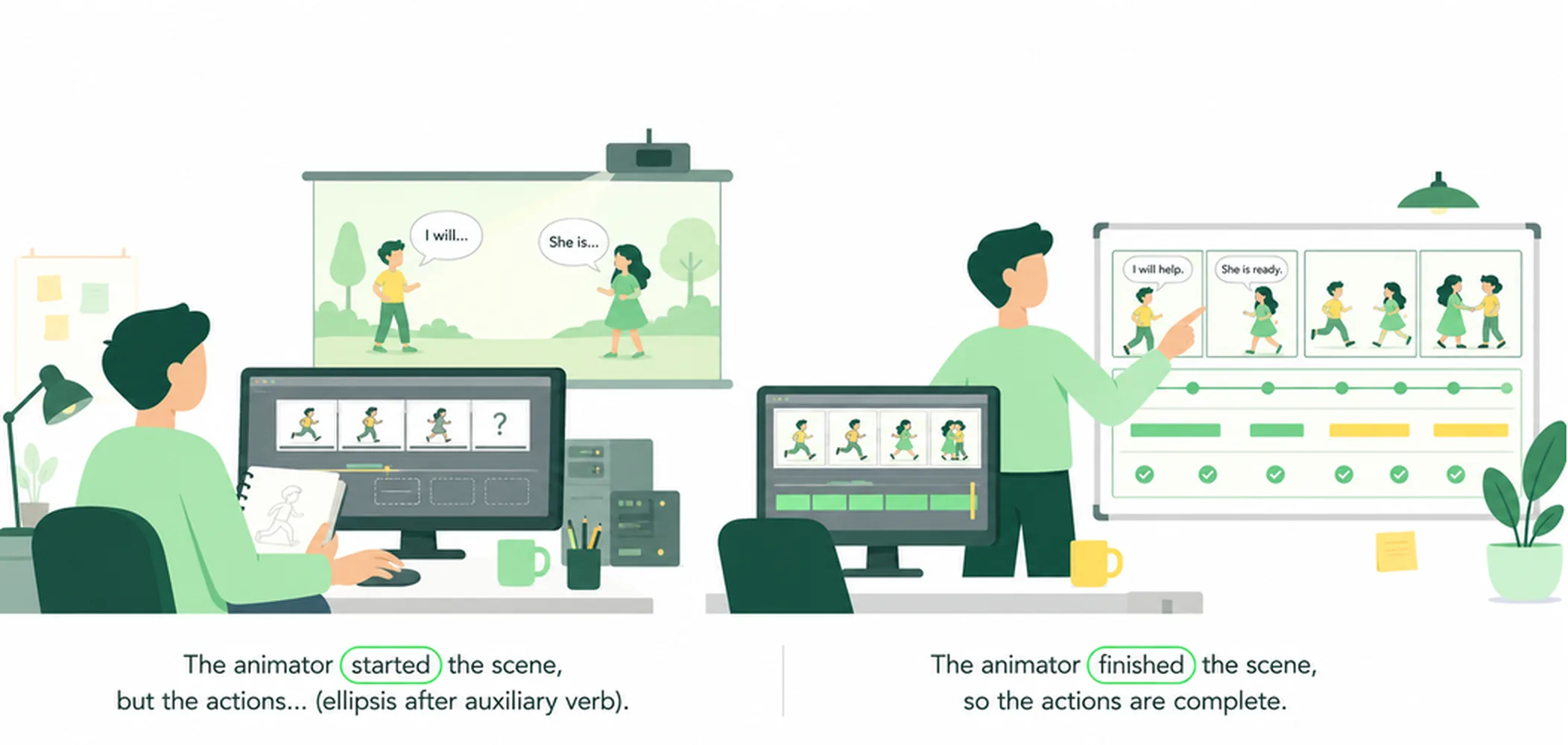
What is Ellipsis After Auxiliary Verbs?
Ellipsis is the omission (removal) of words that are already understood from context. When we use auxiliary verbs like 'have', 'do', 'be', or 'will', we often repeat the same main verb in a nearby clause. To avoid repetition and make our speech more natural, we can delete the main verb and keep only the auxiliary verb. This is called ellipsis after auxiliary verbs.
How Does It Work?
The pattern is simple: when the main verb is understood from the first clause, you can omit it in the second clause and use only the auxiliary verb. For example, instead of saying 'I have finished my work and you have finished your work', we say 'I have finished my work and you have too.' The main verb 'finished' is understood, so we don't need to repeat it. This happens with 'have', 'has', 'had', 'do', 'does', 'did', 'be', 'been', 'will', 'would', and other auxiliaries.
Why Use Ellipsis?
Using ellipsis makes your English sound more natural and fluent. Native speakers use it constantly in conversation and informal writing. It helps you avoid sounding repetitive and makes sentences shorter. However, in formal writing like academic essays or official documents, you should use complete sentences. Understanding ellipsis also helps you understand native speakers better, especially in conversations and dialogues.
Auxiliary Verbs Used in Ellipsis
| Auxiliary | Tense / Form | Ellipsis Example | Note |
|---|---|---|---|
| have | Present perfect (I/you/we/they) | "Have you finished?" "Yes, I have." (= have finished) | Main verb omitted after auxiliary |
| has | Present perfect (he/she/it) | "Has she called?" "She has." (= has called) | Third-person singular form |
| had | Past perfect (all subjects) | "Had they left?" "They had." (= had left) | Also used in conditionals |
| do | Simple present (I/you/we/they) | "Do you run?" "I do." (= do run) | Used for emphasis or short answers |
| does | Simple present (he/she/it) | "Does he work here?" "He does." (= does work) | Third-person singular form |
| did | Simple past (all subjects) | "Did they win?" "They did." (= did win) | Replaces any past-tense main verb |
| is | Present continuous / linking (he/she/it) | "Is she coming?" "She is." (= is coming) | Stands alone; no participle needed |
| are | Present continuous / linking (you/we/they) | "Are they studying?" "They are." (= are studying) | Plural and second-person form of be |
| was | Past continuous / linking (I/he/she/it) | "Was he sleeping?" "He was." (= was sleeping) | Singular past form of be |
| were | Past continuous / linking (you/we/they) | "Were they waiting?" "They were." (= were waiting) | Plural past form; also subjunctive |
| will | Simple future (all subjects) | "Will you help?" "I will." (= will help) | Modal; base form after it is omitted |
| would | Conditional / past of will | "Would you go?" "I would." (= would go) | Common in polite or hypothetical contexts |
| can | Present ability / permission | "Can she swim?" "She can." (= can swim) | Modal; no conjugation for subject |
| could | Past ability / conditional | "Could they help?" "They could." (= could help) | Also expresses polite possibility |
| should | Obligation / advice | "Should I leave?" "You should." (= should leave) | Conveys recommendation or duty |
| must | Necessity / strong obligation | "Must we attend?" "You must." (= must attend) | No past form; use had to instead |
| may | Present possibility / permission | "May I sit?" "You may." (= may sit) | Formal tone; signals uncertainty or permission |
Examples




What to Remember
- Ellipsis after auxiliary verbs means omitting the main verb when it's understood from context.
- Keep the auxiliary verb (have, do, be, will) and delete the main verb to avoid repetition.
- The auxiliary verb alone carries the meaning of the full verb phrase in the second clause.
- Use ellipsis only when the main verb is identical in both clauses; different verbs need full repetition.
- Common mistake: Don't omit the auxiliary verb itself; always keep it as the substitute for the main verb.