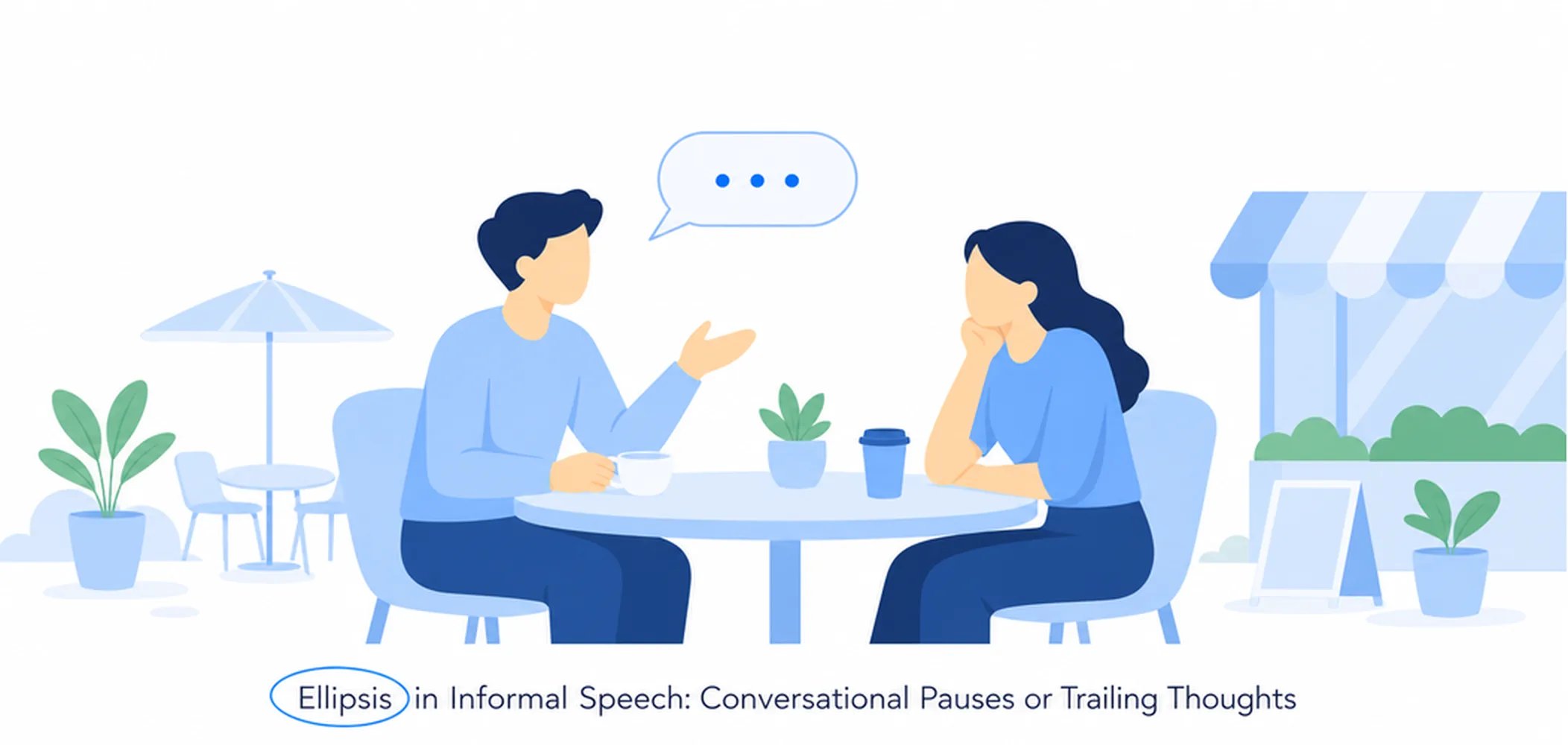
What is Ellipsis?
Ellipsis means leaving out words that are obvious or already known. In informal conversation, we do this naturally to sound more natural and avoid repetition. Instead of saying the same words again, we omit them because the listener already understands what we mean. This happens in everyday speech all the time, especially in short replies and quick exchanges.
Why Do We Use Ellipsis?
We use ellipsis to make conversation faster and less repetitive. Without it, we would sound formal and robotic. Ellipsis helps us sound natural and friendly. It's especially common in questions, answers, and short responses where repeating the full sentence would be unnecessary. Native speakers use ellipsis constantly without thinking about it.
Common Types in Conversation
The most common types include subject ellipsis (leaving out the subject), verb ellipsis (leaving out the main verb), and object ellipsis (leaving out the object). In responses to questions, we often leave out the subject and auxiliary verb. For example, when someone asks 'Do you like coffee?', you might answer 'Yes, I do' instead of 'Yes, I like coffee.' The listener understands the full meaning even though words are missing.
Ellipsis vs. Full Form in Conversation
| Category | Full-Form Version | Ellipsis Version (Informal) | Words Dropped | Why Words Are Dropped |
|---|---|---|---|---|
| Subject Pronoun + Auxiliary Drop (Greeting) | "Are you coming to the party tonight?" | "Coming to the party tonight?" | Are you (subject pronoun + auxiliary verb) | In a direct face-to-face exchange the addressee ("you") is obvious from context, so the subject and its auxiliary are redundant and routinely omitted in casual speech. |
| Subject Pronoun Drop (Statement) | "I don't know what she was thinking." | "Don't know what she was thinking." | I (first-person subject pronoun) | When the speaker is clearly the topic of their own utterance, "I" is recoverable without effort. Dropping it speeds up the conversational turn and sounds more natural in informal registers. |
| Auxiliary + Subject Drop (Yes/No Question) | "Did you see the game last night?" | "See the game last night?" | Did you (auxiliary + subject) | Rising intonation alone signals the interrogative intent, making the auxiliary unnecessary. The listener can infer "Did you" from shared situational context and prosody. |
| Verb Phrase Ellipsis (Response) | A: "Are you going to the shops?" B: "Yes, I am going to the shops." | B: "Yeah, I am." / "Yeah." | going to the shops (entire verb phrase after auxiliary) | The verb phrase was already stated in the preceding question (antecedent). Repeating it would be verbose; the auxiliary "am" alone is sufficient to confirm the proposition, a pattern called VP-ellipsis. |
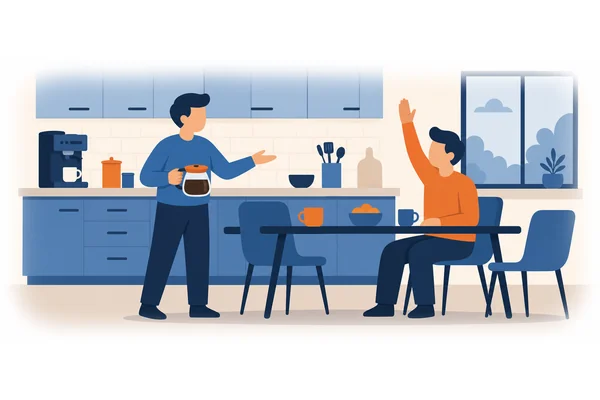
| Determiner + Noun Drop (Situational Ellipsis) | "The coffee is ready on the counter." | "Coffee's ready." | The (definite article) + on the counter (prepositional phrase) | Both speaker and listener share the immediate environment (the kitchen, the counter), so locating details and determiners are recoverable from situational context without being stated. |
| Gapping (Coordinated Clause) | "Tom ordered a burger and Maria ordered a salad." | "Tom ordered a burger and Maria a salad." | ordered (repeated verb in second conjunct) | In parallel coordinate structures ("and / but / or"), the shared verb in the second clause is predictable from the first clause. Omitting it (gapping) avoids repetition and creates a more efficient, fluent utterance. |
| Stripping (Single-Element Response) | A: "She passed the exam." B: "And Jake passed the exam too." | B: "And Jake too." / "Jake as well." | passed the exam (verb + object carried over from prior utterance) | Stripping retains only the new information (the contrasting subject "Jake") and a polarity/additive particle ("too"). Everything recoverable from A's previous turn is stripped away, keeping the response maximally concise. |
| Sluicing (Wh- Question Ellipsis) | "She's going somewhere. I wonder where she is going." | "She's going somewhere. I wonder where." | she is going (subject + verb phrase after the wh-word) | The embedded question's verb phrase is fully reconstructable from the antecedent clause ("she's going somewhere"). Leaving only the wh-word (sluicing) focuses attention on the unknown variable while discarding repeated content. |
| Pseudo-Gapping (Partial VP Deletion) | "He hasn't eaten lunch but she has eaten lunch." | "He hasn't eaten lunch but she has." | eaten lunch (main verb + object in second clause) | The auxiliary "has" is retained to mark the contrasting polarity (positive vs. negative), while the repeated lexical verb and its complement are deleted. This type is pseudo-gapping because the auxiliary survives alongside ellipsis of the main VP. |
| Right Node Raising (Shared Final Element) | "Sam likes pizza and Dana likes pizza." | "Sam likes and Dana likes pizza." → spoken as "Sam and Dana both like pizza." | pizza from the first conjunct (shared rightmost element) | When two coordinated clauses share an identical final element, that element is "raised" to the end and mentioned only once, eliminating redundancy. In rapid speech this often merges further into a simple conjoined subject construction. |
| Key Difference — Textual vs. Situational Ellipsis: All ellipsis relies on recoverability, but the source of that recovery varies. Textual (anaphoric) ellipsis — as seen in VP-ellipsis, gapping, stripping, sluicing, and pseudo-gapping — drops material that was already spoken in an immediately preceding clause or turn; the listener reconstructs the gap from the linguistic co-text. Situational ellipsis — as in the subject-pronoun drops and the "Coffee's ready" example — drops material that is recoverable not from prior words but from the shared physical environment, the identities of the participants, or the immediate speech situation. In both cases the dropped words are fully understood without loss of meaning, but only situational ellipsis could work at the very start of a conversation before any prior text exists. Recognising which type is operating helps learners understand when informal abbreviation is natural and when it might cause genuine ambiguity. | ||||
Examples





What to Remember
- Ellipsis means leaving out words that are already understood from context.
- Use ellipsis in informal conversation to sound natural and avoid unnecessary repetition.
- Omit obvious words in short replies while keeping meaning clear for listeners.
- Ellipsis is common in everyday exchanges but less appropriate in formal writing.
- Be careful not to omit words so much that your meaning becomes unclear.