What is Ellipsis?
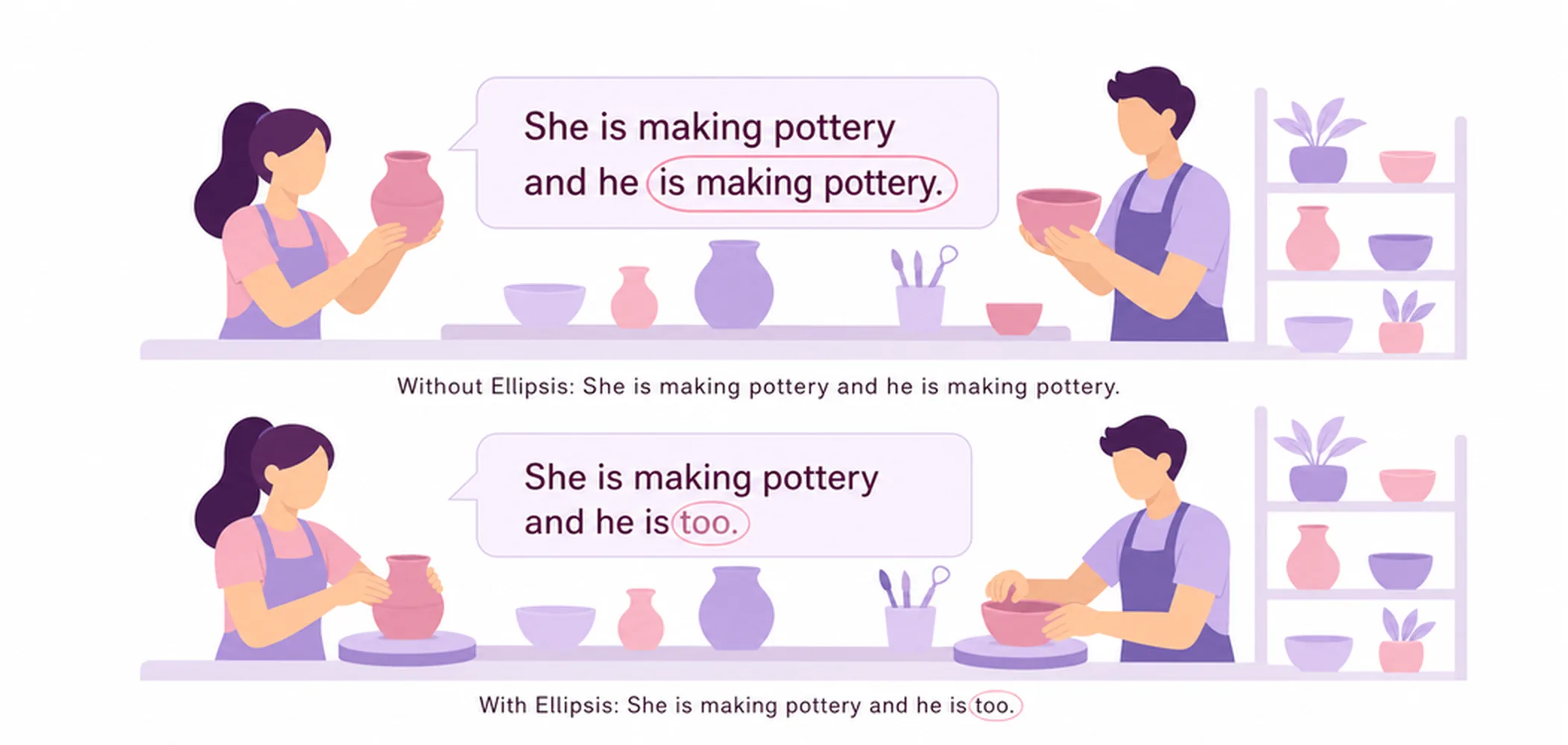
Ellipsis is the omission of words from a sentence when the meaning is still clear from context. Instead of repeating the same words, we leave them out to make our speech and writing shorter and more natural. For example, if someone asks "Do you like coffee?" you might answer "Yes, I do" instead of "Yes, I like coffee." The verb "like" is implied and doesn't need to be repeated. This happens frequently in everyday English, especially in conversations and shorter sentences.
Key Characteristics
The most important rule of ellipsis is that the omitted words must be easily understood from what comes before or after. Common types include omitting verbs, objects, or subjects. You'll often see ellipsis in comparisons ("She drinks more coffee than tea"), in responses to questions ("Who wants dessert?" "I do."), and in coordinate clauses ("Tom likes pizza and Sarah does too"). Ellipsis makes English sound fluent and natural—using it correctly helps you sound like a native speaker.
Ellipsis vs. Full Sentences
| Category | Full Sentence | Elliptical Equivalent | Words Omitted | Why It Is Still Understood |
|---|---|---|---|---|
| Form | A complete clause containing a subject, a verb, and all necessary complements or objects. | A shortened clause where one or more recoverable elements have been deliberately left out. | Subject, auxiliary verb, main verb, object, or complement — whichever is recoverable from context. | The omitted material is identical to, or directly recoverable from, an earlier or later part of the discourse. |
| When to Use | Use the full form when the information is new, formal writing demands clarity, or the listener/reader cannot infer what is missing. | Use ellipsis to avoid repetition, create concision, reflect natural spoken rhythm, or add stylistic emphasis in both speech and writing. | N/A — no omission in the full form. | Shared context, preceding utterance, or situational knowledge makes the ellipsis unambiguous. |
| Positive Example | "She can play the piano, and he can play the piano too." | "She can play the piano, and he can too." | play the piano (verb phrase repeated in the second clause) | The verb phrase "play the piano" was established in the first clause; the auxiliary "can" signals that the same predicate applies to "he." |
| Negative Example | "Tom did not finish his homework, and Maria did not finish her homework either." | "Tom did not finish his homework, and Maria didn't either." | finish her homework (repeated verb phrase in negative clause) | The negative auxiliary "didn't" together with "either" signals that the same negative predicate from the first clause is being attributed to Maria. |
| Question Example | "Would you like to come to the party?" — "Yes, I would like to come to the party." | "Would you like to come to the party?" — "Yes, I would." | like to come to the party (the entire infinitive complement) | The question itself supplies all the missing information; the modal "would" acts as a pro-verb standing in for the full predicate. |
| Key Signal Words / Structures | All content words are present; no reliance on auxiliary verbs or discourse context to fill gaps. | so, neither, nor, too, either, do so, does, did, will, would, can, could, have, has, be — auxiliary or pro-verb left to carry meaning. | N/A | These "trigger" words signal to the reader that an antecedent clause or phrase must be retrieved to complete the meaning. |
| Key Difference: A full sentence is self-contained and requires no prior context to be understood; an elliptical construction deliberately omits recoverable words — typically a repeated verb phrase, subject, or complement — relying on the surrounding discourse, a shared auxiliary verb, or situational knowledge to restore meaning. Ellipsis is not a grammatical error but a pragmatic device that improves fluency, reduces redundancy, and mirrors natural speech patterns, provided the omitted material can always be unambiguously reconstructed by the reader or listener. | ||||
Examples





What to Remember
- Ellipsis omits words from sentences when meaning remains clear from context.
- Use ellipsis in conversations and informal writing to make language sound natural.
- The omitted words must be clearly understood from what was already said.
- Common ellipsis occurs with auxiliary verbs like "do," "have," and "be."
- Never omit words if the listener or reader cannot understand the meaning.