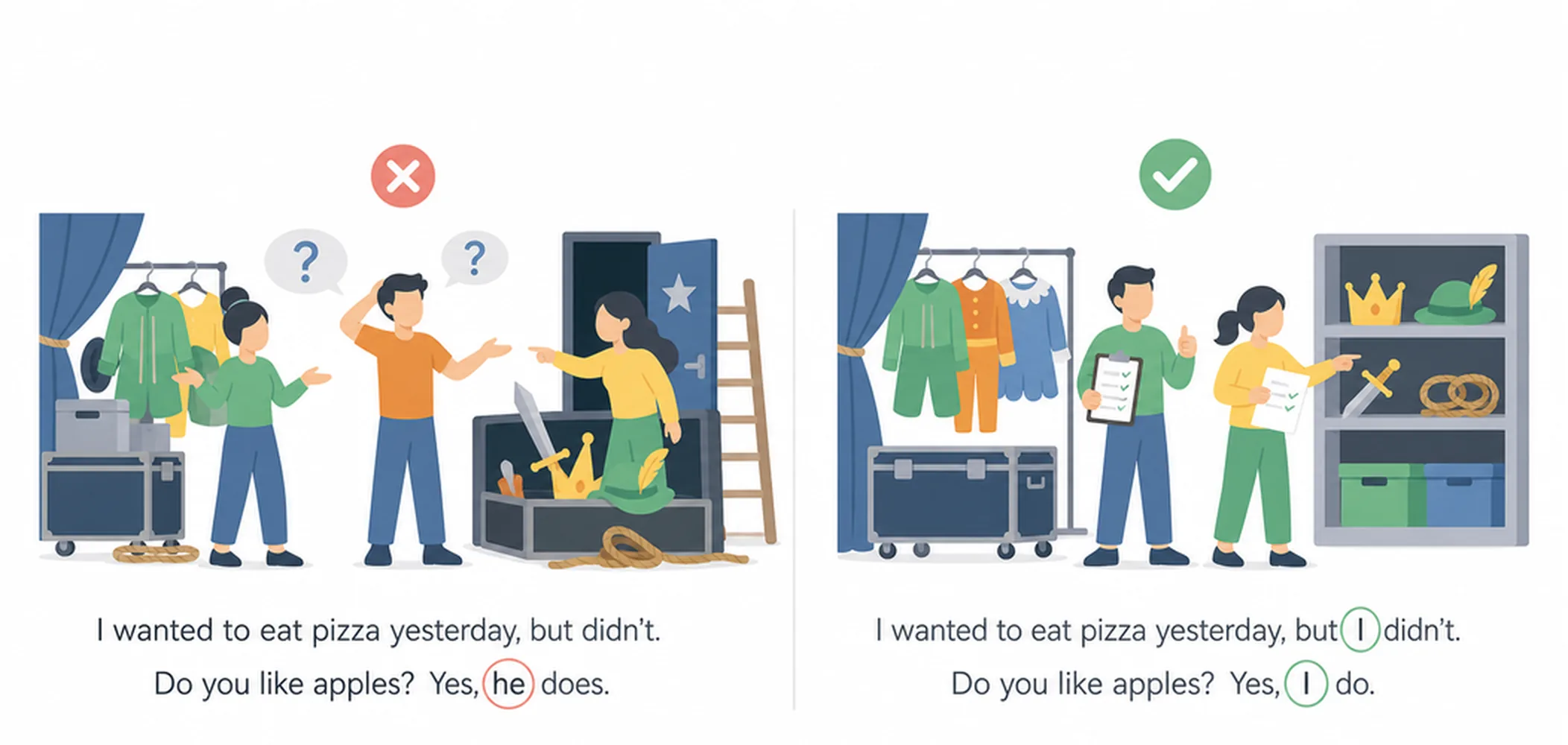
Why Learners Struggle with Ellipsis and Substitution
Ellipsis (leaving out words) and substitution (replacing words with pronouns or other words) help English sound natural and avoid repetition. However, B1 learners often repeat the same words when they should omit them, or use the wrong substitute word. The key is understanding which words can safely be removed or replaced without losing clarity. This article shows you the most common mistakes and how to fix them.
Ellipsis vs Substitution: What's the Difference?
| Aspect | Ellipsis | Substitution |
|---|---|---|
| Form | Words or phrases are completely omitted from the sentence because they are understood from context. Nothing replaces them — a gap is left. | Words or phrases are replaced by a pro-form (e.g., one / ones, do / do so, so, not, neither) to avoid repetition while still filling the grammatical slot. |
| When to Use | Use when the omitted element is entirely recoverable from the immediately preceding clause or shared context and its absence does not cause ambiguity. | Use when the grammatical structure requires a placeholder to be present, or when removing the word entirely would sound unnatural or create confusion. |
| Positive Example |
Incorrect: "She can play the piano and I can play the piano too." Corrected (Ellipsis): "She can play the piano and I can [play the piano] too." → The repeated verb phrase is simply dropped: "…and I can, too." |
Incorrect: "I need a red pen. Can you give me a red pen?" Corrected (Substitution): "I need a red pen. Can you give me one?" → One substitutes for a red pen without leaving a gap. |
| Negative Example |
Incorrect: "He didn't finish the report and she didn't finish the report either." Corrected (Ellipsis): "He didn't finish the report, and she didn't [finish the report] either." → Drop the repeated verb phrase: "…and she didn't either." |
Incorrect: "I think it will rain. He doesn't think it will rain." Corrected (Substitution): "I think it will rain. He doesn't think so." → So substitutes for the whole clause it will rain. |
| Question Example |
Incorrect: "Are you coming to the party? — Yes, I am coming to the party." Corrected (Ellipsis): "Are you coming to the party? — Yes, I am [coming to the party]." → Simply omit: "Yes, I am." |
Incorrect: "Will they win the match? — I hope they will win the match." Corrected (Substitution): "Will they win the match? — I hope so." → So stands in for the entire clause rather than leaving it absent. |
| Words Omitted or Replaced |
Typically omits: repeated verb phrases, noun phrases, or clauses after auxiliary verbs (can, will, have, do) or conjunctions (and, but, or). Common patterns: auxiliary + [VP] → "She will and he will [go]." |
Replaces: • Noun phrases → one / ones • Verb phrases → do / do so • Clauses → so / not • Verb phrases in comparatives → so / neither / nor |
| Key Signal Words | too, either, but, and, or, also, as well — these conjunctions or additive adverbs often signal that a repetition can be dropped cleanly. | one, ones, do, do so, so, not, neither, nor — these pro-forms are the substitutes themselves and serve as the clearest marker that substitution is being used. |
| Common Mistake |
Using ellipsis where a pro-form is needed, leaving the sentence grammatically incomplete. ✗ "I hope [they will win]." — sounds abrupt and non-idiomatic. ✓ "I hope so." — substitution is required here. |
Using a substitute pro-form where simple omission would be more natural and fluent. ✗ "She can sing and I can do so too." — do so is unnecessary. ✓ "She can sing and I can, too." — ellipsis is cleaner. |
| Key Difference: The fundamental distinction is structural. Ellipsis leaves a gap — the missing words are simply absent but recoverable from context (e.g., "She plays guitar and he does [play guitar] too" → "…and he does, too"). Substitution fills that potential gap with a pro-form placeholder — the slot is occupied, not empty (e.g., replacing a noun phrase with one or a clause with so/not). A reliable test: if removing the element leaves a grammatically complete and natural sentence, it is ellipsis; if a small stand-in word (one, so, do) is needed to keep the sentence grammatical or idiomatic, it is substitution. Mixing them up — omitting where a pro-form is required, or inserting a pro-form where nothing is needed — is the most common error writers make with these two cohesive devices. | ||
Examples

I went to the cinema yesterday, and my friend did too.
Verb substitution · Informal speech

Tom wants to study medicine, but his parents don't want him to.
Ellipsis with infinitive · Common in speech

She can speak French, and so can her brother.
Substitution with auxiliary · Formal and informal
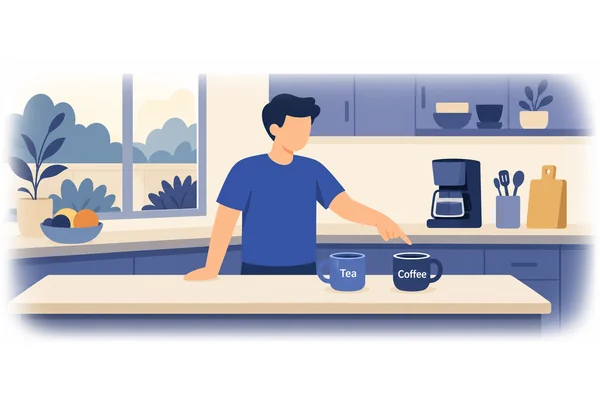
Would you like tea or coffee? I'd like coffee, please.
Ellipsis omitting repeated noun · Polite request
When to use it
Everyday Conversation
Use substitution and ellipsis to sound natural when responding to questions. Avoid repeating the whole verb phrase.
"Do you like this book?" "Yes, I do." (not "Yes, I like this book.")
Writing & Essays
Use ellipsis and substitution to avoid repetition and make your writing flow better. This shows advanced English skills.
"Tom finished his work, and Maria did too." (not "Tom finished his work, and Maria finished her work.")
Comparing People
Use substitution with pronouns when talking about multiple people doing the same thing. It sounds more natural.
"He studies hard, and she does as well." (not "He studies hard, and she studies hard.")
Signal words
too
also
as well
so
neither
nor
either
instead
however
but
Common Mistakes
✕
Wrong
Sarah loves swimming, and her brother loves swimming too.
✓
Correct
Sarah loves swimming, and her brother does too.
Use 'does' to substitute 'loves swimming' instead of repeating the verb phrase. This is called verb substitution.
✕
Wrong
I want to go to the party, but my parents don't want to go to the party.
✓
Correct
I want to go to the party, but my parents don't want to.
Use ellipsis to omit the infinitive 'go to the party' after 'want to'. Keep only 'want to'.
✕
Wrong
Tom passed the exam, and also Maria passed the exam.
✓
Correct
Tom passed the exam, and so did Maria.
Use 'so did Maria' to substitute the entire verb phrase instead of repeating 'passed the exam'.
✕
Wrong
She asked me if I liked pizza, and I said I liked pizza.
✓
Correct
She asked me if I liked pizza, and I said I did.
Use the auxiliary verb 'did' to substitute the main verb 'liked' in short answers and affirmative responses.
✕
Wrong
My teacher gave me homework yesterday, and the teacher gave me homework today.
✓
Correct
My teacher gave me homework yesterday, and she gave me homework today.
Use the pronoun 'she' instead of repeating 'my teacher'. This is substitution, not ellipsis.
✕
Wrong
Do you want coffee? Yes, I want coffee.
✓
Correct
Do you want coffee? Yes, I do.
In short answers, use 'do' to substitute the main verb instead of repeating the whole phrase.
✕
Wrong
He enjoys reading books, and his sister enjoys reading books as well.
✓
Correct
He enjoys reading books, and his sister does too.
Use 'does' (auxiliary) to substitute the verb phrase 'enjoys reading books'.
KEY TAKEAWAYS
What to Remember
- Use ellipsis to omit repeated words in coordinated clauses, but keep the first mention clear.
- Replace repeated nouns with pronouns like "he," "she," "it," or "one" to avoid repetition.
- Don't omit auxiliary verbs; use them as substitutes instead: "I haven't finished, but she has."
- Remove words only when context makes the meaning absolutely clear to your reader.
- Avoid substituting verbs with "do/does/did" unless it's in comparative or emphatic structures.