What is Ellipsis?
Ellipsis is when we omit (leave out) words from a sentence because they are already understood from context. This is very common in English, especially in conversations and informal writing. Instead of repeating the same words, we can use ellipsis to make our sentences shorter and more natural. Understanding ellipsis helps you sound more like a native speaker.
Examples — page 1 of 3
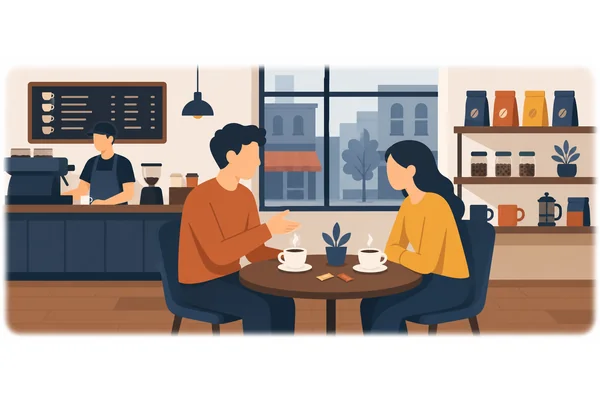
A: Do you like coffee? B: Yes, I do.
Conversation · Verb ellipsis

She went to the party, and so did her brother.
Everyday speech · Auxiliary verb omitted

I can speak Spanish, but he can't.
Comparison · Negative ellipsis

Some students prefer online classes; others prefer in-person ones.
Formal writing · Noun substitution

He's taller than his sister (is).
Comparison · Verb omitted

A: Who finished the project? B: Sarah did.
Question-answer · Verb substitution

I'll have a coffee, and she'll have a tea.
Restaurant order · Repeated verb omitted

The old house was beautiful; the new one is modern.
Descriptive writing · Noun replaced

Maria loves swimming, but her sister doesn't.
Opinion sharing · Auxiliary ellipsis

If you need help, call me. If not, don't worry.
Conditional · Subject and verb omitted
When to use it
Conversation Replies
In short answers, we often omit the main verb and keep only the auxiliary. This sounds natural and is very common in spoken English.
"Do you like tea?" "Yes, I do." (omit: like tea)
Comparisons
When comparing two things, we leave out repeated words to avoid redundancy. The omitted part is always clear from context.
"She's younger than he [is]." "My phone is better than yours [is]."
Coordinating Clauses
When joining sentences with 'and' or 'but', we can omit the subject and verb if they're the same as the first clause.
"He plays guitar, and [he plays] piano too." "I like tea, but [I don't like] coffee."
Question-Answer Pairs
In responses to questions, we often drop the main verb and key nouns when they're already mentioned in the question.
"Who ate the cake?" "Tom did [eat the cake]." "Which one do you prefer?" "The blue one [do I prefer]."
Formal Writing
In essays and official documents, ellipsis helps avoid repetition and makes sentences flow smoothly while remaining clear.
"Some students prefer maths; others [prefer] languages." "The old system had many problems; the new one [has] none [of them]."
Signal words
and
but
or
nor
so
too
either
neither
if not
do
does
did
can
will
would
have
has
had
KEY TAKEAWAYS
What to Remember
- Ellipsis omits understood words from context to avoid repetition and make sentences shorter and more natural.
- In conversations, we often omit subject pronouns, auxiliaries, and repeated words that the listener already understands.
- Common ellipsis patterns include omitting the verb in comparisons: "She works harder than he does."
- Ellipsis is informal and conversational; use complete sentences in formal writing unless the meaning is completely clear.
- Be careful not to omit words that change the sentence meaning or create confusion for your reader.