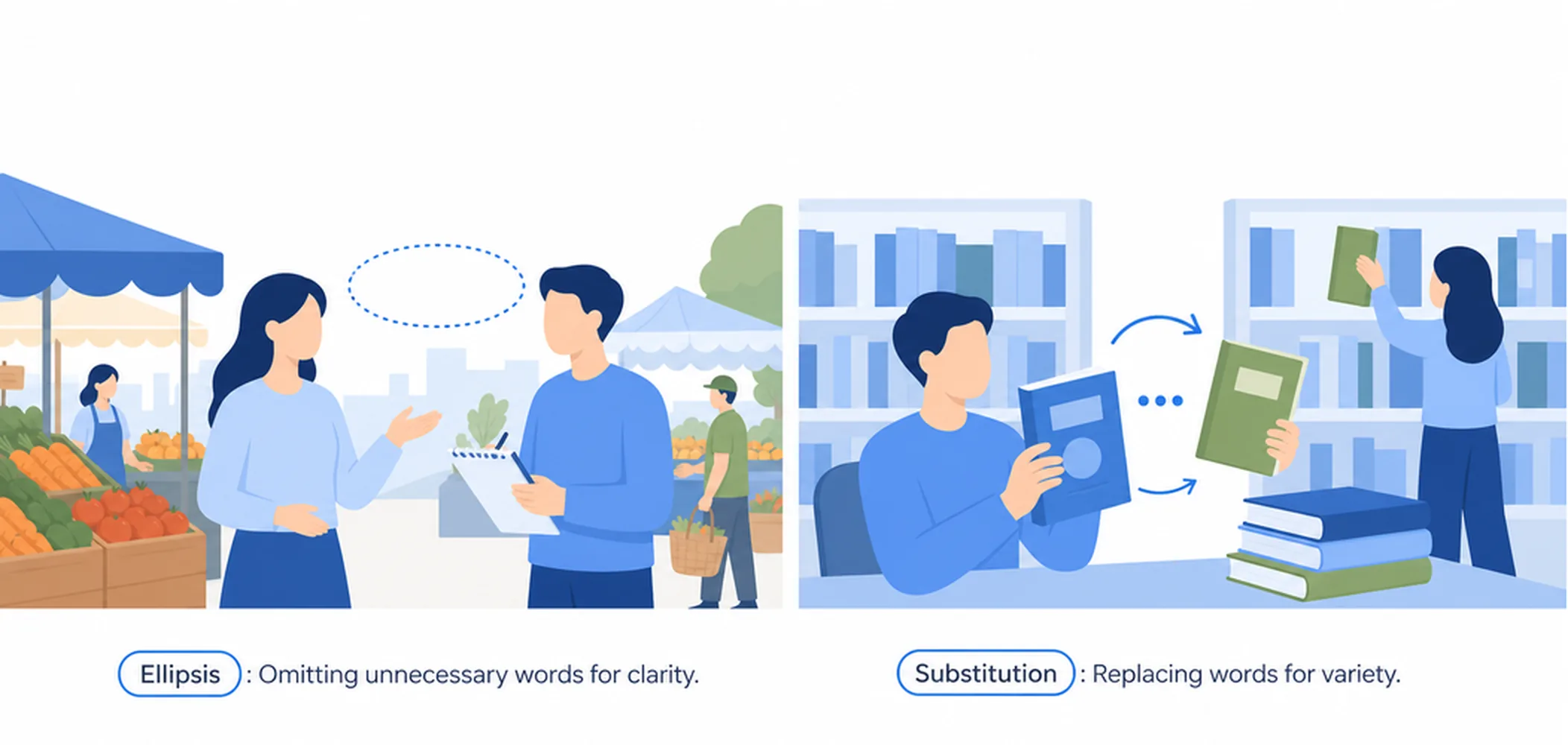
What is Ellipsis?
Ellipsis means leaving out words that are already understood from the context. Instead of repeating the same words, we omit them to avoid repetition and make writing more concise. This is very common in English, especially when the missing words are obvious to the reader. For example, if someone asks 'Do you like coffee?', you can answer 'Yes, I do' instead of 'Yes, I like coffee' — the verb 'like' and object 'coffee' are understood and don't need to be repeated.
What is Substitution?
Substitution is when we replace a word or phrase with another word (usually a pronoun or auxiliary verb) to avoid repetition. Common substitutions include using pronouns like 'it', 'they', or 'one' instead of repeating a noun, or using 'do' instead of repeating an entire verb phrase. For instance, instead of writing 'My sister plays tennis and my brother plays tennis too,' you can write 'My sister plays tennis and my brother does too' — the word 'does' substitutes the whole phrase 'plays tennis.'
Why Use Ellipsis and Substitution?
Using ellipsis and substitution makes your writing clearer, smoother, and more natural. It helps you avoid awkward repetition and makes sentences easier to read. These techniques are especially useful when comparing or contrasting ideas, listing items, or responding to questions. Professional and natural writing relies heavily on these skills, so they are important to master at B1 level and beyond.
Ellipsis vs Substitution: What's the Difference?
| Dimension | Ellipsis | Substitution |
|---|---|---|
| Definition | The omission of one or more words that are understood from the context and do not need to be repeated. | The replacement of a word or phrase with a pro-form (e.g., a pronoun or substitute word) to avoid repetition while keeping the slot filled. |
| Method | Words are left out entirely; nothing replaces them. The sentence is grammatically shorter. | Words are swapped out for a stand-in item (e.g., one, ones, do so, the same). The grammatical slot remains occupied. |
| Form | Results in a structurally reduced or incomplete-looking clause where the missing element is recoverable from prior text. | Results in a complete clause structure; the substitute word (pro-form) holds the syntactic position of the original item. |
| Positive Example | "Sarah passed her exam and Tom did too." → Full form: "Tom passed his exam too." The verb phrase passed his exam is omitted after did. Pure ellipsis: "She can swim and he can [swim] too." — the word swim is simply dropped. | "I need a red pen. Do you have one?" — one substitutes for a red pen, filling the noun slot. |
| Negative Example | "He wanted to leave but she didn't [want to leave]." — The bracketed portion is elided in the negative construction. | "He wanted to leave early but she didn't want to do so." — do so substitutes for leave early. |
| Question Example | "Will you come to the party?" "I might [come to the party]." — The main verb phrase is elided in the reply. | "Will you come to the party?" "I might do so." — do so substitutes for the action come to the party. |
| Effect on the Sentence | Creates economy and brevity; makes prose feel tight and natural. Can occasionally risk ambiguity if context is unclear. | Maintains sentence completeness and flow; explicitly signals reference back to the original item. Slightly less elliptical in style but equally cohesive. |
| Types | Nominal ellipsis (omitting a noun phrase), verbal ellipsis (omitting a verb phrase), clausal ellipsis (omitting an entire clause). | Nominal substitution (one / ones), verbal substitution (do / do so / do the same), clausal substitution (so / not — e.g., "I think so"). |
| Key Signal Words / Markers | Auxiliary verbs standing alone (can, will, should, did, might); coordinating conjunctions (and, but, or) preceding the gap; to-infinitive without the main verb (want to). | one, ones, do so, do the same, so, not, the former, the latter, such |
| When to Use | Use when the omitted element is completely obvious from context and its removal makes writing feel natural, concise, and uncluttered — especially in dialogue, responses, and parallel structures. | Use when you want to avoid repetition but still need to keep the grammatical slot filled for clarity, completeness, or stylistic balance — especially in formal or complex prose. |
| Cohesion Role | Creates cohesion through absence — the reader mentally retrieves the missing information from earlier in the text. | Creates cohesion through reference — the substitute word explicitly points back to the antecedent, guiding the reader's attention. |
Examples





What to Remember
- Use ellipsis to avoid repeating words that are already clear from context.
- Omit understood verbs, objects, or other words to make writing more concise.
- Common ellipsis pattern: answer yes/no questions with auxiliary verb only (Yes, I do).
- Substitution replaces words with pronouns or other words instead of omitting them.
- Ensure omitted words are obvious to readers; don't create confusion or ambiguity.