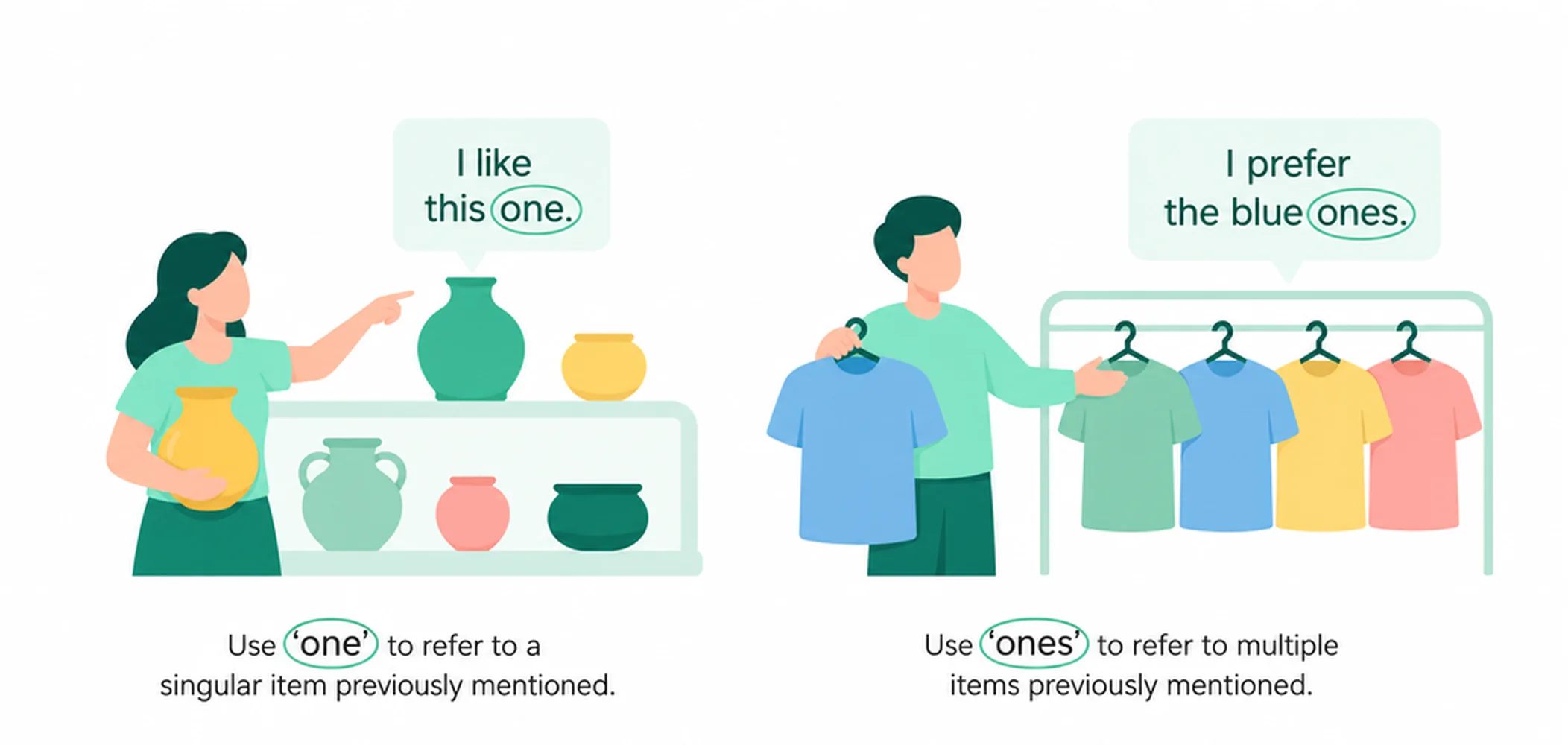
What are 'one' and 'ones'?
'One' and 'ones' are pronouns that replace countable nouns to avoid repeating the same word. We use 'one' for singular nouns and 'ones' for plural nouns. This substitution makes your sentences shorter and more natural. For example, instead of saying 'I like this coffee and that coffee,' you can say 'I like this coffee and that one.'
When to use 'one' and 'ones'
Use 'one' or 'ones' when the noun is already clear from context. The noun should be countable (like 'book,' 'car,' 'idea'), not uncountable (like 'water' or 'information'). You can use adjectives before 'one' or 'ones' to describe which noun you mean. For example: 'I want the red one' or 'These are the best ones.' This is very common in spoken English and informal writing.
Important rules to remember
Do not use 'one' or 'ones' if the noun is not clear. Never use them with uncountable nouns. You can combine 'one/ones' with demonstratives (this, that, these, those), possessives (my, your, his), or relative clauses (who, that). For example: 'the one I like,' 'my ones,' 'those ones.' The article 'the' is often used before 'one' or 'ones' to make the reference specific.
How Substitution Works: The Formula
↑ "one" replaces the singular noun bag
↑ "ones" replaces the plural noun shoes
↑ "one" replaces the singular noun book
Examples

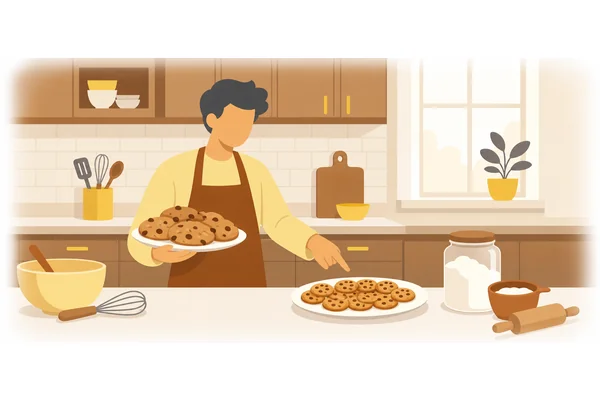




What to Remember
- Use 'one' for singular countable nouns and 'ones' for plural countable nouns to avoid repetition.
- Only use 'one' or 'ones' when the specific noun is already clear from the previous context.
- Never use 'one' or 'ones' to replace uncountable nouns like water, information, or furniture.
- The noun being replaced must be countable, such as book, car, idea, or person.
- One and ones make sentences shorter and more natural by eliminating unnecessary noun repetition.