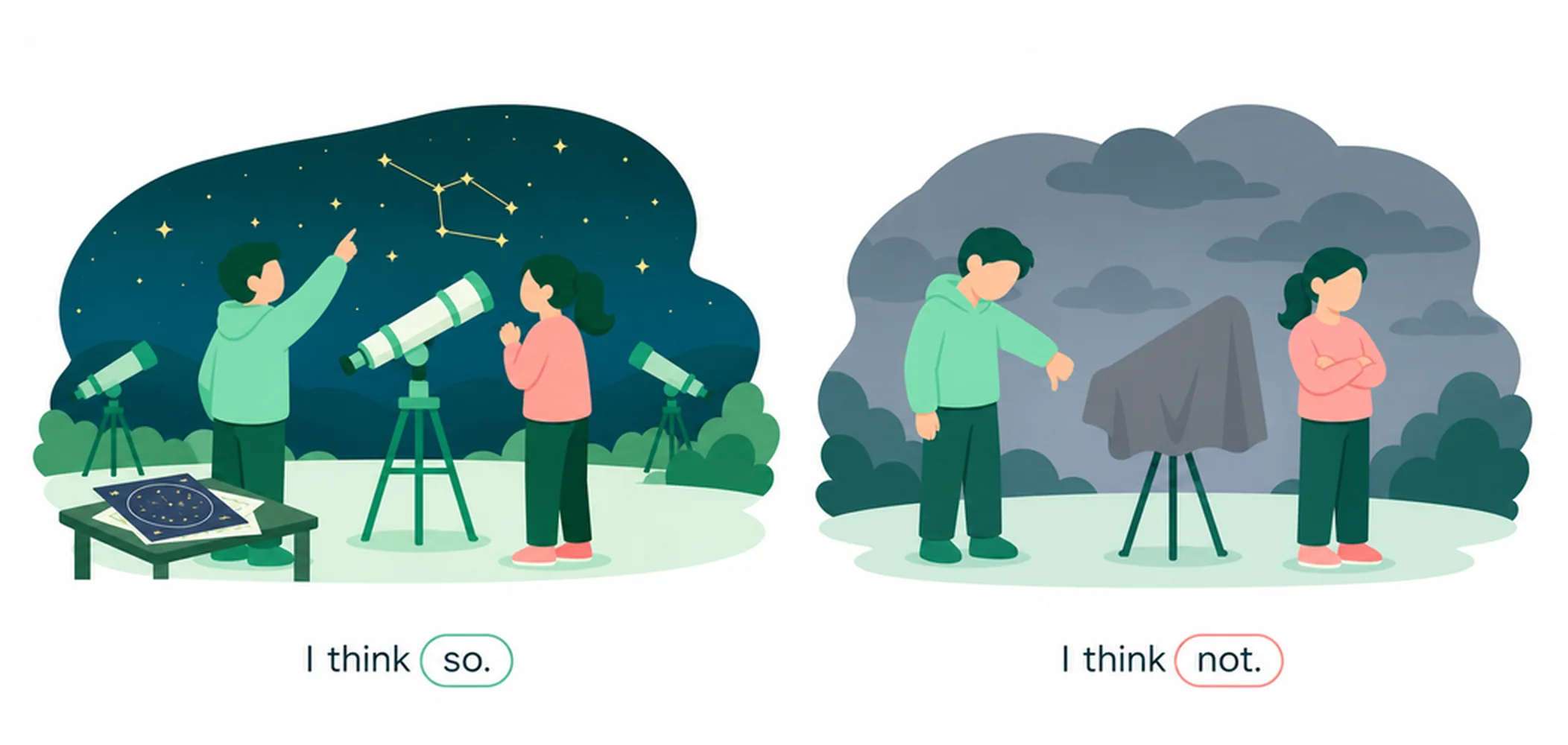
What is Substitution with So and Not?
Substitution with 'so' and 'not' is a grammar technique that helps you avoid repeating long noun clauses. Instead of repeating the same idea, you can replace it with the word 'so' (for positive statements) or 'not' (for negative statements). This makes your speech and writing shorter and more natural. For example, instead of saying "I think that it will rain tomorrow," you can simply say "I think so."
Using 'So' as a Substitute
Use 'so' to replace a positive noun clause after certain verbs. The most common verbs are: think, believe, suppose, expect, hope, imagine, guess, assume, and say. The pattern is: verb + so. For example: "Will you be at the party?" "Yes, I think so." Here, 'so' replaces the clause "that I will be at the party." This substitution is very common in spoken English and makes conversations more efficient.
Using 'Not' as a Substitute
Use not as a substitute to replace a negative noun clause. The pattern is: verb + not. However, in modern English and everyday conversation, we typically use so combined with the negative form of the verb instead of not alone.
| Question | Response with 'So' | Response with 'Not' (Formal) |
|---|---|---|
| Do you think it will snow? | No, I don't think so. | No, I think not. (rare) |
| Do you believe they will come? | No, I don't believe so. | No, I believe not. (rare) |
| Is she arriving tomorrow? | No, I don't suppose so. | No, I suppose not. (formal) |
In contemporary English, the construction don't think so is far more common and natural than think not. While suppose not and believe not may appear in formal or literary contexts, they sound archaic in everyday speech. Use the pattern don't + verb + so for natural, idiomatic responses.
So vs Not: Side-by-Side Comparison
| Category | Substitution with SO | Substitution with NOT |
|---|---|---|
| Form | Reporting verb + so Replaces an affirmative that-clause with the word so. |
Reporting verb + not Replaces a negative that-clause with the word not. |
| When to Use | Used to avoid repeating a full clause when the speaker believes, expects, or assumes something to be true or affirmative. | Used to avoid repeating a full clause when the speaker believes, expects, or assumes something to be false or negative. |
| Compatible Reporting Verbs | think, believe, hope, expect, suppose, imagine, guess, reckon, assume, fear, be afraid | think, believe, hope, expect, suppose, imagine, guess, reckon, assume, fear, be afraid Note: hope and be afraid use not exclusively for negation (not hope so not). |
| Positive Example | "Is the shop open?" → "I think so." Full clause equivalent: "I think that the shop is open." |
"Is the shop open?" → "I think not." Full clause equivalent: "I think that the shop is not open." |
| Negative Example | "Will it rain?" → "I hope so." / "I expect so." Full clause equivalent: "I hope that it will rain." |
"Will it rain?" → "I hope not." / "I expect not." Full clause equivalent: "I hope that it will not rain." |
| Question Example | "Did they pass the exam?" → "I believe so." Full clause equivalent: "I believe that they passed the exam." |
"Did they pass the exam?" → "I believe not." Full clause equivalent: "I believe that they did not pass the exam." |
| Two Negative Structures | Some verbs allow negation of the reporting verb instead: "I don't think so." (more common in informal speech) Equivalent to: "I think not." |
The verb itself can be negated as an alternative: "I don't think so." ↔ "I think not." Both are acceptable, but don't think so is more common in everyday English. |
| Verbs Where NOT Is Preferred | With hope and be afraid, the negative cannot be formed by negating the reporting verb: ✗ "I don't hope so." (ungrammatical) ✓ "I hope so." (affirmative only) |
With hope and be afraid, not is the only correct negative form: ✓ "I hope not." ✓ "I'm afraid not." ✗ "I don't hope so." (ungrammatical) |
| Register / Tone | I think so, I hope so, I suppose so — neutral to informal; very common in everyday spoken English. | I think not, I suppose not — can sound more formal or emphatic; I hope not and I'm afraid not are common in both formal and informal contexts. |
| Key Signal Words | so (replaces an affirmative clause); signalled by a yes/no question or affirmative context. | not (replaces a negative clause); signalled by a yes/no question or negative context where the speaker expects/fears a negative outcome. |
| Key Difference: So substitutes for an affirmative that-clause (the speaker believes something IS the case), while not substitutes for a negative that-clause (the speaker believes something is NOT the case). For most reporting verbs (e.g., think, suppose, believe), the negative meaning can be expressed either by using not after the verb ("I think not") or by negating the reporting verb itself ("I don't think so") — both are correct and equivalent. However, for hope and be afraid, only the not form is grammatically possible for the negative ("I hope not" / "I'm afraid not"), making the choice between so and not especially important with these two verbs. | ||
Examples






What to Remember
- Use 'so' to replace positive noun clauses after verbs like think, believe, hope, and expect.
- Use 'not' to replace negative noun clauses after the same verbs: "I don't think so."
- Say 'I think so' instead of repeating the entire noun clause to avoid repetition.
- 'So' and 'not' substitute for the complete noun clause, not just the main verb.
- Don't use 'so' or 'not' after all verbs; they only work with specific reporting verbs.