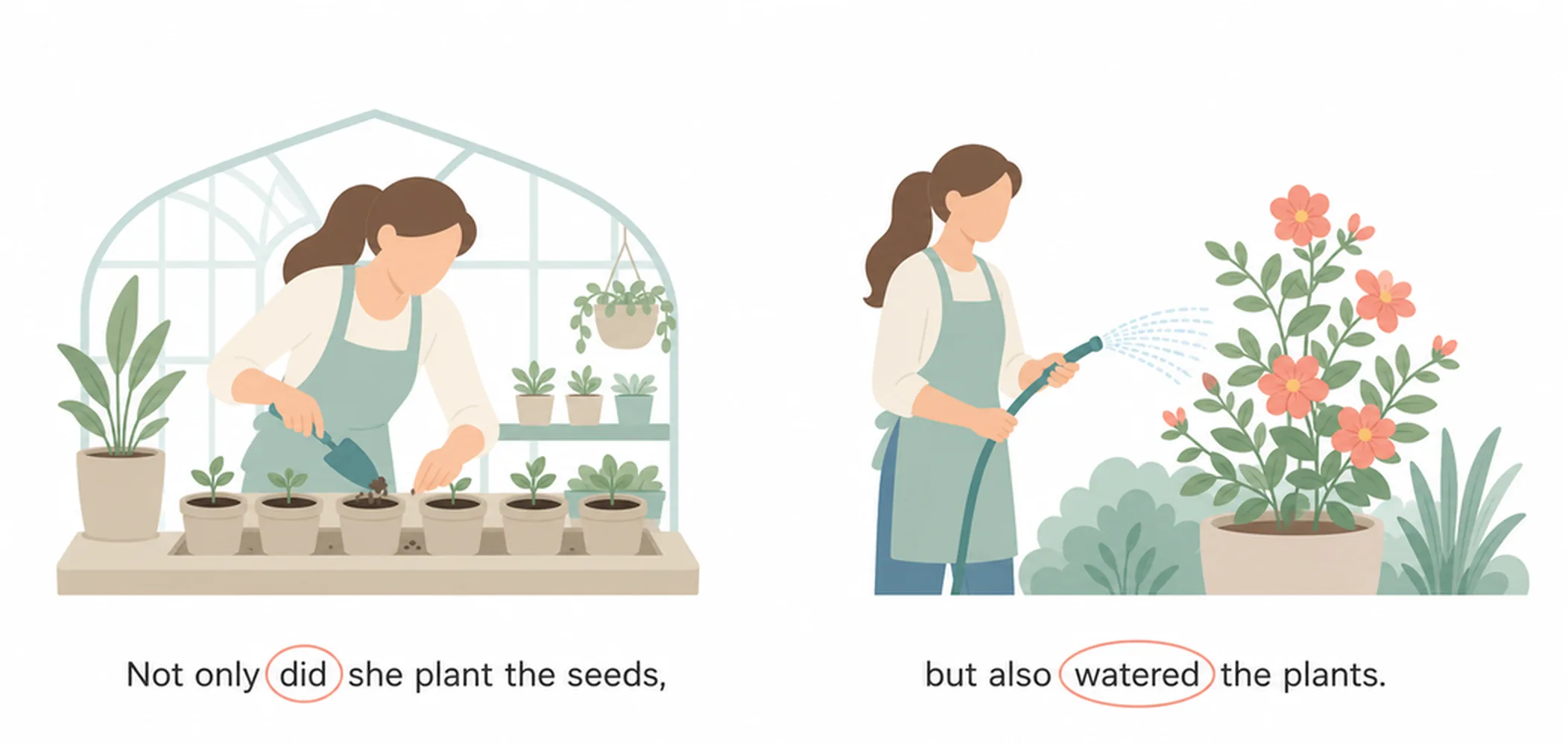
What is Inversion After 'Not Only...But Also'?
Inversion means changing the normal word order of a sentence. When we use 'not only...but also' at the beginning of a sentence, we often invert the subject and auxiliary verb to create emphasis and a more formal tone. This is a common technique in academic and professional English. The structure helps us highlight important information and make our writing more dramatic or impressive.
When Do We Use Inversion?
Inversion happens when 'not only' starts the sentence. We move the auxiliary verb (be, have, do, will, etc.) before the subject. This creates a more emphatic statement. Without inversion, the sentence is still correct but less formal. Inversion is optional—you can choose to use it for greater effect. It is especially common in formal writing, speeches, and when you want to emphasize a point strongly.
Important: The Second Part Doesn't Invert
Remember: only the first part (after 'not only') inverts. The second part after 'but also' follows normal word order. This creates a balanced, symmetrical structure. The 'but also' clause is there to add extra information and maintain the parallel structure of the sentence.
Inversion vs. No Inversion: Side-by-Side Comparison
| Mid-Sentence Position (No Inversion — Normal Word Order) |
Fronted Position (With Inversion — Formal / Emphatic) |
|
|---|---|---|
| Form |
Subject + verb + not only … but also + second element
Normal subject–verb order is kept throughout.
|
Not only + auxiliary/modal + subject + main verb … but (subject) also + second element
The auxiliary moves before the subject in the first clause (subject–auxiliary inversion).
|
| When to Use | Everyday speech and informal writing. Used when not only…but also connects two elements within a sentence without special emphasis. | Formal writing, speeches, academic or literary contexts. Used when the speaker/writer wants to add strong emphasis or dramatic effect by placing not only at the very beginning of the clause. |
| Positive Example |
She not only speaks French but also writes it fluently.
→ Subject she comes before both verbs; word order unchanged.
|
Not only does she speak French, but she also writes it fluently.
→ Auxiliary does moves before she in the first clause.
|
| Negative Example |
The policy not only failed to reduce costs but also did not improve efficiency.
→ Negation is placed naturally inside each clause; no inversion needed.
|
Not only did the policy fail to reduce costs, but it also did not improve efficiency.
→ Did inverts with the policy; the second clause keeps normal order.
|
| Question Example |
Did you know that the team not only won the tournament but also broke the record?
→ Inversion appears only in the main question; the not only…but also clause stays normal.
|
Did you know that not only did the team win the tournament, but they also broke the record?
→ The fronted not only clause uses its own inversion (did + subject) inside the reported context.
|
| Key Signal Words / Triggers |
not only…but also, not only…but…as well, not only…but…too
Position: mid-sentence, after the subject of the clause.
|
Not only (at the very start of a clause), but also / but … also
Position: sentence-initial or clause-initial. A comma usually separates the two clauses.
|
Examples






What to Remember
- Use inversion when 'not only' starts a sentence to create emphasis and a more formal tone.
- Move the auxiliary verb before the subject after 'not only' at the beginning of sentences.
- You need an auxiliary verb (be, have, do, will) to invert; main verbs alone cannot invert.
- The structure is: Not only + auxiliary verb + subject + main verb + rest of sentence.
- Inversion after 'not only' is common in academic and professional writing for dramatic effect.