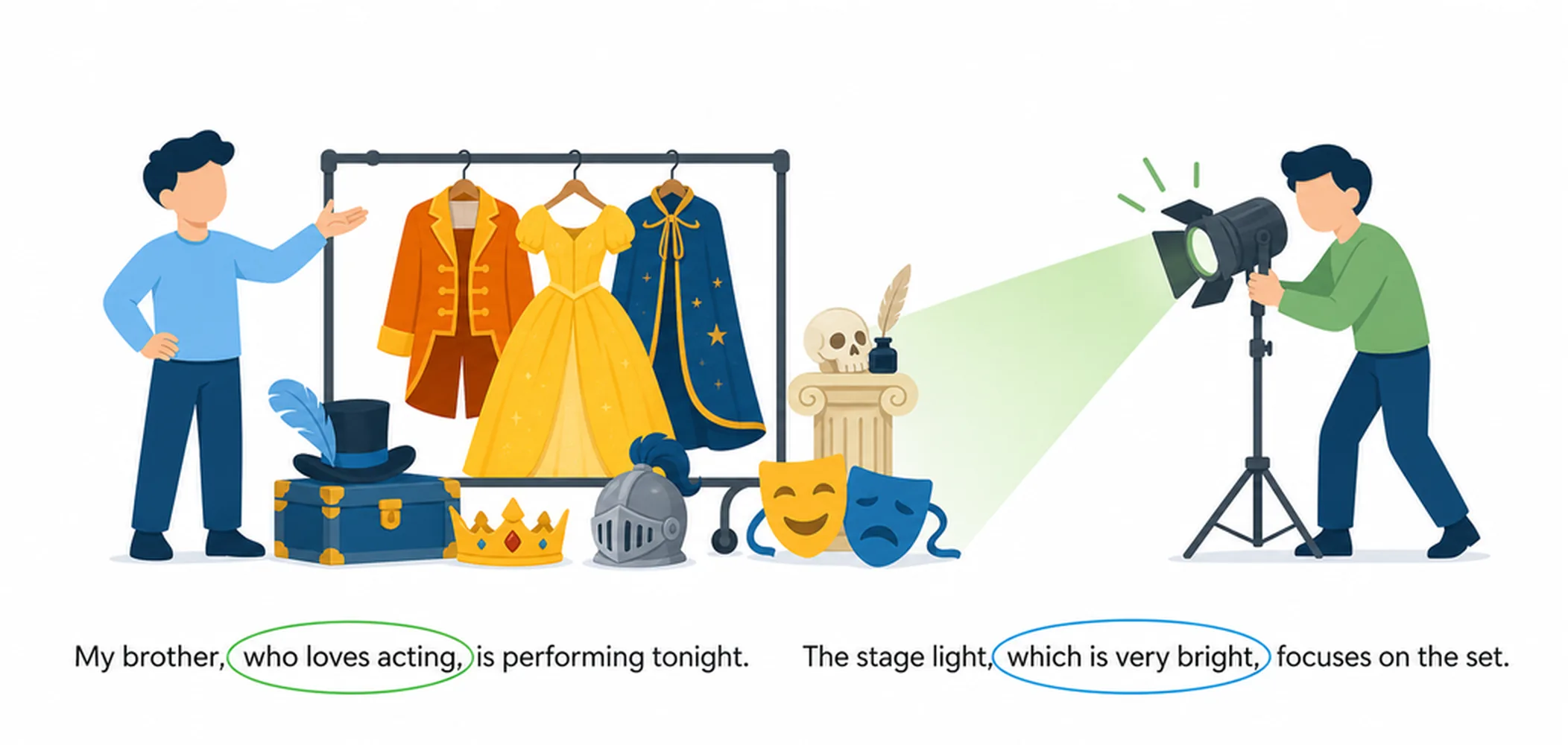
What are non-defining relative clauses?
A non-defining relative clause gives extra information about a noun. The noun is already specific and identified, so the clause adds details rather than defines it. Non-defining clauses are always separated by commas. For example: 'My sister, who lives in Paris, is a doctor.' We already know which sister—she is identified by being 'my sister'—so the clause 'who lives in Paris' adds extra information but doesn't define which sister we mean.
Non-defining vs. defining clauses
This is the key difference: defining clauses have NO commas and tell us which person or thing we are talking about. Non-defining clauses HAVE commas and give optional extra information. Compare: 'The student who finished first won a prize' (defining—tells us which student) and 'Tom, who finished first, won a prize' (non-defining—Tom is already identified, and 'who finished first' is extra information).
Relative pronouns in non-defining clauses
Use who for people, which for things and animals, and whose for possession. Important: in non-defining clauses, you cannot use 'that' as a relative pronoun. You must use who, which, or whose. You can also use where for places and when for times. Example: 'The café, which opened last year, is very popular' (correct) not 'The café, that opened last year, is very popular' (incorrect).
Defining vs. Non-Defining Relative Clauses: Side-by-Side Comparison
| Feature | Defining Relative Clauses | Non-Defining Relative Clauses |
|---|---|---|
| Form | Relative clause placed directly after the noun it modifies, without commas separating it from the rest of the sentence. | Relative clause placed after the noun it modifies, separated by commas (or dashes/parentheses in informal writing). |
| Comma Usage | No commas used. The clause is integral to the sentence structure and flows without a pause. | Commas required before and after the clause (unless the clause ends the sentence, in which case only a comma before it is needed). |
| Pronoun Choices | who, whom, which, that, whose, when, where — notably, that is commonly used and the relative pronoun can be omitted when it is the object of the clause. | who, whom, which, whose, when, where — that cannot be used, and the relative pronoun cannot be omitted. |
| Removability of the Clause | Cannot be removed without losing essential meaning. The clause identifies which person or thing is being discussed, making it grammatically and semantically necessary. | Can be removed without changing the core meaning of the sentence. The clause adds extra, supplementary information about a noun already clearly identified. |
| Effect on Meaning | Restricts or defines the noun — it narrows down which specific person, thing, or place is meant out of a larger group. Without the clause, the sentence becomes ambiguous or incomplete. | Adds extra detail — it provides additional, non-essential information about a noun already uniquely identified. Removing the clause leaves the main meaning intact. |
| Positive Example | The student who studies every night always passes her exams. (Identifies a specific student among many.) |
Maria, who studies every night, always passes her exams. (Maria is already identified; the clause simply adds information.) |
| Negative Example | The car that he bought last year doesn't start in cold weather. (Specifies which car out of potentially several.) |
His old Volkswagen, which he bought last year, doesn't start in cold weather. (The car is already uniquely identified by name.) |
| Question Example | Is the restaurant that opened last month still busy? (Defines which restaurant is being asked about.) |
Is Bella Italia, which opened last month, still busy? (The restaurant is already named; the clause provides background.) |
| Key Signal Words / Markers | that, who, which, whose, where, when (no commas); pronoun often omittable; noun is usually non-specific (e.g., a man, the people, the book). | who, which, whose, where, when (always with commas); noun is usually a proper noun or already uniquely identified (e.g., London, my brother, the President). |
| 🔑 Key Difference: A defining relative clause tells us which specific person or thing is meant — without it, we don't know who or what is being discussed. A non-defining relative clause adds bonus information about someone or something already clearly identified — it is always separated by commas, can never use that, cannot drop the relative pronoun, and can be removed from the sentence without changing its essential meaning. | ||
Examples






What to Remember
- Non-defining relative clauses add extra information about a noun that is already identified.
- Always separate non-defining clauses with commas before and after the clause.
- The noun in a non-defining clause is specific and already known to the reader.
- Defining clauses identify which noun you mean, while non-defining clauses just add details.
- Common mistake: don't use commas with defining clauses, only with non-defining clauses.