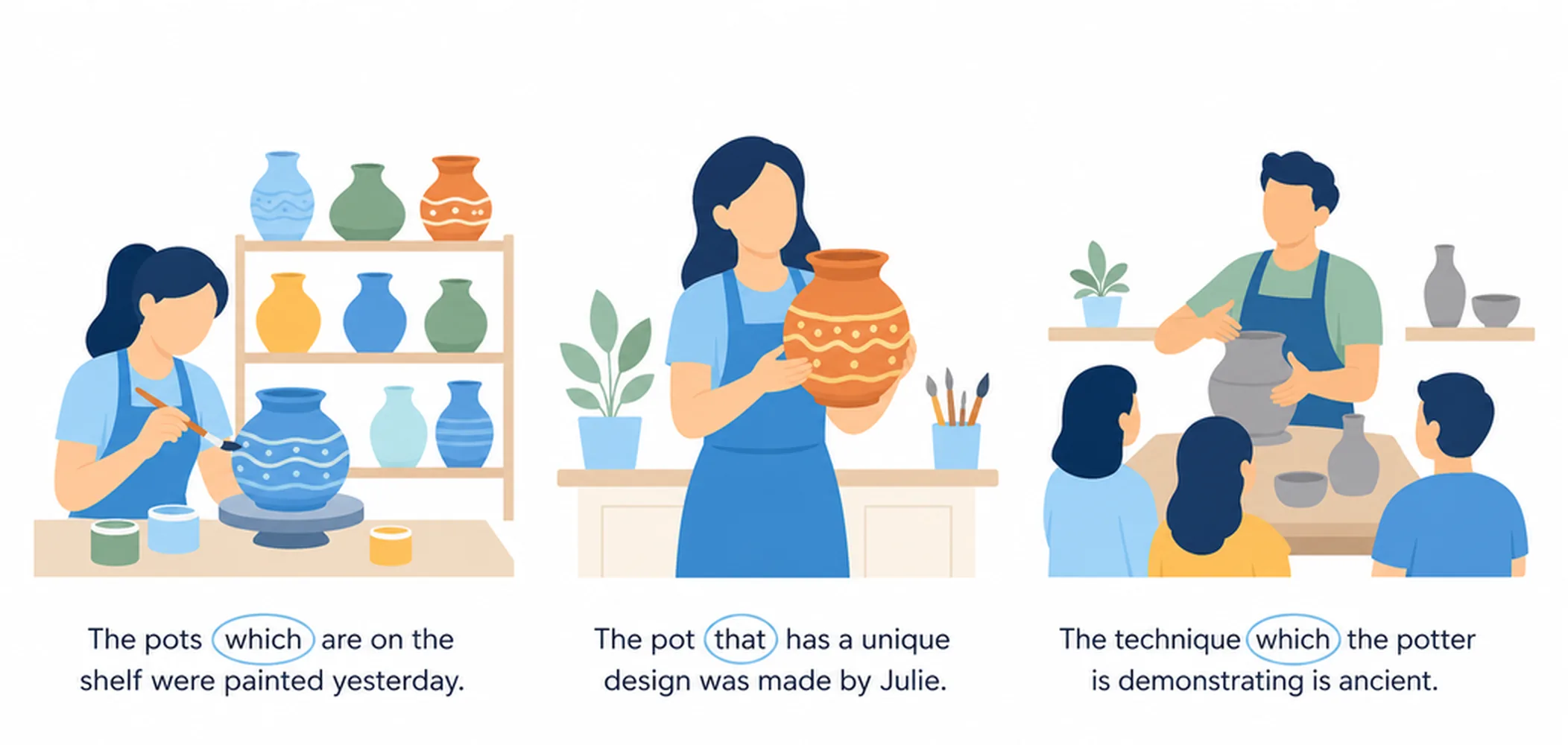
What are defining relative clauses?
A defining relative clause gives essential information about a noun. It tells us which person, thing, or group we are talking about. Without this clause, the sentence is unclear or incomplete. Defining relative clauses are very common in English and help us describe and identify specific nouns.
How to form defining relative clauses
Defining relative clauses start with a relative pronoun: who (for people), which (for things), or that (for people or things). The relative pronoun acts as the subject or object in the clause. We do not use commas with defining relative clauses because the information is necessary. The clause comes immediately after the noun it describes.
When to use who, which, or that
Use 'who' for people: the woman who works here. Use 'which' for things: the car which is red. Use 'that' for both people and things, especially in informal English: the student that passed the exam. In formal writing, 'that' is common for things. Many English speakers use 'that' for both in everyday conversation, but 'who' and 'which' are more formal and precise.
Defining vs Non-Defining Relative Clauses
| Feature | Defining Relative Clauses | Non-Defining Relative Clauses |
|---|---|---|
| Form | Main clause + relative pronoun/adverb + defining clause. No commas are used around the clause. | Main clause + comma + relative pronoun/adverb + extra-information clause + comma (or end of sentence). Commas are required. |
| Purpose / When to Use | Use to identify which specific person, thing, or place you mean. The clause is essential — without it, the sentence loses its specific meaning or becomes unclear. | Use to add extra, supplementary information about a noun that is already clearly identified. The clause is not essential to understanding which noun is meant. |
| Punctuation | No commas. The relative clause is written directly after the noun with no punctuation separating it from the main clause. | Commas required. The clause is enclosed by commas (or a comma and a full stop/period if it ends the sentence), like a parenthetical remark. |
| Omissibility | Cannot be omitted. Removing the clause changes the meaning significantly or makes the sentence too vague. E.g. "The man is my uncle" — which man? | Can be omitted without affecting the core meaning. The sentence remains clear and grammatically complete without the relative clause. |
| Relative Pronouns Used | who, whom, whose, which, that — Notably, "that" is commonly used and is often preferred in informal English. The relative pronoun can also be omitted when it is the object of the clause (e.g. "The book I read…"). | who, whom, whose, which — "That" cannot be used, and the relative pronoun can never be omitted. It must always be stated explicitly. |
| Positive Example | "The woman who lives next door is a doctor." (Tells us which woman — essential information.) | "My sister, who lives next door, is a doctor." (We already know which person — "my sister" — so the clause just adds extra detail.) |
| Negative Example | "The students who didn't study failed the exam." (Only the students who didn't study failed — others may have passed.) | "The students, who hadn't studied enough, failed the exam." (All the students failed; the clause simply explains a contributing reason.) |
| Example with "which" / "that" | "The car that/which broke down belongs to Paul." ("That" or "which" are both acceptable here.) | "Paul's car, which broke down, is now repaired." ("That" is NOT possible here; only "which" can be used.) |
| Effect on Meaning | Restricts and narrows the meaning of the noun. It distinguishes one specific group or item from all others of the same type. | Adds information but does not restrict or narrow meaning. The noun is already fully identified; the clause merely enriches our knowledge about it. |
| Use with Proper Nouns & Unique References | Not used with proper nouns or unique references (e.g. names of specific people, countries, one-of-a-kind titles), because these are already uniquely identified. | Commonly used with proper nouns and unique references. E.g. "Paris, which is the capital of France, attracts millions of tourists." |
| Key Signal Words / Relative Adverbs | who, that, which, whose, whom, where, when, why (no commas before them). "That" is a strong signal it is defining. | who, which, whose, whom, where, when (always preceded by a comma). A comma before the pronoun is a strong signal it is non-defining. |
| Spoken English | Very common in both spoken and written English. "That" is especially frequent in casual speech. | Used in both registers, but the parenthetical nature is clearer in writing (via commas). In speech, it is signalled by a slight pause and a change in intonation around the clause. |
| 🔑 Key Difference: A defining relative clause is essential — it tells us which specific noun is meant and cannot be removed without loss of meaning or clarity. It uses no commas and may use "that". A non-defining relative clause is extra — it adds bonus information about a noun we already know, can be removed without changing the core sentence, always requires commas, and can never use "that". The simplest test: remove the clause — if the sentence still makes clear sense and refers to the same specific noun, the clause is non-defining; if the sentence becomes vague or loses its point, the clause is defining. | ||
Examples






What to Remember
- A defining relative clause gives essential information that identifies which specific person, thing, or group you mean.
- Use who for people, which for things, and that for both people and things in defining relative clauses.
- The relative pronoun connects the clause to the noun and acts as the subject or object within it.
- Defining relative clauses are essential to the sentence meaning; without them, the main sentence becomes unclear or incomplete.
- Do not use commas around defining relative clauses because they contain information necessary to identify the noun clearly.