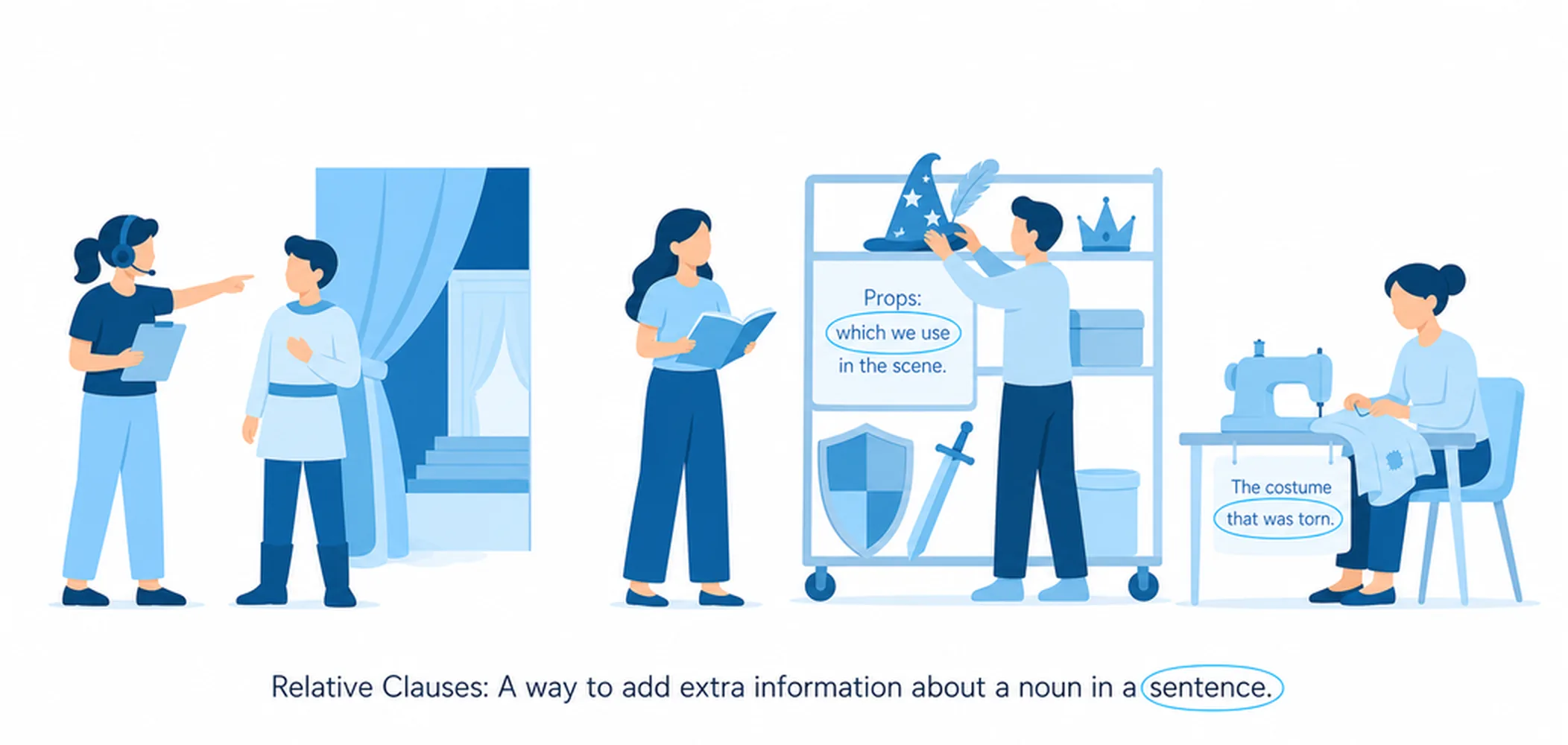
What is a Relative Clause?
A relative clause is a group of words that gives extra information about a noun in a sentence. It starts with a relative pronoun like 'who', 'which', 'that', or 'whose'. The relative clause comes after the noun it describes. It helps us give more details without creating a new sentence. For example, instead of saying 'I know a girl. She speaks five languages,' we can combine them: 'I know a girl who speaks five languages.'
Two Types of Relative Clauses
There are two main types: defining and non-defining relative clauses. A defining relative clause gives essential information about the noun—without it, we wouldn't know which person or thing we mean. For example: 'The student who won the prize was very happy.' Without 'who won the prize', we don't know which student. A non-defining relative clause gives extra, optional information. Commas separate it from the main sentence. For example: 'My brother, who lives in London, is a doctor.' We already know it's your brother; the clause just adds extra details.
Relative Pronouns and When to Use Them
| Pronoun | Use For | Example |
|---|---|---|
| who / that | People | The teacher who helped me was very kind. |
| which / that | Things | The book which I borrowed was interesting. |
| whose | Possession | The girl whose bag was stolen went to the police. |
| where | Places | The café where we met has closed. |
| when | Times | The day when you arrived was special. |
In informal speech, you can often leave out the relative pronoun if it refers to the object of the clause.
The book I borrowed was interesting.
Defining vs Non-Defining Relative Clauses: Side-by-Side Comparison
| Feature | Defining Relative Clause | Non-Defining Relative Clause |
|---|---|---|
| Form | Written without commas. The relative clause follows directly after the noun it modifies: The man [who called] is my uncle. | Written with commas (or dashes/parentheses) to separate the clause from the rest of the sentence: My uncle, who called yesterday, is a doctor. |
| Purpose / Role | Identifies or defines the noun — it tells us which person or thing is being referred to. The clause is essential to the meaning of the sentence. | Adds extra, supplementary information about a noun that is already clearly identified. The clause is optional and parenthetical. |
| Is the information essential? | Yes. Removing the clause changes or destroys the core meaning of the sentence. The reader would not know which specific noun is meant. | No. Removing the clause leaves the sentence grammatically complete and the main meaning intact. The extra detail is simply lost. |
| Comma usage | No commas. The clause is integrated tightly into the sentence with no punctuation separating it from the noun. | Commas required. A comma is placed before the relative pronoun and after the clause (if the sentence continues). Example: , who is very kind, |
| Relative pronouns used | who, whom, whose, which, that. Notably, that is commonly used and accepted in defining clauses. The pronoun can also be omitted when it is the object: The book (that) I read… | who, whom, whose, which. The pronoun that is not used in non-defining clauses. The relative pronoun can never be omitted. |
| Positive example | The student who studies hard will pass the exam. (Tells us which student — only the one who studies hard.) |
Maria, who studies hard, will pass the exam. (Maria is already identified by name; the clause just adds information about her.) |
| Negative example | Students who do not attend classes will fail. (Defines a specific group of students — those who don't attend.) |
Tom, who did not attend the lecture, still passed. (Tom is already known; the clause gives background detail.) |
| Effect of removing the clause | The sentence becomes vague or meaningless. "The student will pass the exam" — we no longer know which student is meant. | The sentence remains clear and complete. "Maria will pass the exam" — the meaning is fully preserved. |
| Can "that" be used? | Yes. That is widely used in defining clauses and is often preferred in informal contexts: The car that I bought… | No. Using that in a non-defining clause is considered grammatically incorrect: ✗ My car, that I bought last year, … |
| Can the pronoun be omitted? | Sometimes. The pronoun may be dropped when it acts as the object of the clause: The film (which/that) we watched was great. | Never. The relative pronoun must always be included: ✗ The film, we watched, was great. |
| Typical noun type | Often used with non-specific, general, or unidentified nouns where the clause is needed to pinpoint the exact referent: a man, the book, students, any car… | Used with specific, already-identified nouns such as proper nouns (names), unique items, or previously mentioned nouns: London, Shakespeare, my mother… |
| Register / Usage | Common in both formal and informal speech and writing. Very frequent in everyday conversation. | More common in formal or written English. In spoken language, speakers may use a pause or a separate sentence instead. |
| 🔑 Key Difference: A defining relative clause is essential — it identifies exactly which person or thing is meant, uses no commas, and can include that. A non-defining relative clause is non-essential — it adds bonus information about an already-identified noun, is always surrounded by commas, never uses that, and can be removed without changing the core meaning of the sentence. | ||
Examples






What to Remember
- A relative clause adds extra information about a noun and starts with who, which, that, or whose.
- Place the relative clause immediately after the noun it describes to keep sentences clear.
- Defining relative clauses give essential information and use no commas; non-defining clauses add extra details with commas.
- Use 'who' for people, 'which' for things, and 'whose' to show possession in relative clauses.
- Relative clauses help combine two simple sentences into one more complex and detailed sentence.