What are sentence patterns?
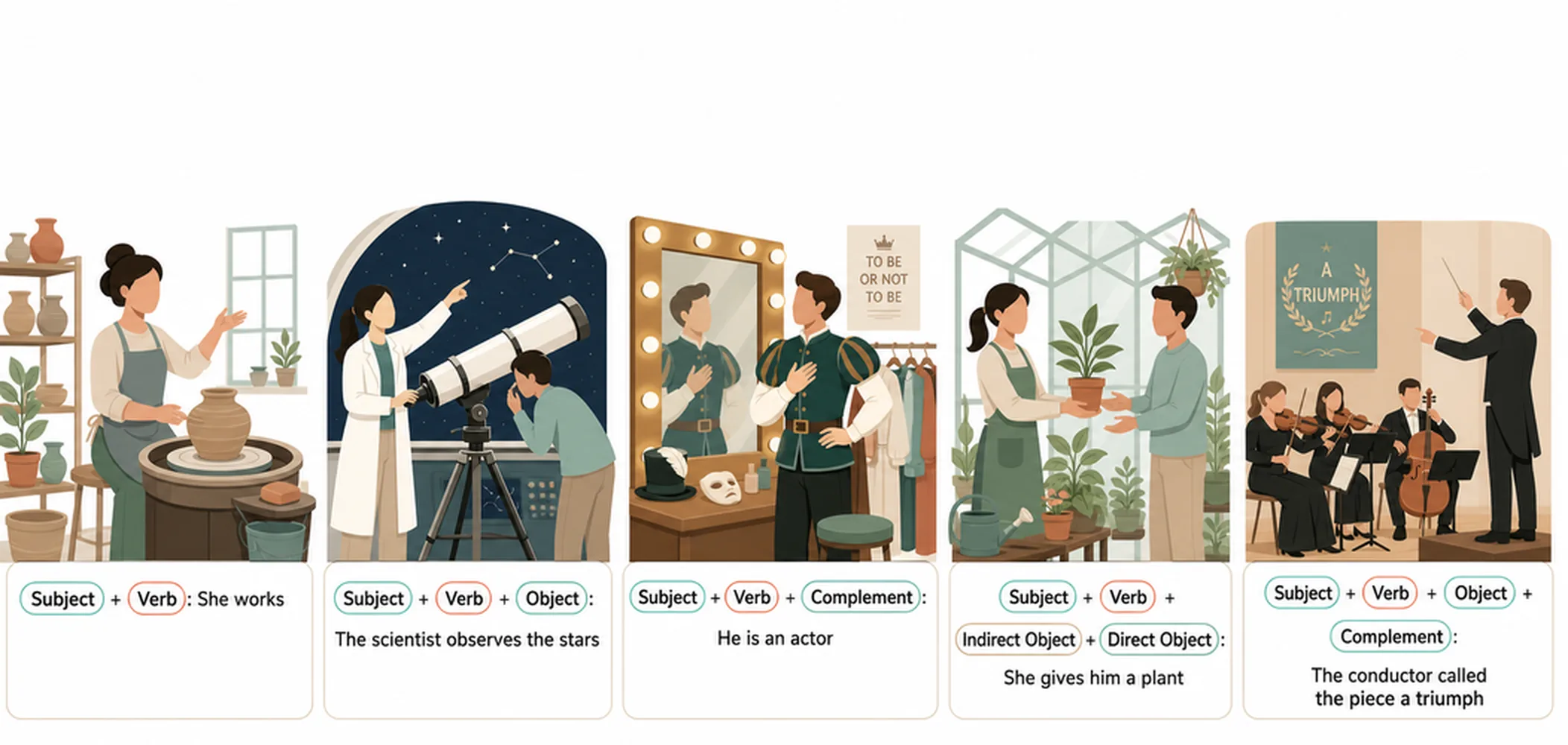
A sentence pattern is the basic structure of a sentence, built around a verb and what follows it. In English, we have five main sentence patterns. Each pattern follows a simple formula: the subject (who or what the sentence is about) plus a verb (the action or state) plus what comes after the verb. These patterns help you build correct sentences and understand how English works. Every English sentence you write or speak will fit into one of these five patterns.
The five sentence patterns explained
Pattern 1 (SV) has only a subject and verb: 'The cat slept.' Pattern 2 (SVO) adds a direct object: 'I love coffee.' Pattern 3 (SVIO) uses an indirect object and direct object: 'She gave me a book.' Pattern 4 (SVC) has a subject complement after a linking verb: 'The weather is cold.' Pattern 5 (SVOC) has both a direct object and an object complement: 'We named our dog Max.' Understanding these patterns helps you write more complex sentences and recognize how words relate to each other.
Why learn sentence patterns?
Sentence patterns are important for grammar accuracy and writing clarity. When you know the pattern, you understand which words are necessary and which are optional. This helps you avoid mistakes and build confidence in speaking and writing. You will also understand more complex sentences by recognizing their basic pattern underneath.
All 5 Sentence Patterns at a Glance
| Feature | SV | SVO | SVIO | SVC | SVOC |
|---|---|---|---|---|---|
| Pattern Code | SV | SVO | SVIO | SVC | SVOC |
| Full Name | Subject + Verb | Subject + Verb + Object | Subject + Verb + Indirect Object + (Direct) Object | Subject + Verb + Complement | Subject + Verb + Object + Complement |
| Structure Breakdown | S + V | S + V + O | S + V + IO + O | S + V + C | S + V + O + C |
| When to Use | When the verb needs no object to complete the meaning (intransitive verbs) | When the action passes from the subject directly to one object (transitive verbs) | When the action involves giving or showing something to someone (ditransitive verbs) | When a linking verb connects the subject to a describing word or noun (no action passes to an object) | When an object complement renames or describes the object after the verb |
| Positive Example | The baby slept. | She reads books. | He gave her a gift. | The soup smells delicious. | They painted the fence white. |
| Negative Example | The baby did not sleep. | She does not read books. | He did not give her a gift. | The soup does not smell delicious. | They did not paint the fence white. |
| Question Example | Did the baby sleep? | Does she read books? | Did he give her a gift? | Does the soup smell delicious? | Did they paint the fence white? |
| Key Signal Words / Verb Types | Intransitive verbs: sleep, arrive, run, fall, laugh | Transitive verbs: eat, read, buy, make, write | Ditransitive verbs: give, send, show, tell, offer, bring | Linking verbs: be, seem, appear, become, feel, smell, taste, look | Complex transitive verbs: call, name, elect, make, find, consider, paint |
| Key Difference: The five patterns differ by what follows the verb. SV needs nothing after the verb. SVO adds one object that receives the action. SVIO adds two objects — a recipient (indirect) and a thing transferred (direct). SVC uses a linking verb so the complement describes or renames the subject, not an object. SVOC is like SVO but adds a complement that describes or renames the object, making it the most information-dense basic pattern. | |||||
Examples






What to Remember
- Every English sentence needs a subject and a verb to be complete.
- The subject tells you who or what is doing the action or being described.
- The verb expresses the action or state of being in the sentence.
- Some verbs need an object after them to complete the meaning of the sentence.
- All five sentence patterns follow the basic formula of subject plus verb plus what follows.