Grammar B1 Subject + Verb + Object

Adverbial in a sentence

Adverbial in a sentence

What is an Adverbial?

An adverbial is a word or group of words that adds extra information to a sentence. It modifies the verb, adjective, or entire sentence by explaining when, where, how, why, or to what extent something happens. Unlike adverbs, which are single words, adverbials can be phrases or clauses. For example, "quickly" is an adverb, but "in the morning" is an adverbial phrase. Both work the same way—they provide additional details about the action or situation.

Types of Adverbials

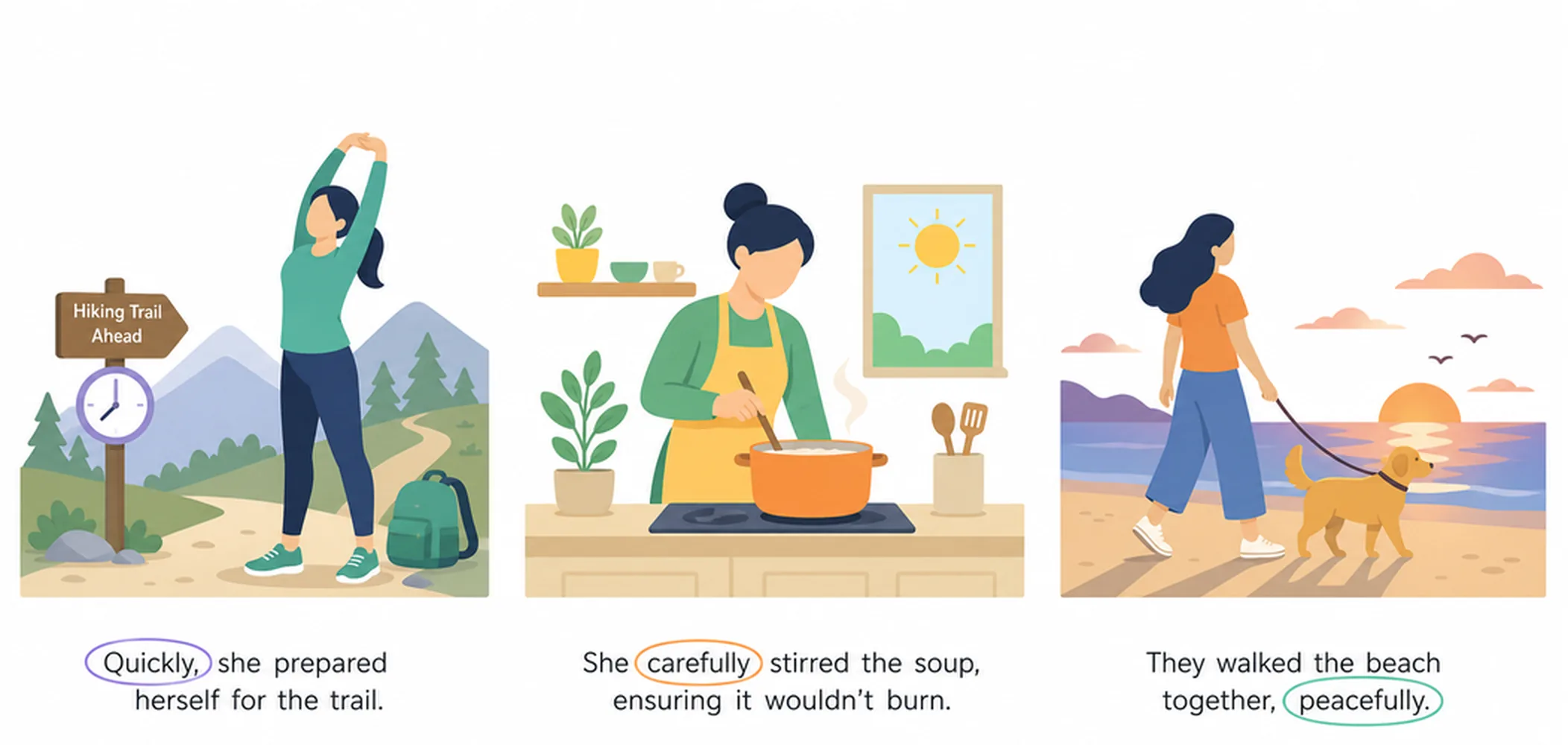
Adverbials are grouped by the type of information they provide. Time adverbials answer "when?" (tomorrow, last week, after lunch). Place adverbials answer "where?" (in London, under the table, at home). Manner adverbials answer "how?" (quickly, carefully, with confidence). Frequency adverbials answer "how often?" (always, never, three times a week). Reason adverbials answer "why?" (because of the rain, to save money). Understanding these types helps you use adverbials effectively in your writing and speech.

Position of Adverbials in Sentences

Adverbials can appear in different positions depending on the type and emphasis. Initial position (at the beginning) emphasizes the adverbial: "Tomorrow, we will visit the museum." Medial position (in the middle) is most common: "We will visit the museum tomorrow." Final position (at the end) is natural for time and place adverbials: "She walked home slowly." Some adverbials work better in certain positions—frequency adverbials like "always" and "never" typically go before the main verb in simple tenses: "I always eat breakfast."

Adverbial Position in a Sentence: The Formula

Adverbial Position in a Sentence: The Formula

Master the three core structural patterns for placing adverbials correctly in positive and negative sentences

Positive
Position Formula Example
Initial [Adverbial] + Subject + Verb + Object Every morning, she drinks coffee.
Medial Subject + [Adverbial] + Verb + Object He quickly finished the report.
Final Subject + Verb + Object + [Adverbial] They played the match yesterday.
Key Points
Initial Position: The adverbial appears at the beginning and is typically followed by a comma. Use this to emphasize timing or frequency.
Medial Position: The adverbial sits between the subject and verb. This is the most common position for adverbs of manner and frequency.
Final Position: The adverbial appears at the end. This is the most natural position for adverbials of time, place, and manner.
Negative
Position Formula Example
Initial [Adverbial] + Subject + do not/does not + Verb + Object Rarely, he does not eat breakfast.
Medial Subject + do not/does not + [Adverbial] + Verb + Object She does not often visit the museum.
Final Subject + do not/does not + Verb + Object + [Adverbial] They did not play the match yesterday.
Important Rules
Negative Auxiliary Placement: In negative sentences, the auxiliary (do/does/did) comes immediately after the subject. The adverbial can appear before or after the auxiliary depending on the emphasis desired.
Adverbial and Negative Interaction: When combining adverbials with negative structures, frequency adverbs (often, rarely, never) typically appear after do not/does not, while other adverbials follow standard position rules.
Emphasis Consideration: Initial position in negative sentences emphasizes the adverbial strongly. Use medial position for standard emphasis and final position for natural, conversational tone.

Examples

She completed the project yesterday afternoon.
Time adverbial · When
The children played outside in the park.
Place adverbial · Where
He spoke to us very carefully about the problem.
Manner adverbial · How
We go to the beach every summer.
Frequency adverbial · How often
Because of the weather, the match was cancelled.
Reason adverbial · Why
They walked to school together this morning.
Place adverbial + manner adverbial · Where + How
When to use it
Describing When
Use time adverbials to tell your reader or listener when an action happens. This is essential for storytelling and giving instructions.
"Next week, I'm starting my new job at the office."
Describing Where
Use place adverbials to clarify the location of an action. This helps your audience understand the physical context.
"The keys are on the table in the kitchen."
Describing How
Use manner adverbials to show the way something is done. This adds detail and helps convey tone or style.
"She answered the question confidently and clearly."
Describing Frequency
Use frequency adverbials to explain how often something happens. This is useful for routines and habits.
"I exercise three times a week at the gym."
Signal words
when where how why yesterday tomorrow today always never sometimes quickly slowly carefully in the morning at home because since to
Common Mistakes
Wrong
I go always to the cinema on Fridays.
Correct
I always go to the cinema on Fridays.
Frequency adverbials go before the main verb, not after 'go'.
Wrong
She speaks English very good.
Correct
She speaks English very well.
Use 'well' (adverb) to modify 'speaks', not 'good' (adjective).
Wrong
Tomorrow I will go to the office tomorrow.
Correct
Tomorrow I will go to the office.
Avoid repeating the same adverbial in one sentence.
Wrong
She spoke quietly because she was excited about the news.
Correct
She spoke quietly because she didn't want to disturb others.
The adverbial 'because' clause must logically explain why the action happened; excitement doesn't explain quiet speaking.
KEY TAKEAWAYS

What to Remember

  • An adverbial is a word or phrase that adds extra information about when, where, how, why, or extent.
  • Adverbials modify verbs, adjectives, or entire sentences to provide additional details about actions or situations.
  • Unlike single-word adverbs, adverbials can be phrases or clauses that function together as one unit.
  • Adverbials can appear at the beginning, middle, or end of a sentence depending on emphasis and clarity.
  • Common mistake: confusing adverbs with adverbials; remember that adverbials include phrases and clauses, not just single words.
← Previous
Complement in a sentence
Next →
Basic sentence patterns — all 5 types