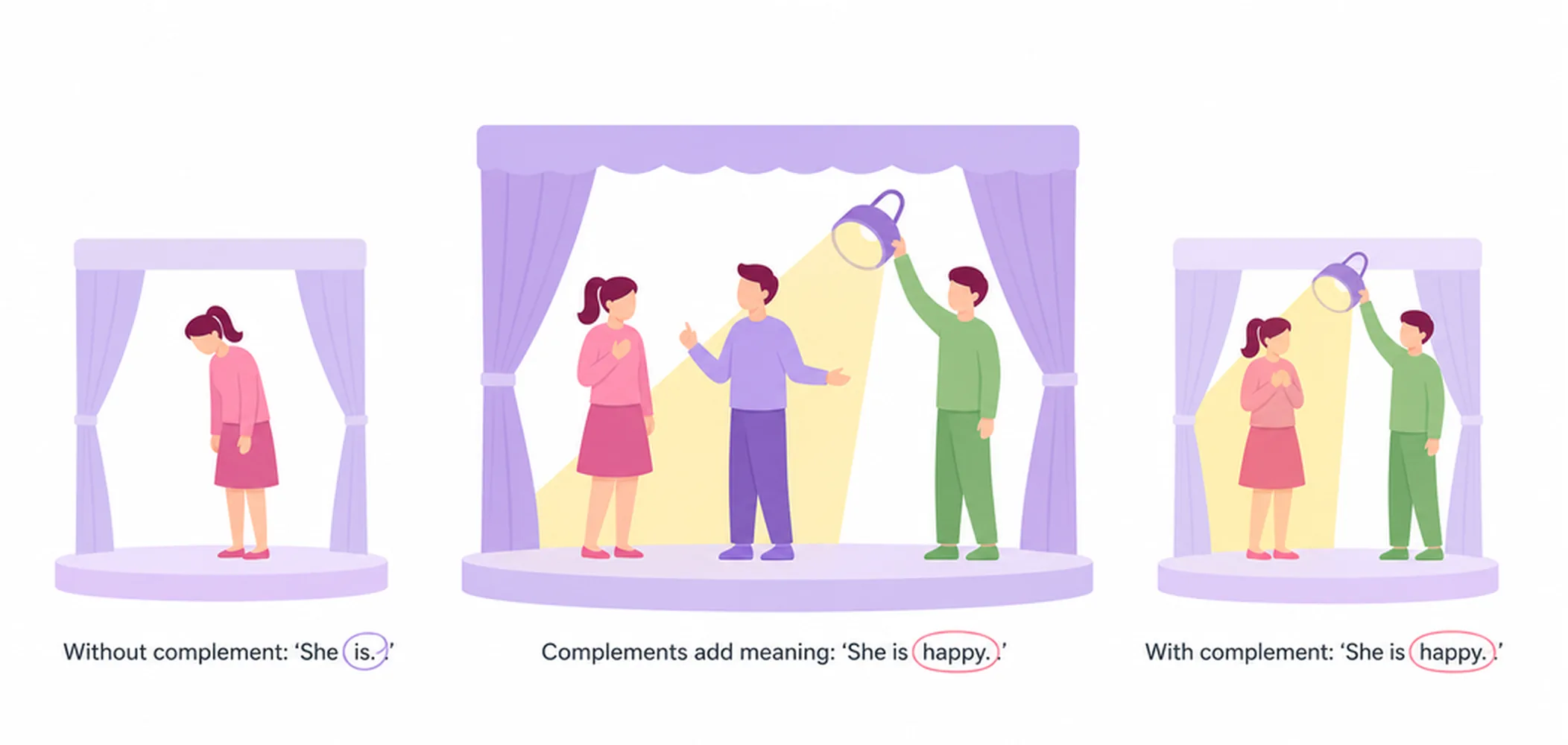
What is a Complement?
A complement is a word or group of words that completes the meaning of a verb in a sentence. Without a complement, some sentences would not make complete sense. Complements are different from objects because they describe or rename the subject or object, rather than showing who receives the action. There are two main types: subject complements and object complements.
Subject Complements
A subject complement describes or renames the subject after a linking verb. Common linking verbs include: be (is, are, was, were), become, seem, appear, feel, look, sound, taste, and smell. The subject complement can be a noun, an adjective, or a noun phrase. For example: 'She is a teacher' (noun), 'The soup is delicious' (adjective), or 'He became very successful' (adjective + adverb).
Object Complements
An object complement describes or renames the direct object after certain verbs like make, call, name, elect, appoint, or consider. The object complement follows the object and adds more information about it. For example: 'We elected him president' (president is the object complement that describes 'him'). Object complements help complete the thought about the object.
Complement vs. Object: What's the Difference?
| Feature | Complement | Object |
|---|---|---|
| Form | Noun phrase, adjective phrase, or pronoun that renames or describes the subject or object | Noun phrase or pronoun that receives the action of the verb; can be direct or indirect |
| Function | Completes the meaning of a linking verb by describing or identifying the subject (subject complement) or the object (object complement) | Receives or is affected by the action of a transitive verb; answers "what?" or "whom?" after the verb |
| Relationship to the Subject | A subject complement refers back to and equals or describes the subject (Subject = Complement) | The object is separate from the subject; the subject performs an action on the object (Subject ≠ Object) |
| Relationship to the Verb | Follows a linking verb; the verb acts as an equals sign connecting subject to complement | Follows a transitive action verb; the verb transfers action from subject to object |
| Example Verbs Used | be, seem, appear, become, feel, look, smell, taste, sound, remain, grow, turn | eat, write, send, give, make, buy, kick, read, see, help, tell, show |
| Positive Example | "She is a doctor." (noun phrase complement) "The soup smells delicious." (adjective complement) |
"She treated a patient." (direct object) "He sent her a letter." (indirect + direct object) |
| Negative Example | "The weather is not cold today." "He did not seem confident." |
"She did not eat breakfast." "They did not send the package." |
| Question Example | "What is she?" → She is a teacher. (complement = teacher) "How does it taste?" → It tastes sweet. |
"What did she eat?" → She ate an apple. (object = apple) "Whom did he call?" → He called his friend. |
| Types | Subject complement: follows linking verb, describes subject Object complement: follows direct object, describes or renames it (e.g., "They elected him president.") |
Direct object: directly receives the action (e.g., "She wrote a letter.") Indirect object: indicates to/for whom the action is done (e.g., "She wrote him a letter.") |
| Can Be Replaced by an Adjective? | Yes. "The sky looks blue." — blue is a predicate adjective acting as complement | No. Objects must be nouns or pronouns; an adjective alone cannot function as an object |
| Quick Identification Test | Try substituting the verb with "is/are/was". If the sentence still makes logical sense, the word after the verb is likely a complement. ("She became a nurse." → "She is a nurse." ✓) | Ask "What?" or "Whom?" directly after the verb. If a clear answer follows, that word is the object. ("She kicked the ball." → Kicked what? The ball. ✓) |
| Key Signal Words | is, are, was, were, be, been, being, seem, appear, become, feel, look, smell, taste, sound, remain, grow, turn, prove, stay | Action verbs followed by noun phrases; signal words for indirect objects include to, for, give, send, show, tell, buy, make, bring, offer |
| 🔑 Key Difference: A complement completes the meaning of a linking verb by describing or renaming the subject (or object) — it loops back to what is already mentioned. An object completes the meaning of a transitive action verb by naming a separate entity that receives the action. In short: if the word after the verb equals or describes the subject, it is a complement; if it receives the action of the verb, it is an object. | ||
Examples






What to Remember
- A complement completes the meaning of a verb and is essential for sentences to make full sense.
- Subject complements describe or rename the subject and always follow linking verbs like be, seem, or become.
- Object complements describe or rename the direct object, not the subject, and follow certain action verbs.
- Complements differ from objects because they describe or rename, while objects receive the action of the verb.
- Common linking verbs introducing subject complements include: be, is, are, was, were, seem, appear, and become.