What is an Object?
An object is a noun or pronoun that receives the action of the verb. In a simple sentence with subject + verb + object, the object is the person or thing that the verb acts upon. Not all verbs take objects. Verbs that take objects are called transitive verbs. For example, in the sentence 'She reads books,' the subject is 'she,' the verb is 'reads,' and the object is 'books' because books receive the action of reading.
Direct Objects and Indirect Objects
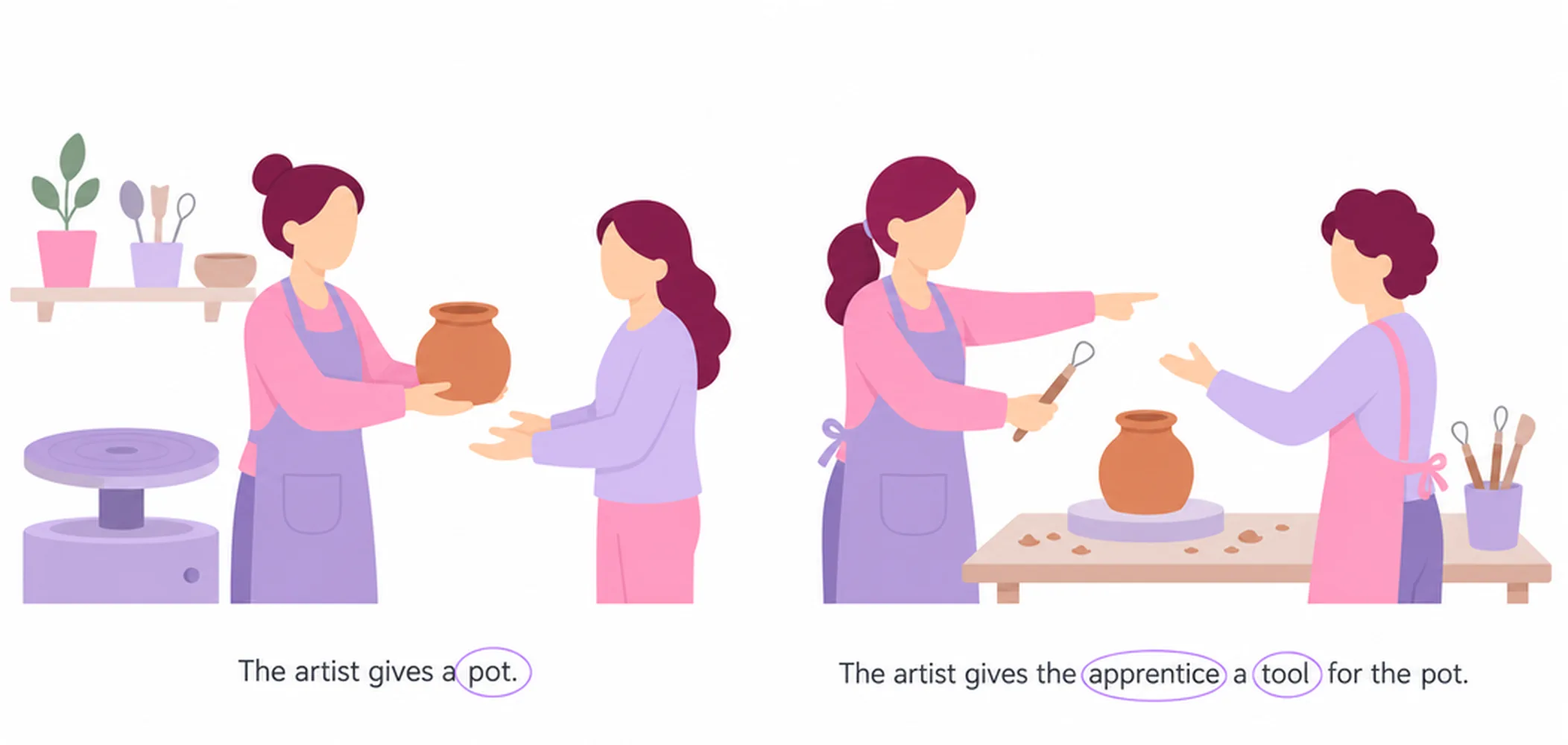
There are two types of objects: direct and indirect. A direct object answers the question 'What?' or 'Who?' after the verb. It is the main receiver of the action. An indirect object answers the question 'To whom?' or 'For whom?' It comes before the direct object and shows who benefits from or receives the result of an action. For example, in 'I gave my friend a book,' 'book' is the direct object (what did I give?) and 'my friend' is the indirect object (to whom did I give it?).
Word Order with Indirect Objects
In English, when you use an indirect object, it usually comes before the direct object: subject + verb + indirect object + direct object. However, you can also use a preposition (to or for) to show the indirect object after the direct object. For example, 'She sent her mother flowers' and 'She sent flowers to her mother' mean the same thing. The first uses word order; the second uses a preposition. Both are correct, but the word order version is often more natural and common in English.
Direct Object vs Indirect Object: Side-by-Side Comparison
| Dimension | Direct Object | Indirect Object |
|---|---|---|
| Definition | The noun, pronoun, or noun phrase that directly receives the action of a transitive verb. It is the primary recipient or result of the action. | The noun, pronoun, or noun phrase that indicates to whom or for whom the action of the verb is performed. It is the secondary recipient of the action. |
| Question It Answers | "What?" or "Whom?" directly after the verb. e.g. She bought a book. → Bought what? A book. |
"To whom?", "For whom?", or "For what?" in relation to the verb and direct object. e.g. She gave him a book. → Gave to whom? Him. |
| Typical Position in Sentence | Immediately follows the transitive verb (or follows the indirect object when both are present). Pattern: Subject + Verb + Direct Object |
Placed between the verb and the direct object, or after the direct object with a preposition (to/for). Pattern: Subject + Verb + Indirect Object + Direct Object OR: Subject + Verb + Direct Object + to/for + Indirect Object |
| Requires the Other? | No. A direct object can exist in a sentence without an indirect object. e.g. She read the letter. (no indirect object needed) |
Yes. An indirect object cannot exist in a sentence without a direct object also being present. e.g. ✗ "She gave him." (incomplete without a direct object) |
| Positive Example | Tom painted the fence. She wrote a letter. They bought groceries. |
Tom painted her the fence. She wrote her friend a letter. They bought the dog some treats. |
| Negative / Incorrect Example | ✗ She explained him the problem. (Here "him" is the indirect object; "the problem" is the direct object — do not confuse them.) | ✗ She sent a package. (This sentence has only a direct object; there is no indirect object telling us who received the package.) |
| Question Example | Q: What did she buy? A: She bought a car. ("a car" = direct object) |
Q: To whom did she give the award? A: She gave the student the award. ("the student" = indirect object) |
| Key Signal Words / Prepositions | No preposition is used before the direct object. Common verbs: buy, read, eat, write, make, see, build, paint, call. | When placed after the direct object, prepositions to or for signal the indirect object. Common verbs: give, send, show, tell, offer, bring, teach, lend, write. |
| Pronoun Forms Used | Objective pronouns: me, you, him, her, it, us, them e.g. She called him. |
Same objective pronouns: me, you, him, her, it, us, them e.g. She gave him a call. (position distinguishes the role) |
| 🔑 Key Difference: The direct object is what directly receives the action of the verb (answers "what?" or "whom?"), and it can stand alone with its verb. The indirect object is the beneficiary or recipient of the direct object (answers "to whom?" or "for whom?") and can only exist in a sentence that also contains a direct object. A quick test: find the direct object first by asking "Verb + what/whom?" — whatever is left receiving the benefit of that action is the indirect object. | ||
Examples





What to Remember
- An object is a noun or pronoun that receives the action of a verb in a sentence.
- Only transitive verbs take objects; intransitive verbs do not have objects at all.
- A direct object answers "what" or "whom" and receives the action directly.
- An indirect object answers "to whom" or "for whom" the action is done.
- A sentence can have a direct object alone, but indirect objects require a direct object.