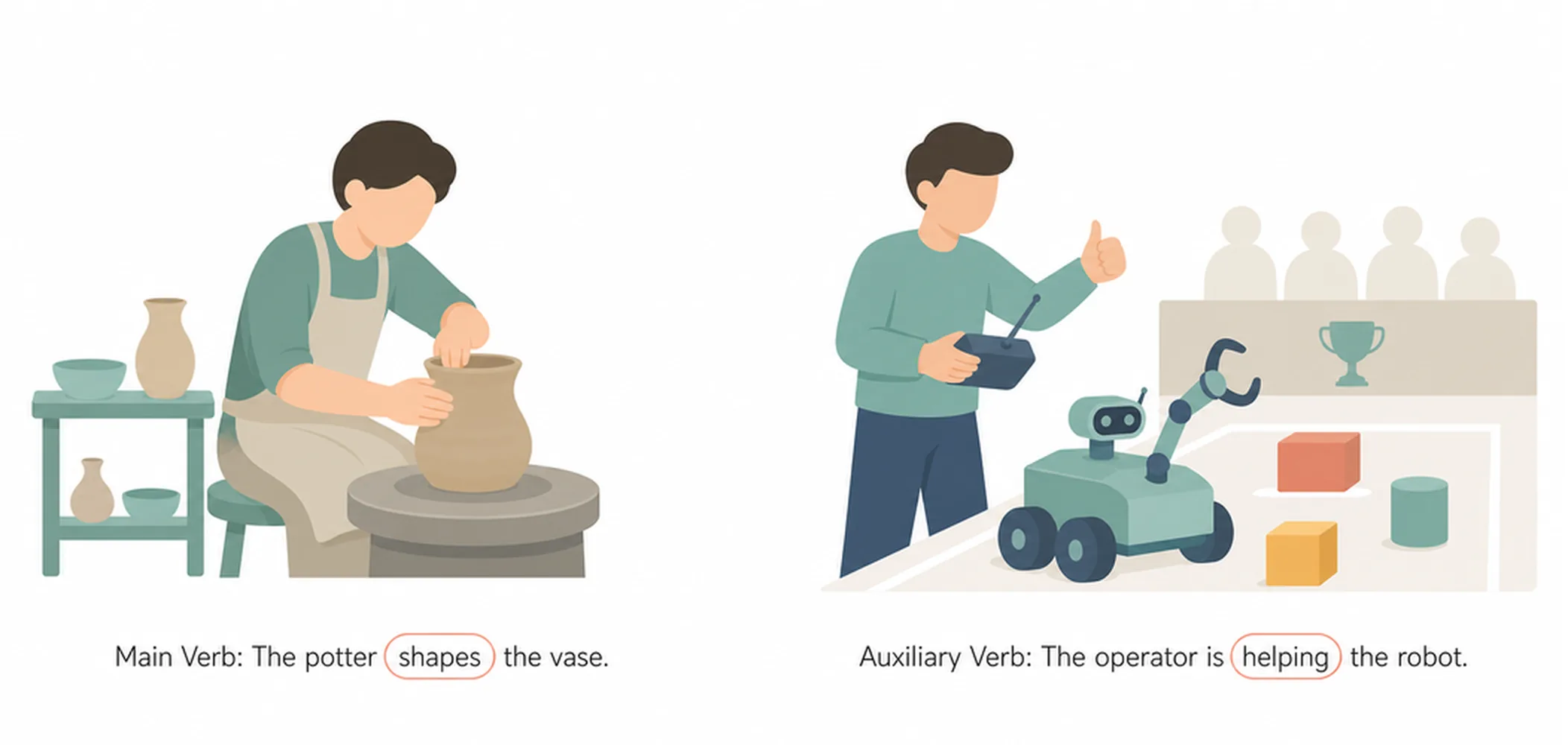
What is a Main Verb?
A main verb (also called a lexical verb) is the most important verb in a sentence. It tells you the action, state, or experience. Every sentence needs at least one main verb. The main verb carries the meaning you want to communicate. For example, in the sentence 'She plays tennis,' the main verb is 'plays' because it shows the action.
What is an Auxiliary Verb?
An auxiliary verb (also called a helping verb) works with the main verb to create different tenses, moods, or voices. Auxiliary verbs do not stand alone—they always support the main verb. Common auxiliary verbs include be, have, and do. For example, in 'She is playing tennis,' the auxiliary verb is 'is' and the main verb is 'playing.' The auxiliary verb 'is' helps create the present continuous tense.
How They Work Together
In many sentences, the main verb and auxiliary verb work as a team. The auxiliary verb usually comes before the main verb and changes its form to express time, certainty, or obligation. For instance, 'They have finished their homework' uses the auxiliary 'have' with the main verb 'finished' to show a completed action. Without the auxiliary, you cannot express this completed action clearly.
Main Verb vs Auxiliary Verb: Key Differences
| Property | Main Verb | Auxiliary Verb |
|---|---|---|
| Definition | The principal verb that carries the core meaning of the sentence, expressing an action, state, or occurrence. | A supporting verb (also called a helping verb) that works alongside the main verb to add grammatical or functional meaning. |
| Primary Function | Expresses the main action or state of the subject (e.g., running, thinking, eating). | Indicates tense, mood, voice, aspect, or modality; helps form questions, negatives, and passive constructions. |
| Ability to Stand Alone | Yes — a main verb can form a complete, grammatically valid sentence on its own without any helping verb.
"She runs." |
No — an auxiliary verb cannot stand alone as the sole verb of a sentence; it must be paired with a main verb.
"She is running." (not just "She is.") |
| Carries Lexical Meaning | Yes — it holds the real, content-based meaning of the sentence. | No (or minimal) — it provides grammatical meaning rather than descriptive content meaning. |
| Position in Sentence | Typically follows the subject (and any auxiliary verbs) in a standard declarative sentence. | Placed immediately before the main verb in a sentence; moves to the front in question formation. |
| Common Forms | All regular and irregular verbs (base, past, past participle, present participle).
e.g., go, went, gone, going; eat, ate, eaten |
Primary auxiliaries: be, do, have Modal auxiliaries: can, could, will, would, shall, should, may, might, must |
| Positive Example | "She sings every morning." "They completed the project." |
"She is singing every morning." "They have completed the project." |
| Negative Example | "He does not sleep late." (main verb = sleep) | "He does not sleep late." (auxiliary = does; negation is attached to the auxiliary) |
| Question Example | "Does he know the answer?" (main verb = know) | "Does he know the answer?" (auxiliary moves to front to form the question) |
| Role in Tense & Aspect | Simple tenses can be formed with a main verb alone.
"I walked." (simple past) |
Required to form perfect, progressive, and passive tenses.
"I have been walking." (present perfect progressive) |
| Role in Voice (Active/Passive) | The past participle form of the main verb is used in passive constructions.
"The letter was written." |
The auxiliary "be" is essential to create passive voice.
"The letter was written." |
| Expressing Modality | Does not express modality on its own. | Modal auxiliaries (can, could, may, might, must, shall, should, will, would) express ability, possibility, permission, obligation, or necessity.
"You must submit the form." |
| Key Signal Words / Identifiers | It answers "What is the subject doing / being?" — the word that captures the action or state.
e.g., run, eat, think, become, seem, appear |
Look for: be/am/is/are/was/were, do/does/did, have/has/had, and the modal verbs (can, could, will, would, shall, should, may, might, must). |
Key Difference: A main verb is the heart of the sentence — it carries the real-world meaning of the action or state and can often stand alone. An auxiliary (helping) verb is a grammatical tool that supports the main verb by expressing tense, aspect, voice, mood, or modality; it cannot independently carry the meaning of a sentence. In any verb phrase, there is always exactly one main verb, but there can be zero, one, or multiple auxiliary verbs working together to shape the precise meaning (e.g., "She could have been sleeping" — three auxiliaries plus one main verb).
Examples






What to Remember
- Every sentence must contain at least one main verb to express action, state, or experience.
- The main verb carries the core meaning and can stand alone in a sentence.
- Auxiliary verbs always work with main verbs; they never stand alone or carry meaning independently.
- Auxiliary verbs help form tenses, moods, and voices but don't replace the main verb.
- Common auxiliaries include be, have, and do; use them to modify the main verb's function.