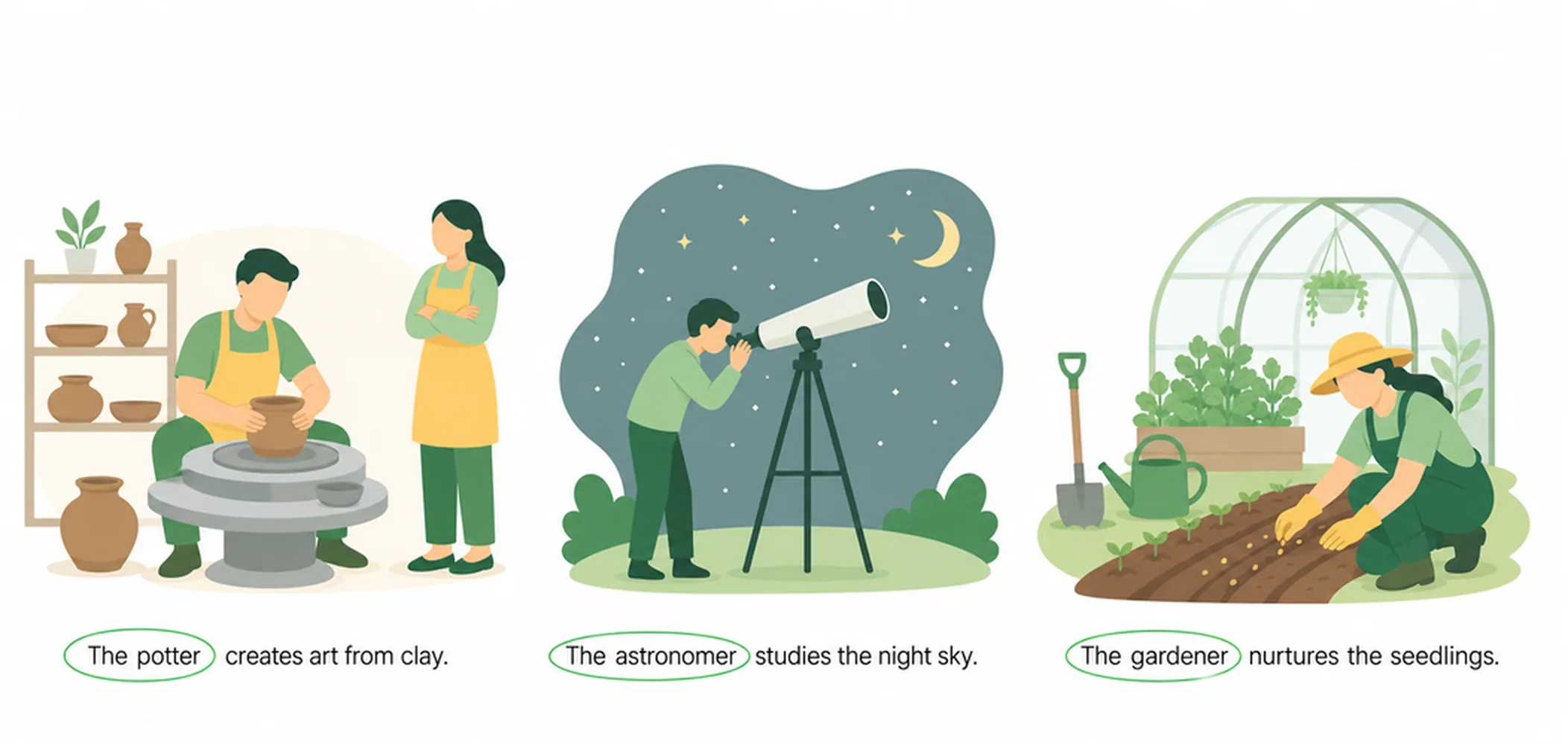
What is a Subject?
The subject is the part of a sentence that performs the action or is described. It answers the question 'who?' or 'what?' at the beginning of the sentence. Every sentence needs a subject because it tells us who or what is doing something or who or what the sentence is about. The subject is usually a noun or a pronoun, and it comes before the verb in most English sentences.
How to Find the Subject
To find the subject, ask yourself 'who or what is performing the action?' or 'who or what is the sentence talking about?' Look for the word that comes before the main verb. For example, in 'The cat sleeps on the bed', ask 'who sleeps?' The answer is 'the cat', so 'the cat' is the subject. Sometimes the subject can be a pronoun like 'I', 'you', 'he', 'she', 'it', 'we', or 'they' instead of a noun.
Subject Types and Complexity
Subjects can be simple or complex. A simple subject is just one noun or pronoun. A complex subject includes the noun or pronoun plus describing words. For example, in 'My best friend travels every summer', the simple subject is 'friend', but the complete subject is 'my best friend'. Both refer to the same person performing the action, but the complete subject gives more information about who that person is.
How to Find the Subject: Step-by-Step
Finding the subject in a sentence is a straightforward process once you know what to look for. Follow these steps to identify the subject accurately.
The most reliable way to find the subject is to ask "Who or what is the sentence about?" The answer is your subject. For example, in the sentence "The cat is sleeping," ask yourself who is sleeping. The answer is "the cat"—that is the subject.
Find the main verb in the sentence. The subject is the word or phrase that performs the action or is described by the verb. In "Sarah reads novels," the verb is "reads." The subject is "Sarah" because she is the one performing the action of reading.
In most English sentences, the subject appears before the main verb. This makes it easier to spot. For instance, in "The students completed their homework," the subject "students" comes before the verb "completed."
Be careful not to confuse the subject with words in prepositional phrases. In "One of the boys plays soccer," the subject is "one" (not "boys"). The phrase "of the boys" is a prepositional phrase that describes which one, but it does not contain the subject.
In some sentences, especially questions and sentences beginning with "there" or "here," the subject may come after the verb. In "Where are you going?" the subject is "you." In "There are many flowers in the garden," the subject is "flowers," not "there."
Some sentences have more than one subject joined by "and," "or," or "nor." In "Maria and Juan are friends," both "Maria" and "Juan" are subjects (this is a compound subject). Both words work together as the subject of the verb "are."
Examples






What to Remember
- The subject is the part of a sentence that performs the action or is described by the verb.
- The subject answers 'who?' or 'what?' and every sentence must have one to be complete.
- Subjects are usually nouns or pronouns and typically come before the verb in English sentences.
- To find the subject, ask 'who or what is performing the action?' or 'what is this about?'
- Remember that the subject performs the action; the object receives it, so do not confuse them.