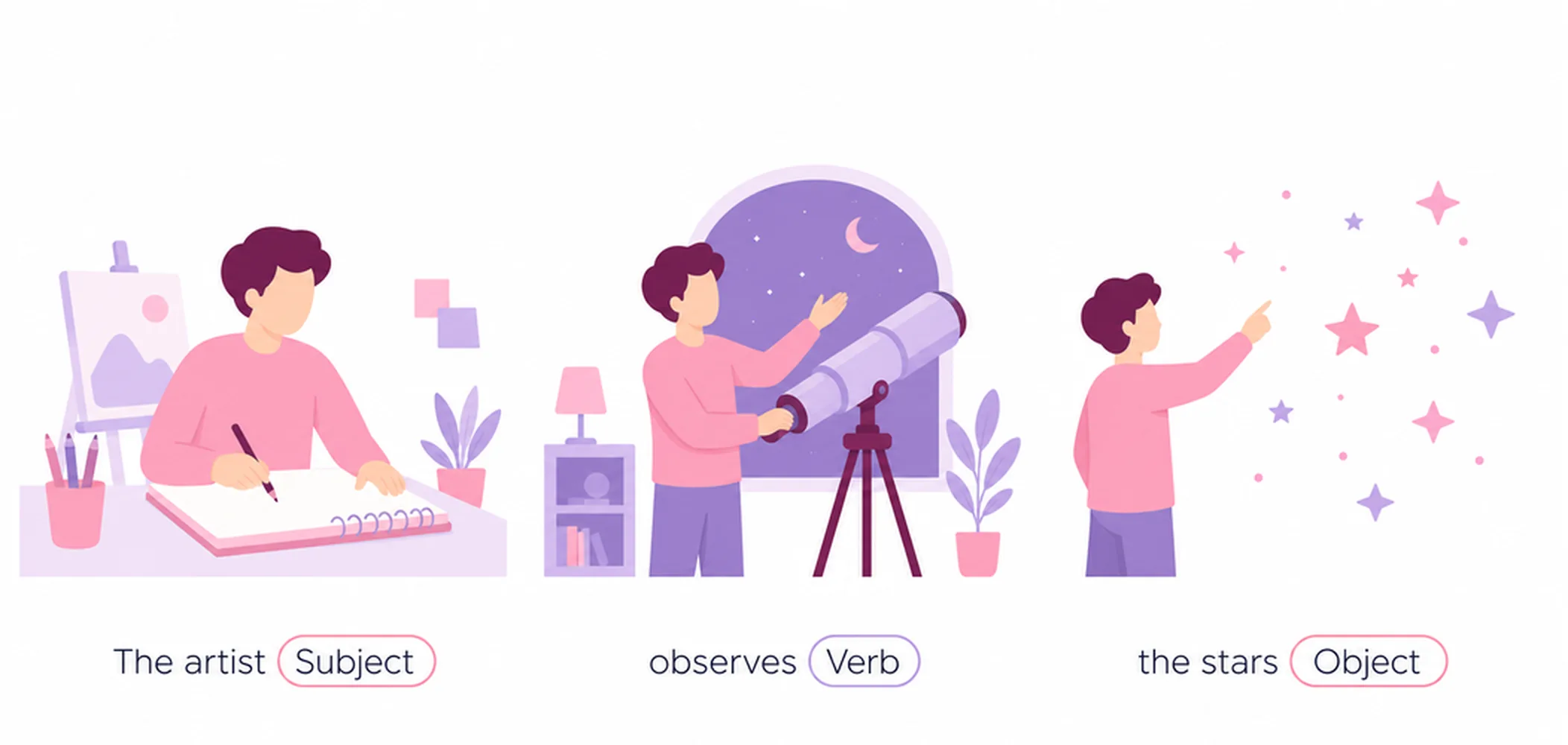
What is SVO Word Order?
English follows a Subject-Verb-Object (SVO) word order. This means the subject comes first, the verb comes second, and the object comes third. This is the most common sentence pattern in English and is used in both simple and complex sentences. Understanding SVO helps you write clear, grammatically correct sentences and understand how English speakers arrange their words.
SVO Structure
The basic pattern is straightforward: Subject performs an action (verb) on or towards an object. The object receives the action of the verb.
Why is Word Order Important?
English is a word-order language, which means the position of words changes the meaning of a sentence. Unlike some languages with flexible word order, English requires SVO structure to be clear and correct. Changing the word order can completely change the meaning or make the sentence sound unnatural. Learning to use SVO correctly helps you communicate precisely in English.
SVO in Different Sentence Types
The SVO pattern works for most English sentences: simple sentences, compound sentences, and main clauses. In questions and negative sentences, the word order changes slightly, but the basic principle remains. Once you master basic SVO, you can understand how English builds more complex structures by adding adverbs, adjectives, and clauses around this core pattern.
SVO vs. Other Word Orders
| Feature | SVO — English Subject → Verb → Object |
SOV — Japanese / Turkish Subject → Object → Verb |
VSO — Arabic / Welsh Verb → Subject → Object |
|---|---|---|---|
| Form | Subject + Verb + Object The subject acts first, the verb follows, then the receiver of the action. |
Subject + Object + Verb The subject and object are stated before the verb is revealed at the end. |
Verb + Subject + Object The action is announced first, then who performs it, then what it affects. |
| When to Use | Always — English relies on fixed word order to signal grammatical roles. Changing the order changes or destroys meaning. | Standard in Japanese, Turkish, Korean, and Hindi. Case markers (not position) often indicate roles, so some flexibility exists. | Standard in Classical Arabic, Welsh, Irish, and many Semitic languages. Agreement markers on the verb help identify the subject. |
| Positive Example | The cat [S] chases [V] the mouse [O]. Clear: the cat is the doer. |
Japanese: Neko ga nezumi wo ou. [Cat] [mouse] [chases] Particles (ga, wo) mark roles; verb comes last. |
Arabic: Yatʿaqqabu al-qittu al-faʾra. [Chases] [the-cat] [the-mouse] Verb leads; subject and object follow. |
| Negative Example | The cat does not chase the mouse. "Not" inserted between auxiliary and main verb; order otherwise unchanged. |
Japanese: Neko ga nezumi wo owanaI. Negation suffix attaches to the verb at the end. |
Arabic: Lā yatʿaqqabu al-qittu al-faʾra. Negation particle precedes the already-initial verb. |
| Question Example | Does the cat chase the mouse? Auxiliary moves before subject (V-S inversion), but SVO core is preserved. |
Japanese: Neko ga nezumi wo ou ka? Question particle "ka" added at end; word order unchanged. |
Welsh: Ydy'r gath yn erlid y llygoden? VSO order remains the same for questions; intonation or particles signal query. |
| Key Signal Words / Markers | Word position itself — no case endings. Pronouns shift form (I/me, he/him) to reinforce role. | Grammatical case particles: Japanese ga (subject), wo/o (object); Turkish -ı/-i (accusative). | Verb agreement prefixes and suffixes encode person and number, helping listeners identify the subject even before it appears. |
| Why Reordering Fails | "Mouse the chases cat the" — incomprehensible. "The mouse chases the cat" — grammatical but completely reversed meaning. |
Because particles mark roles, some reordering is possible for emphasis without confusion. | Verb agreement and case markers reduce ambiguity, but deviating from VSO may sound marked or poetic. |
| Approximate % of World's Languages | Approximately 35% of languages are SVO (includes English, Mandarin, French, Spanish, and Russian). | Approximately 45% of languages are SOV — the single most common order worldwide. | Approximately 9% of languages are VSO (Arabic, Welsh, Irish, and Classical Hebrew). |
| Key Difference: English is an analytic, fixed-word-order language. Because it has lost nearly all its case endings, position alone tells readers and listeners who is doing what to whom. Move a word and you either break the grammar or reverse the meaning entirely. SOV languages like Japanese use particles to label each noun's role, freeing word order for emphasis. VSO languages like Arabic embed role information inside the verb itself through agreement markers. English learners must therefore treat SVO order as a non-negotiable rule, not a stylistic choice. | |||
Examples






What to Remember
- Subject always comes first, before the verb and object in English sentences.
- The verb comes second, positioned directly after the subject in the sentence structure.
- The object comes third and receives the action performed by the subject.
- Word order in English changes meaning, so incorrect placement creates different or wrong meanings.
- This SVO pattern applies to most English sentences, both simple and complex structures.