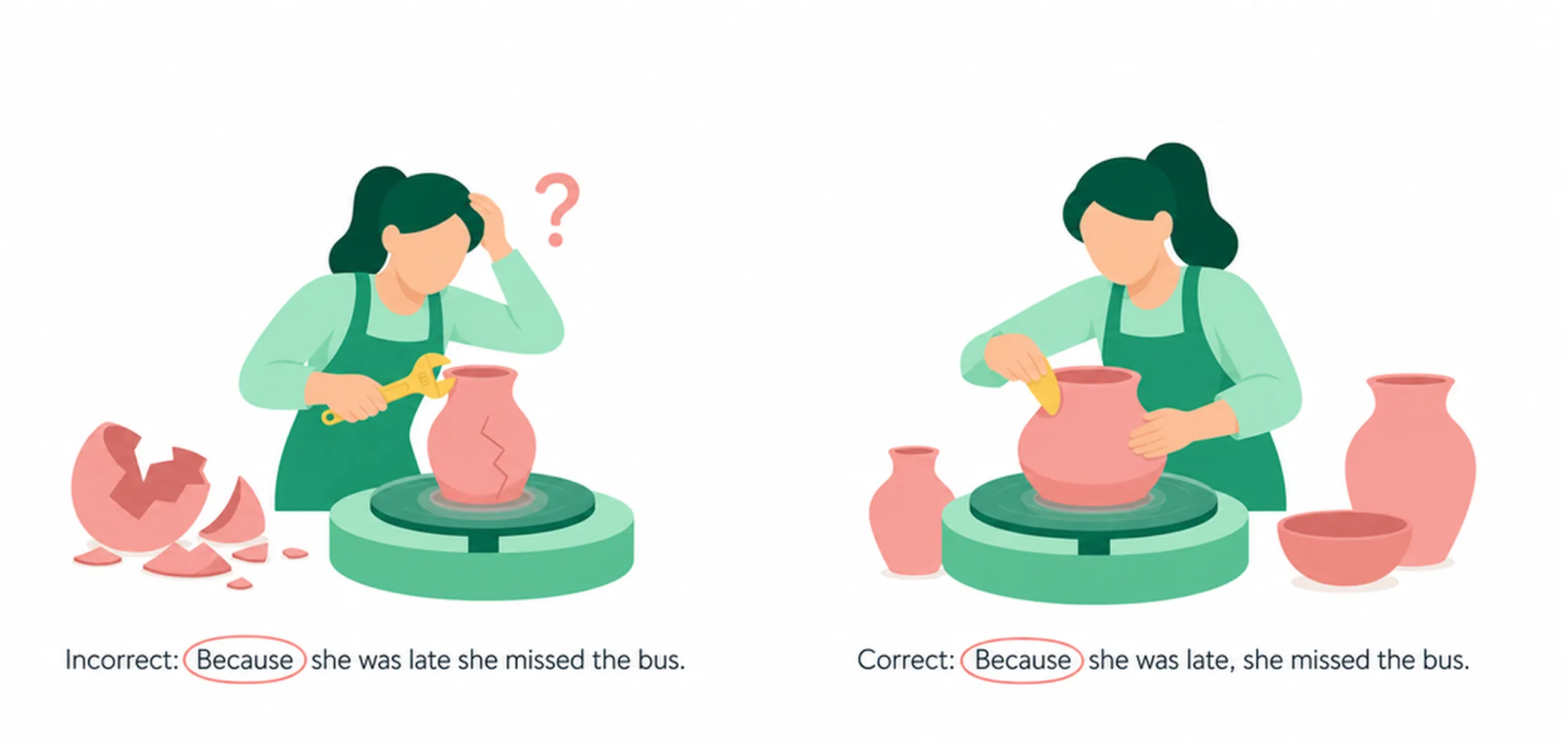
Why Learners Struggle with Subordinating Conjunctions
Subordinating conjunctions connect a main clause to a dependent clause, but learners often make mistakes because these words have specific rules. Common errors include using the wrong conjunction for the meaning you want, forgetting the comma placement, or creating sentence fragments. Many learners also confuse similar conjunctions like 'because' and 'since', or 'although' and 'because'. Understanding these differences will help you write clearer, more grammatically correct sentences.
Easily Confused Subordinating Conjunctions: Side-by-Side
| Aspect | because | since | although | even though | while | whereas |
|---|---|---|---|---|---|---|
| Form | Subordinating conjunction introducing a cause or reason clause | Subordinating conjunction; can introduce reason or time clause | Subordinating conjunction introducing a concessive clause | Stronger emphatic subordinating conjunction introducing a concessive clause | Subordinating conjunction; can show simultaneous time or contrast | Subordinating conjunction introducing a direct contrast or opposition clause |
| When to use | When the reason is new information or the main focus of the sentence; use when answering "Why?" | When the reason is already known to both speaker and listener, or to express time ("from a point in the past until now") | When acknowledging a surprising or contrasting fact; the contrast is real but the main clause still holds true | When the contrast or concession is stronger or more surprising; emphasises that despite a strong obstacle, the main clause is still true | When describing two actions happening at the same time, or (in formal/written English) to show a contrast between two situations | When drawing a direct, factual contrast between two different subjects, situations, or groups; common in academic and formal writing |
| Positive example | "She left early because she had a headache." (New information explaining why) | "Since you already know the rules, I won't repeat them." (Shared knowledge as background reason) | "Although it was raining, they went for a walk." (Mild concession) | "Even though he studied for weeks, he failed the exam." (Strong, surprising contrast) | "She listened to music while she cooked dinner." (Simultaneous actions) | "Cats are independent, whereas dogs tend to be loyal and obedient." (Direct factual contrast) |
| Common mistake | "She left early because you already know — she gets tired quickly." (Using because for shared knowledge) | "He failed since he did not study at all." (Using since for a new, surprising reason that needs emphasis) | "Although he trained every single day for a year, he still could not finish the race." (Contrast is very strong — even though is better) | "Even though it was a little chilly, she wore a jacket." (Contrast is mild — although is sufficient) | "Tom loves spicy food, while Sarah prefers mild dishes." (Ambiguous — whereas is clearer for contrast) | "I was reading whereas my brother was watching TV." (Using whereas for simultaneous actions — use while instead) |
| Correction | "Since she gets tired quickly, she left early." (Use since when the reason is already known) | "He failed because he did not study at all." (Use because to present a reason as new or important information) | "Even though he trained every single day for a year, he still could not finish the race." (Use even though for a strong, emphatic contrast) | "Although it was a little chilly, she wore a jacket." (Use although for a mild or straightforward concession) | "Tom loves spicy food, whereas Sarah prefers mild dishes." (Use whereas when the contrast between two subjects is the main point) | "I was reading while my brother was watching TV." (Use while to connect two actions happening at the same time) |
| Key signal words / context | New reason; direct answer to "Why?"; focuses attention on the cause | Known/assumed reason; "from that time"; background justification | Mild surprise; "in spite of the fact that"; straightforward concession | Strong emphasis; "despite the strong fact that"; unexpected or remarkable outcome | Simultaneous actions; or mild contrast in formal writing | Direct factual opposition between two subjects; formal/academic contrast |
|
Key Differences Summary: Use because (not since) when the reason is new or needs to be emphasised. Use since (not because) when the reason is already known to both parties, or to talk about a point in time leading to the present. Use even though (not although) when the contrast or concession is particularly strong, surprising, or emphatic. Use although (not even though) for mild or neutral concessions where no special emphasis is needed. Use while (not whereas) when two actions occur at the same time; use whereas (not while) to draw a clear, formal factual contrast between two different subjects or groups. When contrast is the intended meaning, whereas is always the safer and more precise choice. |
||||||
Examples

Although it was raining heavily, we decided to go hiking.
Contrast · Shows unexpected result

I stayed inside because the weather was too cold.
Cause · Explains reason
She studied hard so that she could pass the exam.
Purpose · Shows intention

Whenever you visit London, let me know in advance.
Time · Emphasizes any occasion
When to use it
Showing Contrast
Use 'although', 'though', or 'whereas' to show two opposing or different ideas in one sentence.
"Although the job is difficult, I enjoy it very much."
Explaining Reasons
Use 'because', 'since', or 'as' to connect a result to its cause or reason.
"I couldn't finish my homework because I ran out of time."
Showing Time
Use 'when', 'whenever', 'before', 'after', or 'until' to show the relationship between two events in time.
"After you finish dinner, please wash the dishes."
Expressing Purpose
Use 'so that' or 'in order that' to show why someone does something or what they want to achieve.
"I saved money so that I could buy a new laptop."
Signal words
although
though
because
since
if
unless
while
whereas
before
after
when
whenever
until
so that
in order that
as long as
Common Mistakes
✕
Wrong
I didn't go to the party because I was busy, but I wanted to.
✓
Correct
I didn't go to the party although I wanted to because I was busy.
Use 'although' or 'though' for contrasting ideas, not 'because'. 'Because' shows cause, not contrast.
✕
Wrong
Since you didn't study, you passed the test.
✓
Correct
Although you didn't study, you passed the test.
'Since' means 'for the reason that'. Use 'although' when the result is unexpected or contradicts the reason.
✕
Wrong
While I like chocolate, but I prefer vanilla.
✓
Correct
While I like chocolate, I prefer vanilla.
Do not use 'but' after a subordinating conjunction like 'while'; the conjunction already establishes the contrast.
✕
Wrong
He stayed at home. Because he was sick.
✓
Correct
He stayed at home because he was sick.
A dependent clause cannot stand alone. 'Because' introduces a dependent clause that must attach to a main clause.
✕
Wrong
Before you left, you should have locked the door so that nobody can enter.
✓
Correct
Before you left, you should have locked the door so that nobody could enter.
When 'so that' expresses purpose, use the same verb tense as the main clause or use 'could/would' for the dependent clause.
✕
Wrong
I will call you unless if you don't want me to.
✓
Correct
I will call you unless you don't want me to.
'Unless' already means 'if not'. Never use 'if' together with 'unless'—it creates a double negative meaning.
✕
Wrong
Whereas my brother likes sports, I like reading books.
✓
Correct
Whereas my brother likes sports, I prefer reading books.
'Whereas' compares two people or things. Make sure both clauses have parallel structure and clear contrast.
KEY TAKEAWAYS
What to Remember
- Subordinating conjunctions connect a main clause to a dependent clause to show relationships between ideas.
- Use commas after introductory dependent clauses, but not usually when the dependent clause comes last.
- Choose the correct conjunction for your meaning: 'because' shows cause, 'although' shows contrast, 'since' shows time or cause.
- Never use two subordinating conjunctions together or you will create a grammatically incorrect sentence.
- A dependent clause alone is a sentence fragment; it must always be attached to a main clause.