What are subordinating conjunctions?
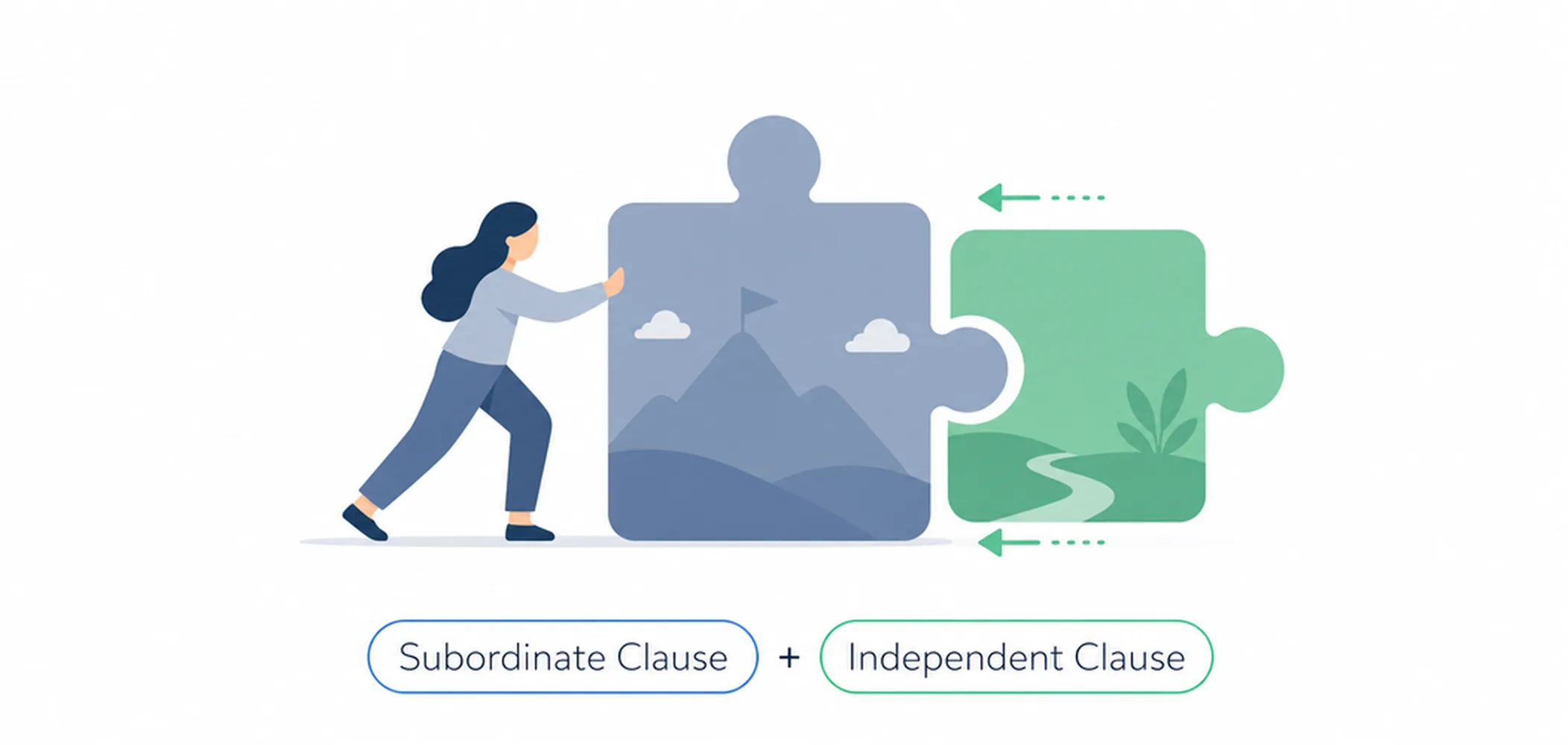
A subordinating conjunction is a word that connects two clauses: an independent clause (a complete sentence) and a dependent clause (an incomplete thought). The subordinating conjunction shows the relationship between these clauses. Unlike coordinating conjunctions that join equal ideas, subordinating conjunctions make one clause dependent on the other, creating complex sentences. The dependent clause cannot stand alone as a complete sentence.
How do subordinating conjunctions work?
When you use a subordinating conjunction, you create a dependent clause that needs an independent clause to complete its meaning. The dependent clause can come before or after the independent clause. If the dependent clause comes first, use a comma to separate it from the independent clause. The subordinating conjunction explains the relationship: cause, effect, time, condition, or contrast.
Common types and their relationships
Different subordinating conjunctions show different relationships. Time conjunctions (when, while, after, before) show when something happens. Reason conjunctions (because, since, as) explain why. Condition conjunctions (if, unless, provided that) show possibilities. Contrast conjunctions (although, though, whereas) show opposing ideas. Choosing the right subordinating conjunction helps your reader understand exactly how your ideas connect.
List of Common Subordinating Conjunctions
| Relationship | Conjunctions | Example | Note |
|---|---|---|---|
| Time | after, before, when, while, as, since, until, till, once, as soon as, whenever, by the time | She left before I arrived. | Tense in the subordinate clause must align logically with the main clause. |
| Reason / Cause | because, since, as, now that, seeing that, inasmuch as | He stayed home because he was ill. | Since and as can also express time; context determines meaning. |
| Condition | if, unless, provided (that), as long as, on condition that, in case, supposing (that), even if | I'll help if you ask me. | Unless = "if not." Conditional clauses often use present tense for future meaning. |
| Contrast / Concession | although, though, even though, whereas, while, even if, despite the fact that, much as | Although it rained, we enjoyed the trip. | While/whereas show contrast between two facts; although/though show concession. |
| Purpose | so that, in order that, lest | She spoke slowly so that everyone could understand. | Lest is formal/literary and means "in order to prevent." |
| Result | so…that, such…that | It was so cold that the pipes froze. | The degree word (so/such) appears in the main clause; that introduces the result. |
| Comparison | than, as…as, just as, as if, as though | She runs faster than he does. / He acted as if nothing had happened. | As if / as though often use subjunctive mood to describe hypothetical situations. |
| Place | where, wherever, everywhere (that) | Sit wherever you like. | Less common as subordinating conjunctions; often classified as relative adverbs. |
| Manner | as, just as, however | Do it just as I showed you. | Describes the way in which the action in the main clause is performed. |
Examples






What to Remember
- A subordinating conjunction connects an independent clause and a dependent clause to form a complex sentence.
- The dependent clause introduced by a subordinating conjunction cannot stand alone as a complete sentence.
- Subordinating conjunctions show relationships like time, cause, condition, or contrast between the two clauses.
- Common subordinating conjunctions include: because, although, while, if, since, unless, after, before, and when.
- A dependent clause can appear at the beginning or end of a sentence with different punctuation rules.