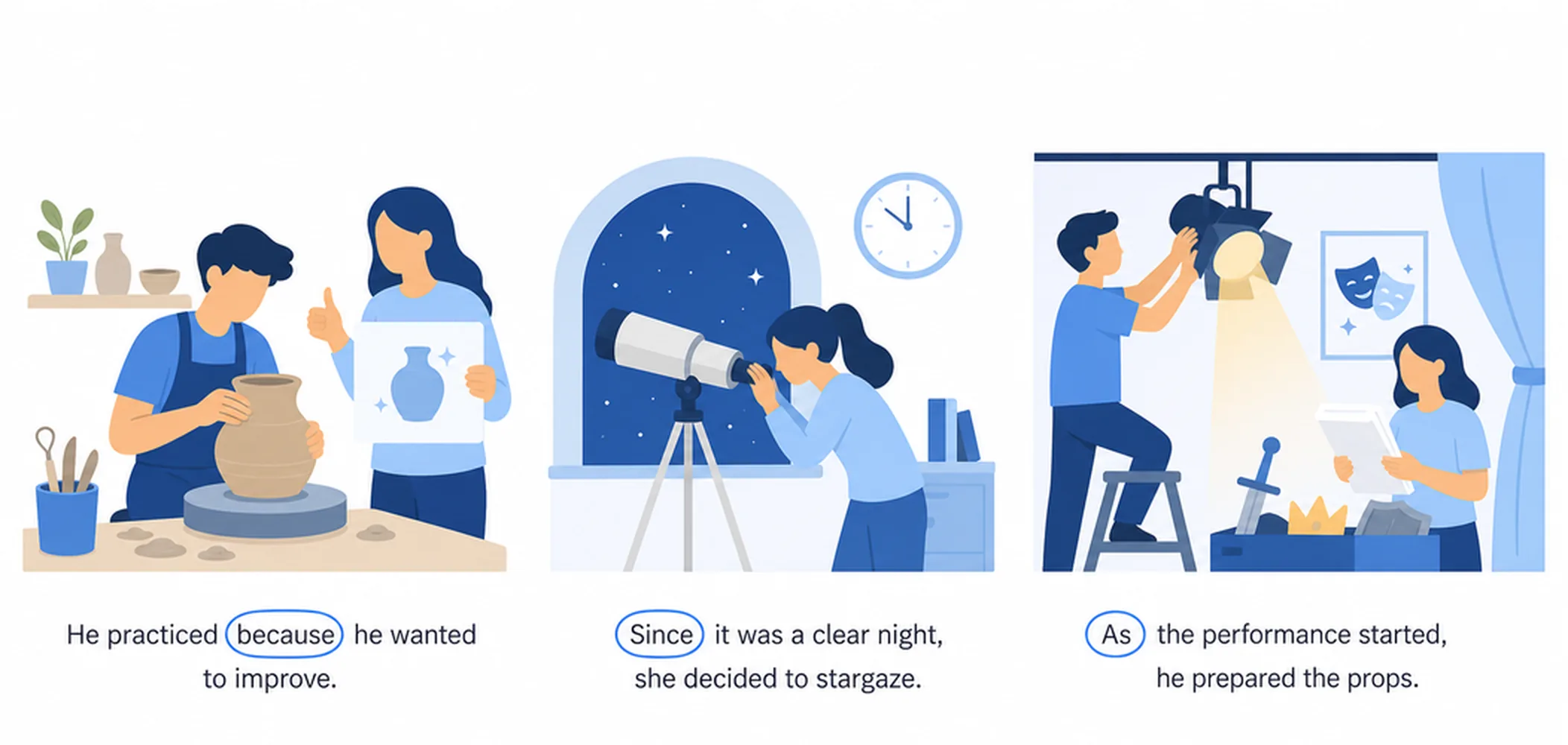
Understanding Reason Conjunctions
Because, since, and as are all subordinating conjunctions that introduce reasons or causes. They connect a dependent clause (the reason) to an independent clause (the main idea). While they are similar in meaning, they have important differences in formality, emphasis, and how we use them in sentences. Choosing the right conjunction makes your English sound more natural and clear.
Because vs Since vs As
Because is the most direct and emphatic way to state a reason. It works in any situation—formal or informal—and the reason clause can come before or after the main clause. Since is more formal and often suggests a reason that is already known or obvious to the listener. The reason usually comes first. As is the most formal of the three and often sounds literary. It emphasizes that the reason and result happen together, and the reason clause typically comes first.
Because — Direct and Flexible
Use because when you want to clearly explain why something happened. It is the strongest and most common choice.
Since — Formal and Known Reasons
Use since when the reason is already understood between you and your listener, or in more formal writing.
As — Literary and Formal
Use as in formal or written English when you want to sound more sophisticated. The reason and result feel like they happen at the same time.
Quick Memory Tip
Think of it this way: Because explains 'why' clearly. Since assumes the listener already knows the background. As sounds like you're writing a novel or giving a formal speech. When in doubt, use because—it is always correct and natural.
Because vs Since vs As — Side-by-Side Comparison
| Dimension | Because | Since | As |
|---|---|---|---|
| Form | Subordinating conjunction introducing a reason clause | Subordinating conjunction introducing a reason or time clause | Subordinating conjunction introducing a reason, time, or manner clause |
| Formality Level | Neutral — suits both formal and informal contexts | Semi-formal — more common in written and academic English | Informal to neutral — very common in spoken English; can feel weak in formal writing |
| Typical Clause Position | Usually mid-sentence (after the main clause); can start a sentence for emphasis | Often at the beginning of a sentence; also used mid-sentence | Usually at the beginning of a sentence; awkward at the end |
| Reason Assumed Known? | No — introduces a new, specific, or surprising reason that the listener may not know | Yes — implies the reason is already known or obvious to the listener | Yes — implies the reason is obvious or self-evident; least emphatic of the three |
| When to Use | Use when the reason is the most important part of the sentence and you want to stress it directly; safest, most explicit choice | Use when the reason is background information already shared with the listener; good for academic and formal writing | Use in conversational or informal writing when the reason is obvious; avoid when precision is needed, as it can be ambiguous with its time and manner meanings |
| Positive Example | She left early because she had a doctor's appointment. | Since the roads were icy, we decided to take the train. | As it was getting dark, they headed back to camp. |
| Negative Example | He didn't attend the meeting because he wasn't feeling well. | Since the budget had been cut, the project could not continue. | As there was no signal, she couldn't make the call. |
| Question Example | Did you leave because you were bored? | Since you've already read the report, can you summarise it for us? | As you're already here, would you like to join the discussion? |
| Key Signal Words / Contexts | Why? questions; direct cause-and-effect; emphasis; after not because constructions; answers to "Why did…?" | Shared context; academic writing; given that; seeing that; formal reports and essays | Conversational tone; simultaneous events; obvious circumstances; informal emails and speech |
| Ambiguity Risk | Very low — meaning is always clear as a causal connector | Medium — can mean "from the time that" (time) or "given that" (reason); context usually clarifies | High — can mean reason, time ("at the same time"), or manner ("in the way that"); can confuse readers |
| Can Start a Sentence? | Yes, but less common; used for rhetorical emphasis — Because safety matters, we wear helmets. | Yes, very commonly — Since the data was incomplete, results were inconclusive. | Yes, most naturally — As everyone agreed, the vote was skipped. |
Examples






What to Remember
- Because is the most formal and emphasizes the reason; use it when the reason is important.
- Since can mean reason or time, so context matters to avoid ambiguity in your sentences.
- As is the least formal and works well when the reason is already understood or obvious.
- These conjunctions introduce dependent clauses that need an independent clause to form complete sentences.
- Place the reason clause before or after the main clause, but avoid starting formal writing with because.