Why Learners Struggle with Future Continuous
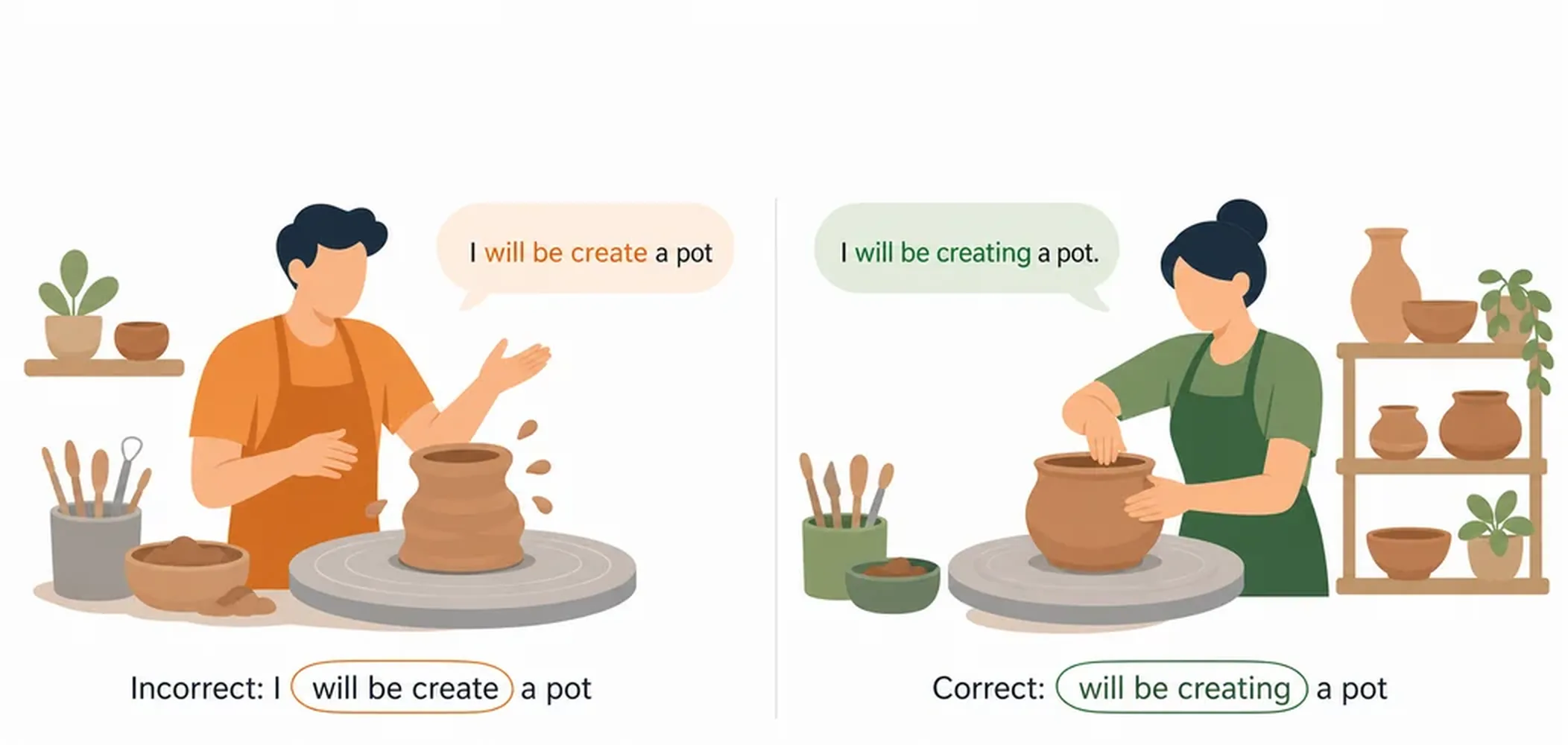
The future continuous (will be + -ing) is often confused with the simple future or present continuous because the structure looks similar to other tenses. Learners frequently forget to include the auxiliary verb "be", mix up when to use this tense instead of will + base form, or apply incorrect spelling rules to the -ing form. Understanding the specific contexts where future continuous is essential—describing ongoing actions at a specific future time, or actions that will be in progress—helps avoid these common pitfalls.

Future Continuous vs. Simple Future: Side-by-Side Comparison
| Category | ❌ Incorrect | ✅ Correct | Why the Error Occurs & How to Fix It |
|---|---|---|---|
| Form | I will be work late tomorrow. She will being cooking dinner at 7 pm. |
I will be working late tomorrow. She will be cooking dinner at 7 pm. |
Learners forget that the future continuous requires will + be + verb‑ing. A common slip is omitting the ‑ing ending or incorrectly inflecting "be." Always check for all three components: will (modal) → be (base form) → main verb + ‑ing. |
| When to Use | I will be finishing my homework now. (talking about a current action) At midnight I will be sleep. |
I am finishing my homework now. (present continuous for current action) At midnight I will be sleeping. |
The future continuous describes an action in progress at a specific moment in the future, not a current action. Using it for present actions confuses tenses. Reserve it for future time references (e.g., "at 9 pm," "this time next week") and ensure the action will be ongoing at that future point. |
| Positive Example | By 3 o'clock they will working on the project. Tomorrow morning he will be works from home. |
By 3 o'clock they will be working on the project. Tomorrow morning he will be working from home. |
"Be" is frequently dropped in positive statements, and learners sometimes add a third‑person ‑s to the main verb (by analogy with simple present). Remember: after will, the verb is always in its base form (be), and the main verb always ends in ‑ing, regardless of subject. |
| Negative Example | She will not working tomorrow afternoon. They won't be work during the holiday. |
She will not be working tomorrow afternoon. They won't be working during the holiday. |
In negatives, not is placed after will, but be and the ‑ing form must still follow: will not be + verb‑ing. A common error is skipping be after not, or forgetting the ‑ing ending. Structure: will + not + be + verb‑ing. |
| Question Example | Will you working this evening? Will be she attending the meeting? |
Will you be working this evening? Will she be attending the meeting? |
In questions, will moves before the subject, but be must remain in the predicate: Will + subject + be + verb‑ing? Learners often place "be" before the subject (like an auxiliary in other tenses) or drop it entirely. Keep the word order: Will → subject → be → verb‑ing. |
| Key Signal Words | Yesterday at 8 pm I will be having dinner. (wrong time reference) I will be knowing the answer soon. (stative verb) |
Tomorrow at 8 pm I will be having dinner. I will know the answer soon. (simple future for stative verb) |
Signal words like at this time tomorrow, by noon, this time next week indicate future continuous is needed — but they must refer to the future, not the past. Also, stative verbs (know, believe, own, want, love) are not used in continuous forms; use the simple future instead. |
| 🔑 Key Difference Summary: The future continuous (will be + verb‑ing) is used to describe an action that will be in progress at a specific point in the future. The three most critical rules are: (1) always include all three parts — will + be + ‑ing; (2) use it only with future time references and dynamic (not stative) verbs; (3) in questions and negatives, maintain the structure will (+ not) + subject + be + verb‑ing — never move or drop be. | |||
Examples
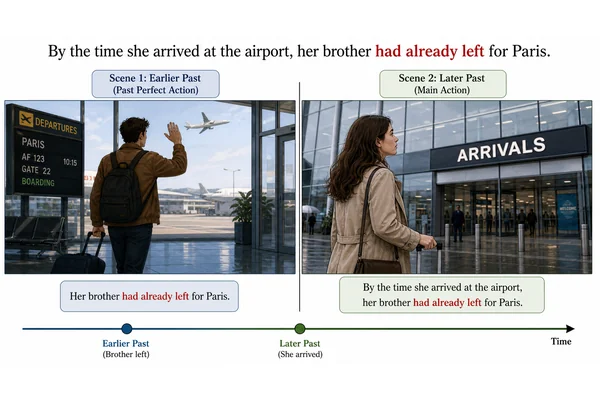
At this time next year, I will be living in Barcelona.
Future actions in progress at a specific time · Positive form
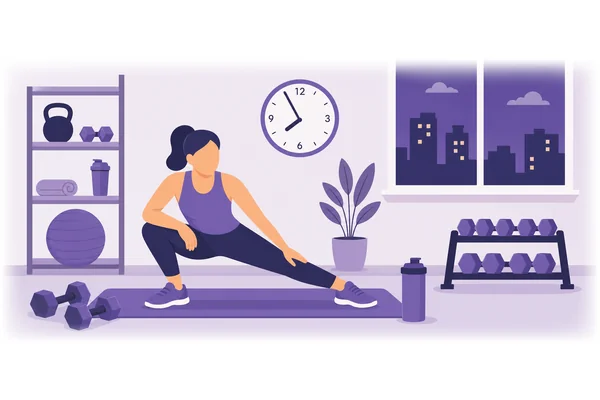
Don't call me at 8 PM because I will be exercising.
Explaining why something won't be possible · Reason clause
Will you be attending the conference next month?
Question about future activity · Yes/no question form
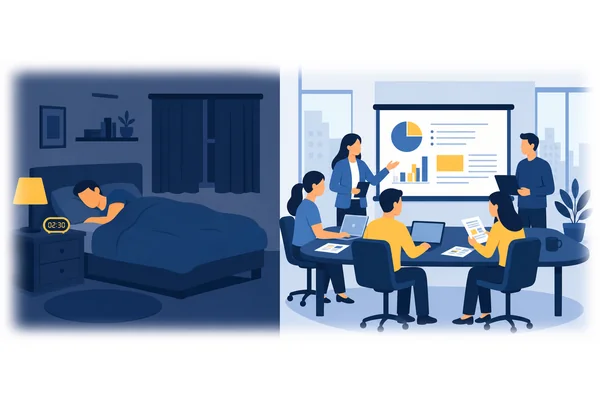
While you are sleeping, the team will be preparing the presentation.
Two simultaneous future actions · Contrast structure
When to use it
Actions at Specific Future Times
Use future continuous to describe what someone will be doing at a particular moment in the future, especially when you want to emphasize the duration or ongoing nature of the action.
"At 2 PM tomorrow, the committee will be discussing the budget proposal."
Explaining Unavailability
Use future continuous to explain why you cannot do something at a future time because you'll be occupied with another activity.
"I can't meet you on Friday afternoon because I will be working on a deadline."
Simultaneous Future Events
Use future continuous to describe two actions happening at the same time in the future, often with 'while' or 'as'.
"As you will be waiting for the bus, why don't you grab coffee?"
Signal words
at this time next...
at [specific future time]
while
when (in future context)
this time tomorrow/next week
all day
the whole time
throughout
Common Mistakes
✕
Wrong
I will going to the cinema tomorrow.
✓
Correct
I will be going to the cinema tomorrow.
The auxiliary verb "be" is mandatory in the future continuous. "Will going" is incomplete and grammatically incorrect.
✕
Wrong
At 9 PM, she will finish her homework.
✓
Correct
At 9 PM, she will be finishing her homework.
When describing an action in progress at a specific future time, use future continuous, not simple future. Finishing suggests completion.
✕
Wrong
They will working on the project next week.
✓
Correct
They will be working on the project next week.
The future continuous requires both 'be' and the -ing form; omitting 'be' creates an ungrammatical sentence.
✕
Wrong
He will be studing for the exam tomorrow afternoon.
✓
Correct
He will be studying for the exam tomorrow afternoon.
When adding -ing to a verb ending in 'e' (like study→studying), drop the 'e' before adding -ing. "Studing" is a common spelling error.
✕
Wrong
What will you be do at 3 o'clock?
✓
Correct
What will you be doing at 3 o'clock?
In questions, the structure is: question word + will + subject + be + -ing verb. "Do" must become "doing".
✕
Wrong
I will be reading a book while you will be watching TV.
✓
Correct
I will be reading a book while you watch TV.
When two actions occur simultaneously, use future continuous for the first action and simple present for the second (in the while clause).
✕
Wrong
She will be not attending the meeting tomorrow.
✓
Correct
She will not be attending the meeting tomorrow.
In negative form, "not" goes after "will", before "be". The correct order is: will + not + be + -ing.
KEY TAKEAWAYS
What to Remember
- Always include both "will" and "be" in the future continuous structure: will be + -ing form.
- Use future continuous to describe actions in progress at a specific future moment, not completed actions.
- Don't confuse future continuous with simple future; use will be -ing for ongoing actions, will + base verb for single events.
- Remember to double the final consonant before adding -ing only when the word is one syllable with a short vowel.
- Future continuous describes duration and overlap, while simple future describes completion; choose based on whether the action continues or finishes.