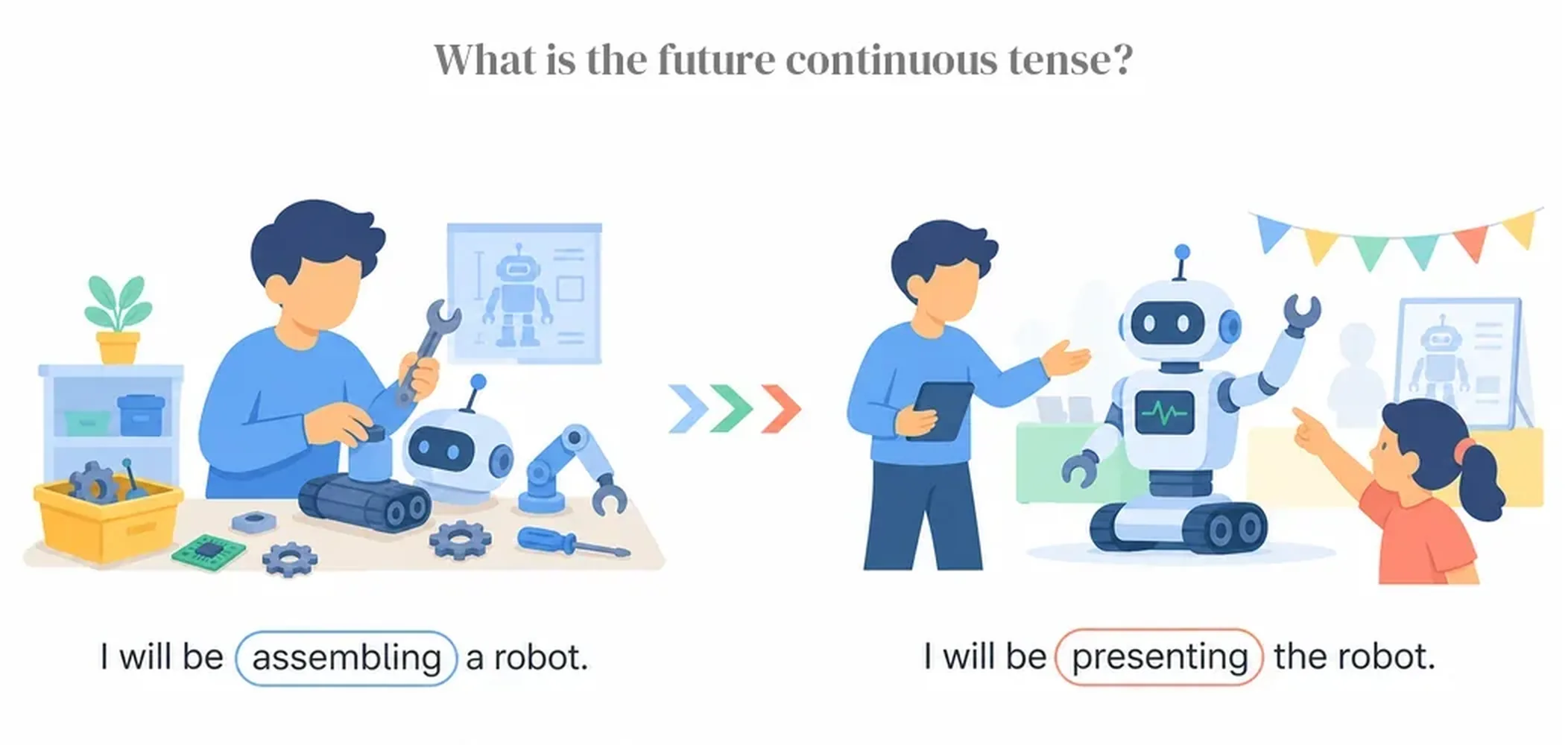
What is the Future Continuous Tense?
The future continuous tense (also called the future progressive) describes an action that will be happening at a specific moment or during a specific period in the future. It emphasizes the duration or ongoing nature of the action, rather than its completion. We form it using 'will be' + the present participle (verb + -ing). This tense is particularly useful when you want to show that two actions will overlap in time, or when you're describing what someone will be doing at an exact moment in the future.

Key Characteristics
The future continuous focuses on the process of an action, not its result or completion. Unlike the simple future ('I will finish my report'), which emphasizes completion, the future continuous ('I will be finishing my report') emphasizes that the action is ongoing. It's commonly used when discussing plans, schedules, or when you want to imagine what will be happening at a particular time. The tense works well in both formal and informal contexts, making it essential for advanced English communication.
Future Continuous Conjugation Table
| Pronoun | Positive | Negative | Question |
|---|---|---|---|
| I | I will be working | I will not be working I won't be working |
Will I be working? |
| You (singular) | You will be working | You will not be working You won't be working |
Will you be working? |
| He / She / It | He will be working She will be working It will be working |
He will not be working She won't be working It won't be working |
Will he be working? Will she be working? Will it be working? |
| We | We will be working | We will not be working We won't be working |
Will we be working? |
| You (plural) | You will be working | You will not be working You won't be working |
Will you be working? |
| They | They will be working | They will not be working They won't be working |
Will they be working? |
Structure
The future continuous follows the formula: Subject + will + be + verb-ing. The form will be remains the same for all pronouns; there is no conjugation variation.
Contractions
will not contracts to won't for all subjects. Subject contractions also exist: I'll, you'll, he'll, she'll, it'll, we'll, they'll + be working.
Spelling Rules for -ing Forms
- Silent -e: Verbs ending in a silent -e drop it before adding -ing (e.g., make → making, write → writing).
- Short vowel + single consonant: Double the final consonant (e.g., run → running, sit → sitting, swim → swimming).
- -ie verbs: Change -ie to -y (e.g., lie → lying, die → dying).
Stative Verbs
Stative verbs (e.g., know, believe, want, love, seem) are not normally used in the future continuous tense, as they describe states rather than ongoing actions.
Alternative Form: Going To + Be + Verb-ing
The structure Subject + am/is/are + going to + be + verb-ing can also express a future continuous action, especially when based on a prior plan (e.g., I am going to be working).
Examples






What to Remember
- The future continuous describes an ongoing action at a specific moment or period in the future.
- Form the future continuous with 'will be' + the present participle (base verb + -ing).
- Use it to show two future actions overlapping in time or happening simultaneously.
- The future continuous emphasizes duration and the ongoing nature of an action, not completion.
- Avoid confusing it with the simple future; use continuous for actions in progress at a time.