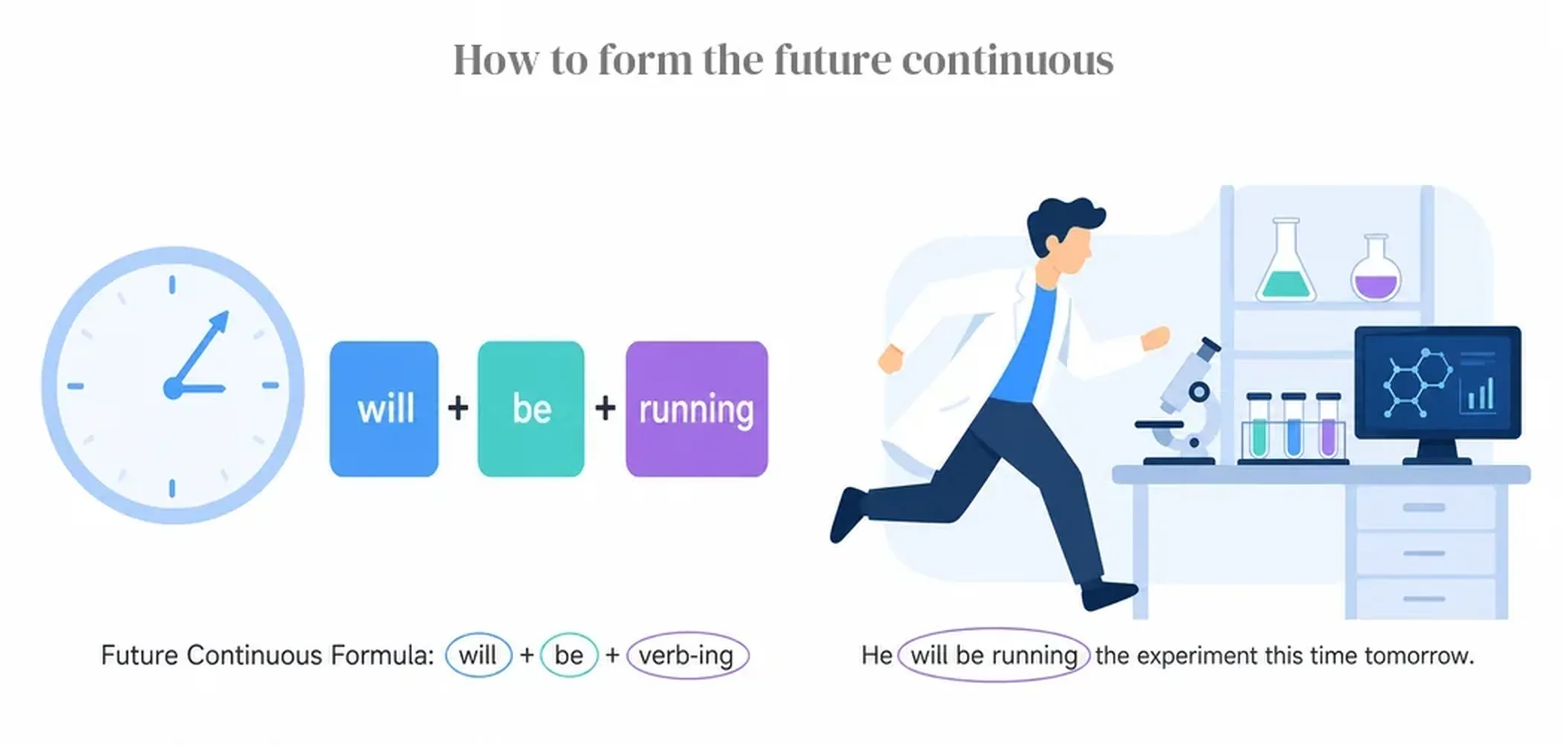
Understanding the Future Continuous
The future continuous tense describes an action that will be in progress at a specific moment in the future. It emphasises the duration or continuity of an action rather than its completion. You form it by combining 'will be' with the present participle (verb + -ing). This tense is particularly useful when you want to talk about what someone will be doing at a particular time, or when describing actions that will happen simultaneously in the future.

Future Continuous Conjugation Table
| Pronoun | Positive | Negative | Question |
|---|---|---|---|
| I | I will be working | I will not be working I won't be working |
Will I be working? |
| you (singular) | you will be working | you will not be working you won't be working |
Will you be working? |
| he / she / it | he will be working she will be working it will be working |
he will not be working she won't be working it won't be working |
Will he be working? Will she be working? Will it be working? |
| we | we will be working | we will not be working we won't be working |
Will we be working? |
| you (plural) | you will be working | you will not be working you won't be working |
Will you be working? |
| they | they will be working | they will not be working they won't be working |
Will they be working? |
Notes:
|
|||
Formula
✔ Positive
Subject
+
will
+
be
+
verb + -ing
+
(object/adverbial)
She will be working on the project tomorrow afternoon.
✖ Negative
Subject
+
will
+
not
+
be
+
verb + -ing
+
(object/adverbial)
They will not be attending the conference next week.
? Question
Will
+
subject
+
be
+
verb + -ing
+
(object/adverbial)?
Will you be using the car this evening?
Examples

At this time next year, I will be studying for my final exams.
Future action in progress at a specific time · Positive form

He will not be sleeping when you arrive—he always stays up late.
Negative statement about a future action · Negative form

Will they be staying at a hotel during their trip?
Inquiry about a future ongoing action · Question form

The team will be developing new features while we are on holiday.
Two simultaneous future actions · Positive form

Won't you be tired after such a long journey?
Contracted negative question · Question form

We will be having lunch when the meeting starts.
Action in progress at a specific future moment · Positive form
When to use it
Actions at Specific Times
Use future continuous to describe what will happen at a particular moment in the future. This is common when making plans or predictions.
"At 3 PM, I will be attending a meeting with the director."
Simultaneous Future Actions
Describe two actions happening at the same time in the future, often to show contrast or connection between events.
"While you are cooking dinner, I will be setting the table."
Polite Questions
The future continuous is often used in questions to ask about someone's plans or availability in a natural, polite way.
"Will you be free next Tuesday to discuss the project?"
Temporary Situations
Talk about situations or actions that will be ongoing for a period of time, emphasising their temporary nature.
"We will be renovating our office for the next two months."
Signal words
at this time
at that moment
when
while
next week/month/year
tomorrow
this time next...
during
tonight
in the evening
Common Mistakes
✕
Wrong
She will be work on the presentation tomorrow.
✓
Correct
She will be working on the presentation tomorrow.
The present participle requires -ing. Use 'working,' not 'work.'
✕
Wrong
Will be you arriving at noon?
✓
Correct
Will you be arriving at noon?
In questions, the subject comes directly after 'will,' before 'be.'
✕
Wrong
He will being studying when you call.
✓
Correct
He will be studying when you call.
Do not repeat the auxiliary verb. Use 'will be,' not 'will being.'
KEY TAKEAWAYS
What to Remember
- The future continuous combines 'will be' with the present participle form (verb + -ing).
- Use it to describe an action in progress at a specific future moment.
- It emphasises duration and continuity rather than completion of the action.
- Employ this tense to discuss simultaneous future actions or what someone will be doing.
- Don't use simple future when emphasising that an action will be ongoing at a time.