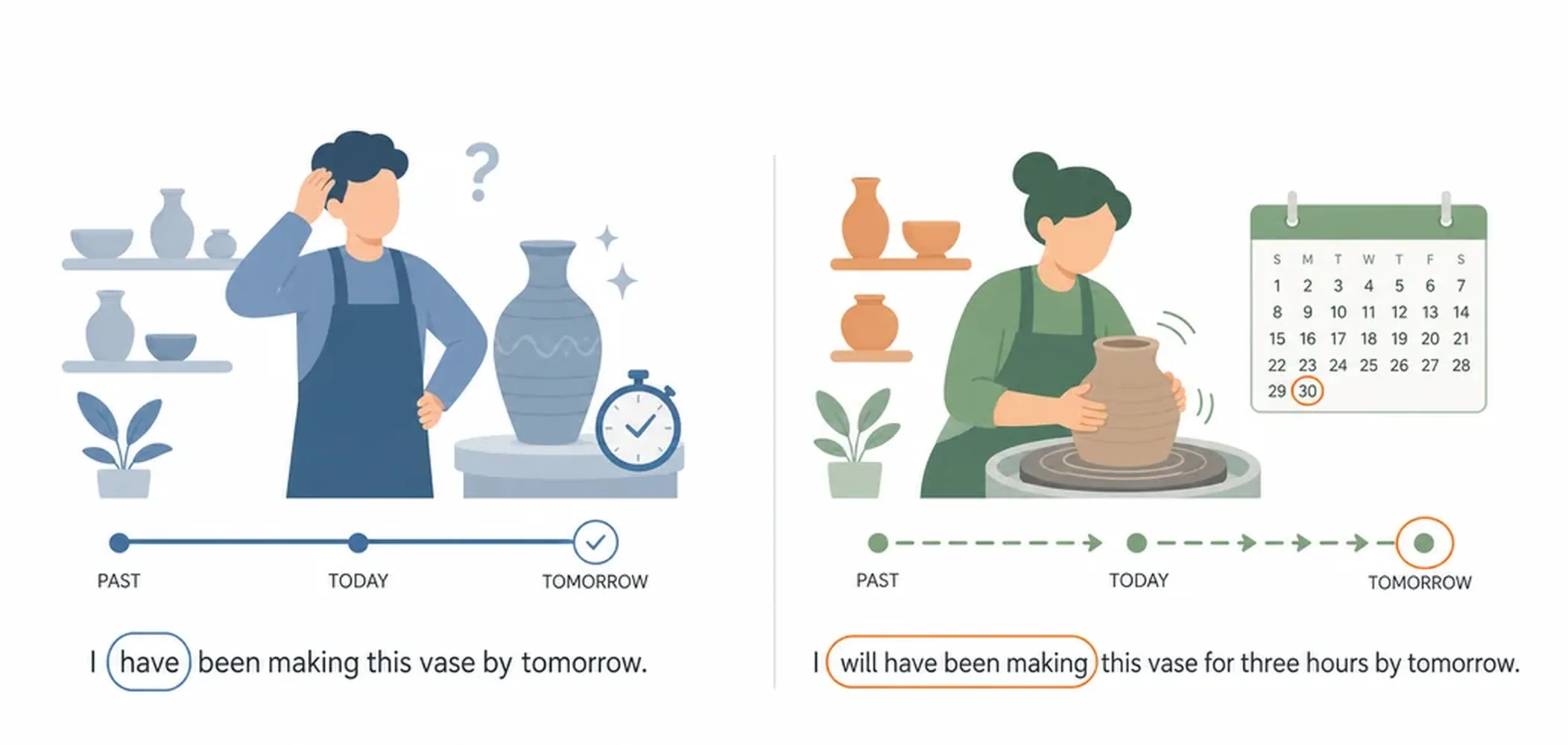
Why Learners Struggle with Future Perfect Continuous
The future perfect continuous tense combines multiple grammatical layers—auxiliary verbs, continuous aspect, and perfect aspect—making it prone to formation errors. C1 learners often confuse it with future perfect simple, misconstruct the auxiliary chain, or misplace duration expressions. These mistakes frequently stem from interference with similar tenses or uncertainty about which aspect emphasizes duration versus completion.

Future Perfect Continuous vs. Future Perfect Simple — Side-by-Side Comparison
| Dimension | Future Perfect Continuous | Future Perfect Simple |
|---|---|---|
| Form | will + have + been + verb-ing e.g. will have been working |
will + have + past participle e.g. will have worked |
| When to use | To emphasise the duration or ongoing nature of an action that will still be in progress up to a specific point in the future. Focus is on the process. | To emphasise that an action will be completed before a specific point in the future. Focus is on the result or completion. |
| Positive example | By next month, she will have been studying French for three years. (Stresses the three years of ongoing study.) |
By next month, she will have finished her French course. (Stresses that the course will be done.) |
| Negative example | By Friday, he won't have been sleeping enough to stay focused. | By Friday, he won't have completed the report. |
| Question example | Will you have been waiting long by the time I arrive? | Will you have finished dinner by the time I arrive? |
| Key signal words | for + period of time, by then / by the time, how long, all day / all year | by + time, before, already, yet, once, by the time |
| Key Difference: Both tenses refer to events set before a future deadline, but they answer different questions. The Future Perfect Continuous answers "How long will something have been happening?" — it highlights duration and the ongoing effort or process involved. The Future Perfect Simple answers "Will something be done by then?" — it highlights completion and the resulting state. A common mistake is using the future perfect simple when the speaker wants to emphasise length of time (e.g. saying "I will have worked here for ten years" instead of "I will have been working here for ten years"), or conversely using the continuous form with verbs that describe states or instantaneous completions rather than ongoing actions. | ||
Formula
✔ Positive
Subject
+
will have been
+
verb (-ing)
+
for/since + time expression
She will have been researching this topic for three months by graduation.
✖ Negative
Subject
+
will not have been
+
verb (-ing)
+
for/since + time expression
They will not have been working on the project for very long when it's completed.
? Question
Will
+
subject
+
have been
+
verb (-ing)
+
for/since + time expression?
Will you have been living abroad for two years by next summer?
Examples
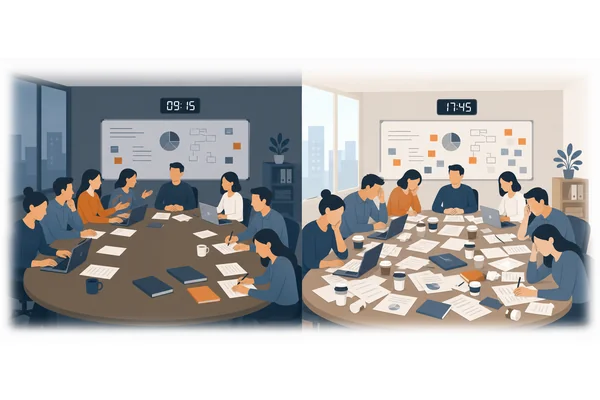
By the time the conference ends, we will have been discussing this proposal for two days straight.
Emphasizes continuous duration leading up to a future point · Professional context
①discussing the proposal for two days
→
②conference ends
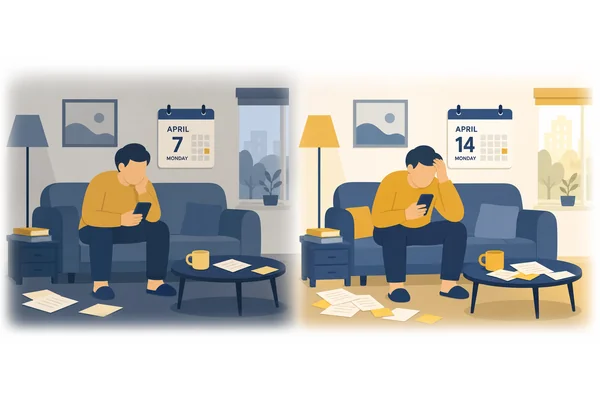
If you don't call her soon, she will have been waiting for your response for a week.
Implies frustration; stresses the extended waiting period · Interpersonal context
①she starts waiting for your response
→
②one week passes from now
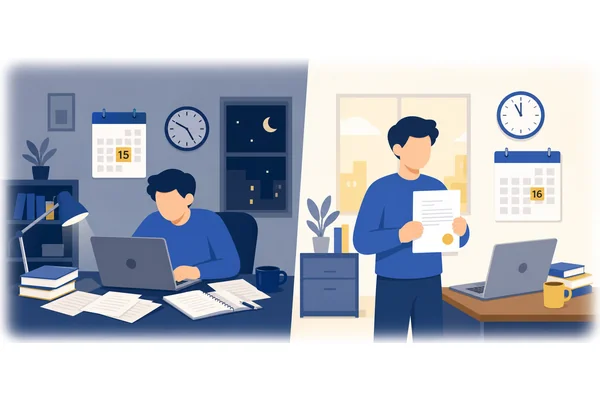
How long will you have been working on this assignment by the submission deadline?
Question form; queries duration accumulated by a future deadline · Academic context
①you start working on the assignment
→
②submission deadline arrives
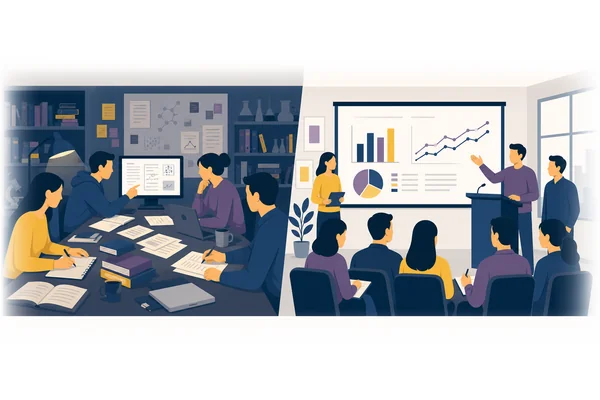
They will have been conducting research for five years by the time they publish their findings.
Links a long-term ongoing process to a future completion point · Scientific context
①They conduct research for five years
→
②They publish their findings
When to use it
Emphasizing Duration
Highlight how long an action will have continued up to a specific future moment, stressing the accumulated time rather than the completion itself.
"By 2030, climate scientists will have been studying glacial melt for decades."
Causal Consequences
Show how an extended future action leads to or explains a future consequence or situation.
"If you keep interrupting her, she will have been losing her patience for hours."
Professional Timelines
In business and academic contexts, link an ongoing project or role to measurable future milestones.
"By the project deadline, our team will have been integrating feedback for several weeks."
Signal words
by + future date
by the time
for + duration
since + starting point
how long
when + future clause
Common Mistakes
✕
Wrong
By next year, I will be working here for five years.
✓
Correct
By next year, I will have been working here for five years.
Future continuous emphasizes the action at a moment; future perfect continuous emphasizes duration up to that moment.
✕
Wrong
She will have worked on the project for two months by June.
✓
Correct
She will have been working on the project for two months by June.
Future perfect simple (will have worked) focuses on completion; use continuous to emphasize the ongoing duration.
✕
Wrong
They will been studying for the exam when you arrive.
✓
Correct
They will have been studying for the exam when you arrive.
Omitting 'have' breaks the auxiliary chain; will have been is the correct structure.
✕
Wrong
By December, we will have been living in this house since 2015 already.
✓
Correct
By December, we will have been living in this house since 2015.
'Since' already indicates the starting point; adding 'already' is redundant and weakens the sentence.
✕
Wrong
How long will you have working here by next month?
✓
Correct
How long will you have been working here by next month?
Questions require the full auxiliary sequence: will + have + been + -ing form.
✕
Wrong
The team will have been developing the software five years.
✓
Correct
The team will have been developing the software for five years.
Duration periods require 'for'; 'for five years' is the correct prepositional phrase.
✕
Wrong
By the time she arrives, I will have been sleep for three hours.
✓
Correct
By the time she arrives, I will have been sleeping for three hours.
The -ing form requires 'sleeping' not base form 'sleep' in continuous constructions.
KEY TAKEAWAYS
What to Remember
- Use will + have + been + verb-ing to form the future perfect continuous tense correctly.
- Duration expressions (for + time period) emphasize the continuous aspect, not completion points.
- The future perfect continuous shows an action ongoing up to a specific future moment.
- Don't confuse future perfect continuous with future perfect simple; one emphasizes duration, one completion.
- By the time clause + future perfect continuous indicates how long an action will have lasted.