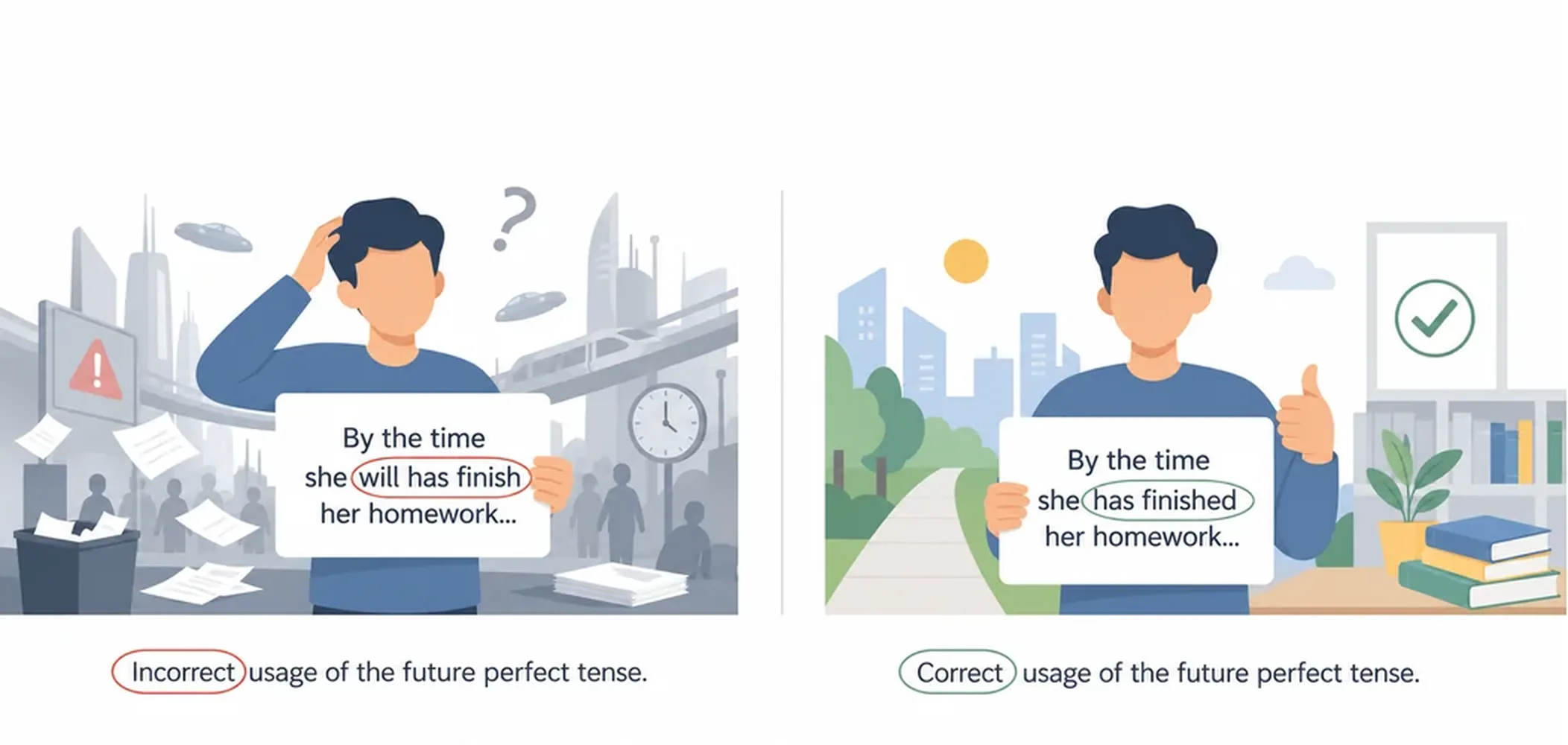
Why C1 Learners Struggle with Future Perfect
Even advanced learners frequently misuse the future perfect because it requires simultaneous awareness of three time references: a fixed future moment, completion before that moment, and the present perspective. The error patterns typically stem from confusion between future perfect and future continuous, incorrect auxiliary verb placement, or failure to recognise when a future time marker renders the future perfect unnecessary. Understanding these pitfalls will refine your precision in formal and academic contexts.

Future Perfect Formula
The future perfect tense expresses an action that will be completed before a specific point in the future. The structure follows a consistent pattern across affirmative, negative, and question forms.
| Form | Structure | Example |
|---|---|---|
| Affirmative | Subject + will + have + past participle | She will have finished the report by Friday. |
| Negative | Subject + will + not + have + past participle | They will not have left by then. |
| Question | Will + subject + have + past participle? | Will you have completed the project by next week? |
Key Components Explained
will — the modal auxiliary that marks future time
have — the auxiliary verb that indicates completion
past participle — the main verb in its past participle form (e.g., finished, left, completed, written)
Examples

By the time the conference concludes on Friday, the committee will have reviewed over two hundred proposals.
Academic/professional context · Emphasis on completion before a defined future point
①committee reviews over two hundred proposals
→
②conference concludes on Friday

She will have earned her certification by the end of next month, allowing her to apply for the senior position.
Professional planning · Future perfect enabling a subsequent event
①She earns her certification
→
②End of next month
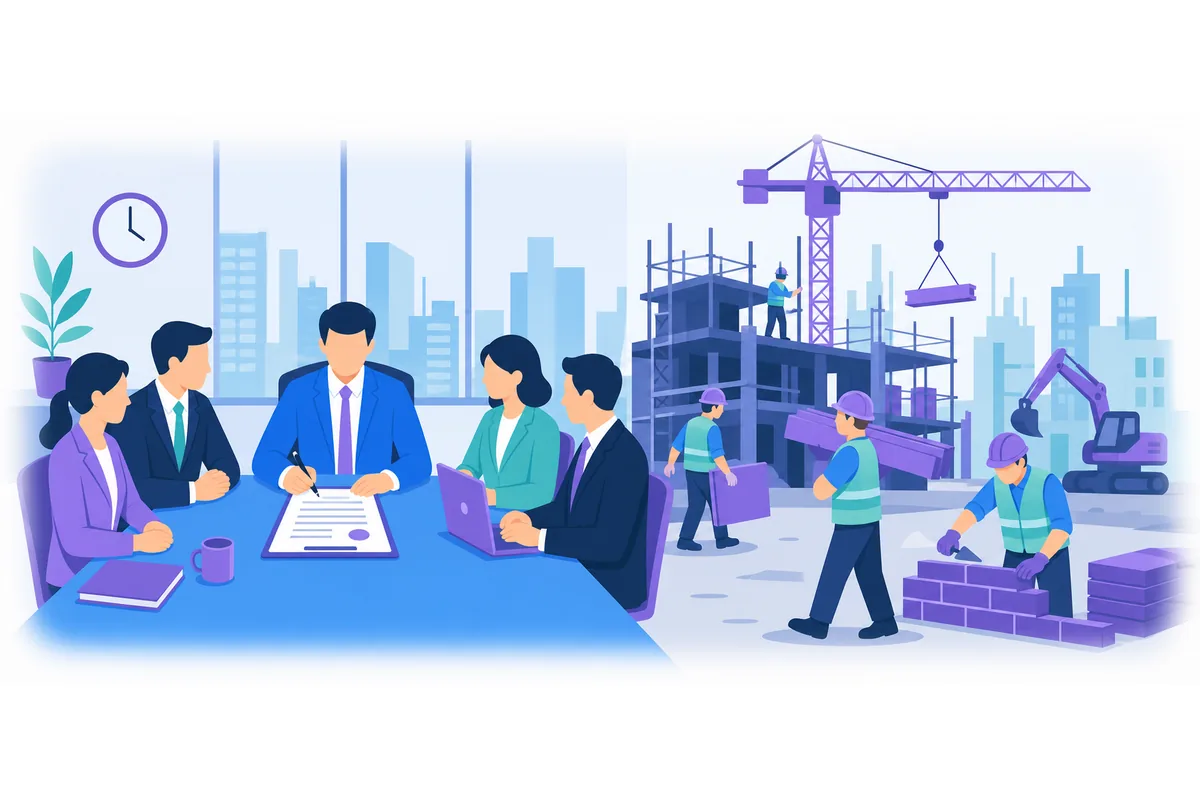
Once we sign the contract, they will have received their deposit and begun construction.
Formal agreement · Conditional sequence with future perfect
①they receive their deposit and begin construction
→
②we sign the contract

Assuming no further delays, the renovation will have been completed for three months before the exhibition opens.
Formal projection · Extended time reference with future perfect
①renovation will have been completed
→
②exhibition opens
When to use it
Project Planning
Express when milestones will be completed before a deadline, essential for formal project documentation and stakeholder communication.
"By Q3, we will have launched the platform and onboarded 500 enterprise clients."
Academic Predictions
Establish completion of qualifications or research before future events or career transitions.
"By her graduation, she will have published two peer-reviewed papers."
Sequential Events
Clarify that one action must finish before another begins, critical for instructions and conditional statements.
"Before you submit the final proposal, you will have completed all three review rounds."
Signal words
by
by the time
by then
before
within
in
by the end of
once
as soon as
after
Common Mistakes
✕
Wrong
By next Friday, I will complete the report.
✓
Correct
By next Friday, I will have completed the report.
Future perfect (will have + past participle) signals completion before a future deadline. Simple future implies the action may still be ongoing at that point.
✕
Wrong
She will have been finishing her PhD by 2026.
✓
Correct
She will have finished her PhD by 2026.
Completion requires future perfect, not future perfect continuous. Use continuous only if emphasising duration up to that moment: 'She will have been studying for five years.'
✕
Wrong
Once you will arrive, I will have prepared dinner.
✓
Correct
Once you arrive, I will have prepared dinner.
Time clauses use present tense, not future. The main clause carries the future perfect to show completed action before arrival.
✕
Wrong
By the time he calls, I will finish the work.
✓
Correct
By the time he calls, I will have finished the work.
Without future perfect, the sentence suggests the work will finish at the moment of the call, not before it. Future perfect establishes prior completion.
✕
Wrong
They will have accomplished the goal until the end of the year.
✓
Correct
They will have accomplished the goal by the end of the year.
'Until' suggests duration up to that point; 'by' denotes completion before a deadline. Future perfect requires 'by' for point-in-time completion.
✕
Wrong
If she will have submitted her application early, she will get the scholarship.
✓
Correct
If she has submitted her application early, she will get the scholarship. / If she submits her application early, she will get the scholarship.
Conditional clauses use present or present perfect, never future or future perfect. Future tense in the if-clause is non-standard in formal English.
✕
Wrong
I will have been writing three novels by next autumn.
✓
Correct
I will have written three novels by next autumn.
Countable achievements require future perfect simple. Continuous is used only for ongoing actions or emphasised duration: 'I will have been writing for ten years.'
KEY TAKEAWAYS
What to Remember
- Use will have + past participle to express an action completed before a specific future moment.
- Future perfect requires three time references: present moment, future completion point, and the action itself.
- Distinguish future perfect (will have done) from future continuous (will be doing) by completion versus duration.
- Avoid future perfect when a future time marker alone makes the completion meaning clear.
- Ensure auxiliary verb 'have' precedes the past participle without inserting other verbs between them.