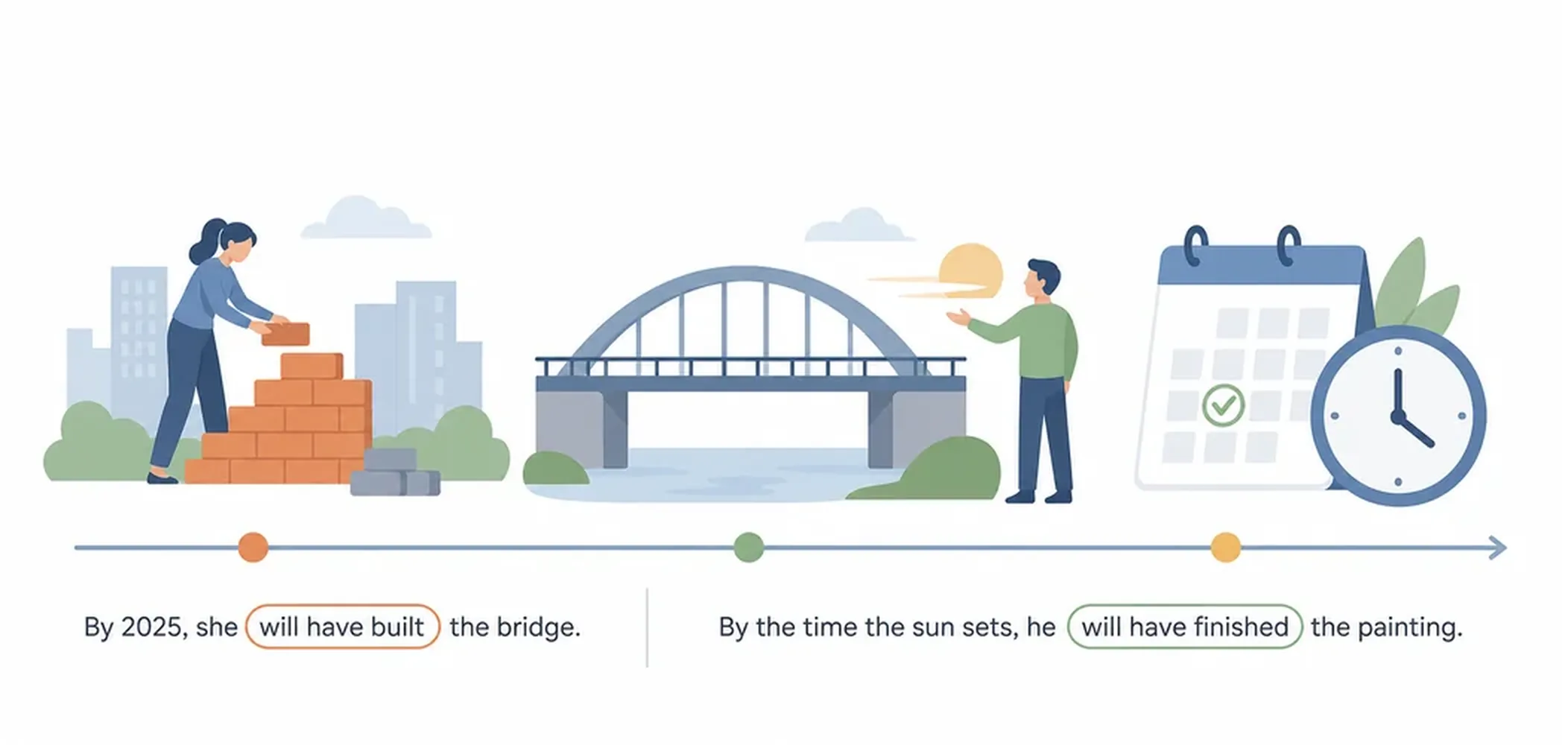
Understanding Future Perfect with 'By' and 'By the Time'
The future perfect tense expresses an action that will be completed before a specific point in the future. When combined with 'by' or 'by the time', it establishes a clear temporal boundary—indicating that something will be finished before that deadline or moment arrives. This structure is essential for expressing anticipated completion, deadlines, and the relationship between two future events. At the C1 level, mastering these constructions allows you to articulate complex temporal relationships with precision and nuance.

Structural Differences: 'By' versus 'By the Time'
'By' introduces a specific point in time (a date, hour, or moment) and emphasizes completion before that moment: 'By 2030, we will have solved climate change' (unlikely, but grammatically illustrates the concept). 'By the time' introduces a clause describing an action or event that will occur; the future perfect action will be complete before that event happens: 'By the time you arrive, I will have finished dinner.' Both create a sense of sequence, but 'by the time' involves two interconnected future events, while 'by' marks a fixed temporal point. Understanding this distinction prevents temporal ambiguity and strengthens your ability to convey sophisticated timelines.
Pragmatic Use and Register Considerations
At C1 level, recognize that future perfect with 'by' and 'by the time' appears frequently in formal contexts—business correspondence, academic writing, and professional planning. These constructions signal certainty and planning; they're used when speakers are confident about completion. In casual speech, native speakers often simplify to present simple or going-to future, but formal writing demands precision. Additionally, context determines whether 'by' or 'by the time' is more appropriate: use 'by' for fixed deadlines; use 'by the time' when emphasizing the sequence between two future actions or when the second event's timing is uncertain.
By vs. By the Time: Side-by-Side Comparison
| Dimension | by | by the time |
|---|---|---|
| Form | by + specific time reference (noun phrase, date, time expression) e.g. by Friday, by 6 o'clock, by next year |
by the time + subject + verb (full clause) e.g. by the time she arrives, by the time we finish |
| What follows it | A noun phrase — a specific point in time, a date, a deadline, or a time expression. No verb follows directly. | A full subordinate clause containing a subject and a verb. The verb in the subordinate clause is usually in the present simple (for future reference) or past simple (for past reference). |
| When to use | Use by to indicate a deadline — to say that an action will be completed at or before a fixed, named point in time. | Use by the time to relate the completion of one action to the moment another action happens. It emphasises that one event will already be done when a second event occurs. |
| Positive example | She will have finished the report by Monday. (The report will be done no later than Monday.) |
By the time he gets home, dinner will have been ready for an hour. (Dinner will already be ready when he arrives.) |
| Negative example | They won't have saved enough money by December. (They will not reach their savings goal before December.) |
By the time the film starts, we won't have found our seats. (We will not be seated before the film begins.) |
| Question example | Will you have completed the project by next Friday? (Asking whether completion will happen before the deadline.) |
Will you have eaten by the time I arrive? (Asking whether eating will be done before the speaker arrives.) |
| Tense in the time clause | Not applicable — by is followed by a noun phrase, not a clause, so no additional tense is needed. | The verb in the by the time clause uses present simple when referring to the future (e.g. by the time she arrives) and past simple for past contexts (e.g. by the time he got there). |
| Key signal words | Specific times: by tonight, by noon, by 2025, by the end of the week, by then, by now | Clauses with events: by the time you read this, by the time we land, by the time they wake up |
Examples






What to Remember
- Use future perfect (will have + past participle) to show completion before a specific future time.
- 'By' indicates a deadline or point in time; the action must be completed before that moment.
- 'By the time' introduces a future event; the first action completes before the second event happens.
- The future perfect emphasizes completion, not the action itself; avoid using simple future for this meaning.
- Don't confuse 'by' (deadline) with 'when' (simultaneous events); use future perfect primarily with 'by' constructions.