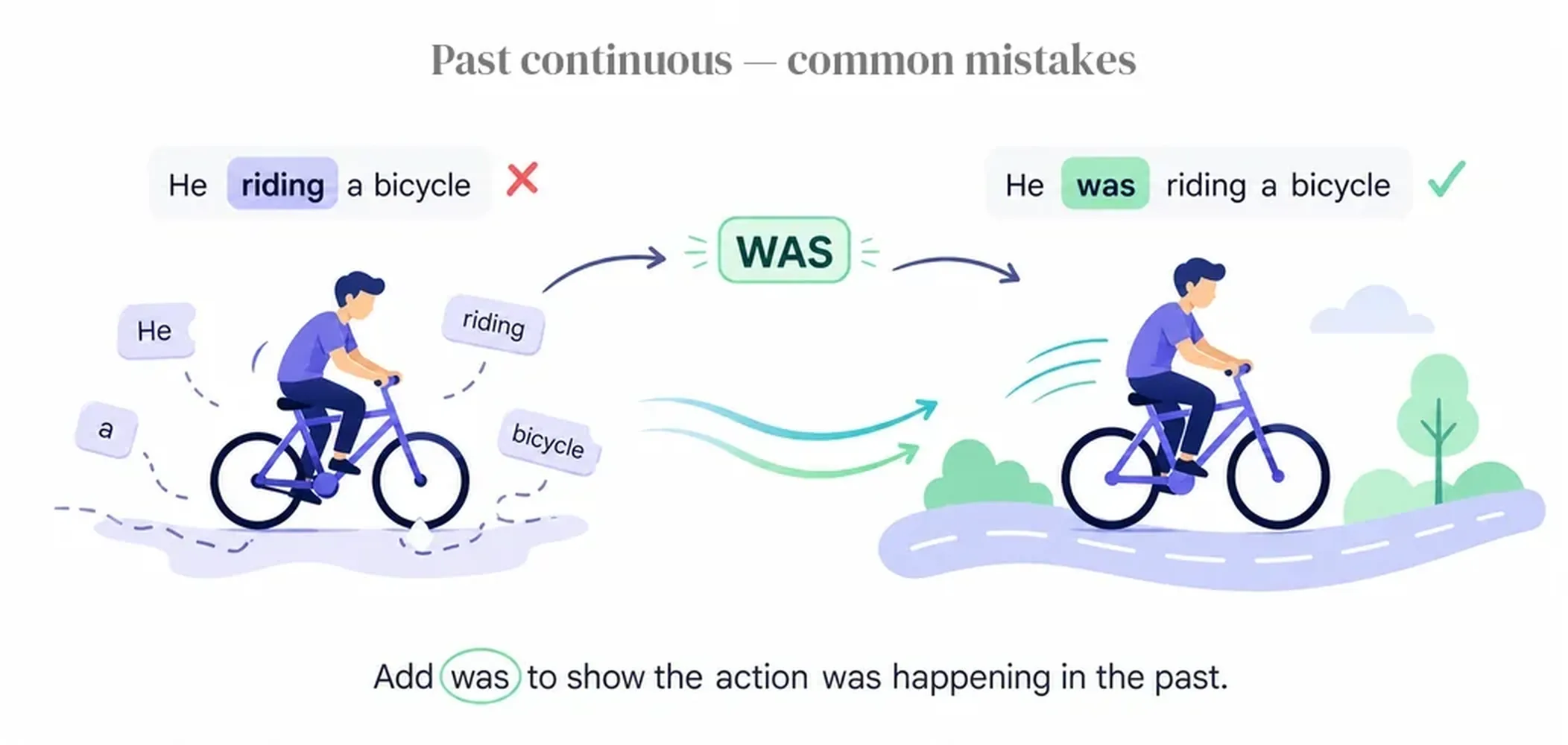
Why Do Learners Make Mistakes With Past Continuous?
The past continuous tense can be tricky because it has two parts: was/were + verb-ing. Learners often forget one part, mix up the form, or use it when a different past tense is better. In this lesson, we show you the most common errors and how to fix them.

Past Continuous Formula
| Structure Type | Pattern | Example |
|---|---|---|
| Positive | Subject + was/were + verb -ing + object/details | She was reading a book when I called. |
| Negative | Subject + was/were + not + verb -ing + object/details | They were not listening during the lesson. |
| Question | Was/Were + subject + verb -ing + object/details? | Were you sleeping when she arrived? |
Key Points
Use was with singular subjects (I, he, she, it). Use were with plural subjects (you, we, they). The verb -ing form remains the same in all three structures—only the auxiliary verb and word order change.
Examples

I was reading a book when my friend called.
Action in progress interrupted by another past action

They were playing football at 5 p.m. yesterday.
Action happening at a specific time in the past

While she was cooking, the children were doing their homework.
Two actions happening at the same time in the past

Were you sleeping when I came home?
Question form with was/were before the subject
When to use it
Interrupted Action
Use past continuous for an action that was happening when another action interrupted it.
"I was taking a shower when the phone rang."
Action at a Specific Time
Use past continuous to say what was happening at a particular time in the past.
"What were you doing at 8 p.m. last night?"
Two Simultaneous Actions
Use past continuous to show two actions happening at the same time in the past.
"While he was working, she was cooking dinner."
Signal words
while
when
as
during
yesterday at [time]
last [day] at [time]
all morning
all evening
Common Mistakes
✕
Wrong
I was study when you called me.
✓
Correct
I was studying when you called me.
After was/were, always add -ing to the verb. Use 'studying', not 'study'.
✕
Wrong
She were playing tennis yesterday at 3 p.m.
✓
Correct
She was playing tennis yesterday at 3 p.m.
Use 'was' with singular subjects (he, she, it). 'Were' is only for plural (we, they, you).
✕
Wrong
They was watching a movie when I arrived.
✓
Correct
They were watching a movie when I arrived.
'They' is plural, so you need 'were', not 'was'.
✕
Wrong
What you was doing at noon?
✓
Correct
What were you doing at noon?
In questions, put 'was/were' before the subject. Say 'were you', not 'you was'.
✕
Wrong
I not was cooking dinner. I was sleeping.
✓
Correct
I was not cooking dinner. I was sleeping.
Put 'not' after was/were, not before. Say 'was not', not 'not was'.
✕
Wrong
He was walk home when it started to rain.
✓
Correct
He was walking home when it started to rain.
Always use the -ing form after was/were. 'Walking', not 'walk'.
✕
Wrong
I was studying and writed the homework.
✓
Correct
I was studying and wrote the homework.
Use past continuous only for the action in progress. For the completed action, use simple past 'wrote'.
KEY TAKEAWAYS
What to Remember
- Use was or were + a verb ending in -ing to form the past continuous tense.
- Remember both parts of the structure; forgetting was/were or -ing is a common mistake.
- Use past continuous for actions in progress at a specific time in the past.
- Don't use past continuous for completed actions; use simple past tense instead.
- Use past continuous with simple past when one action interrupted another action.