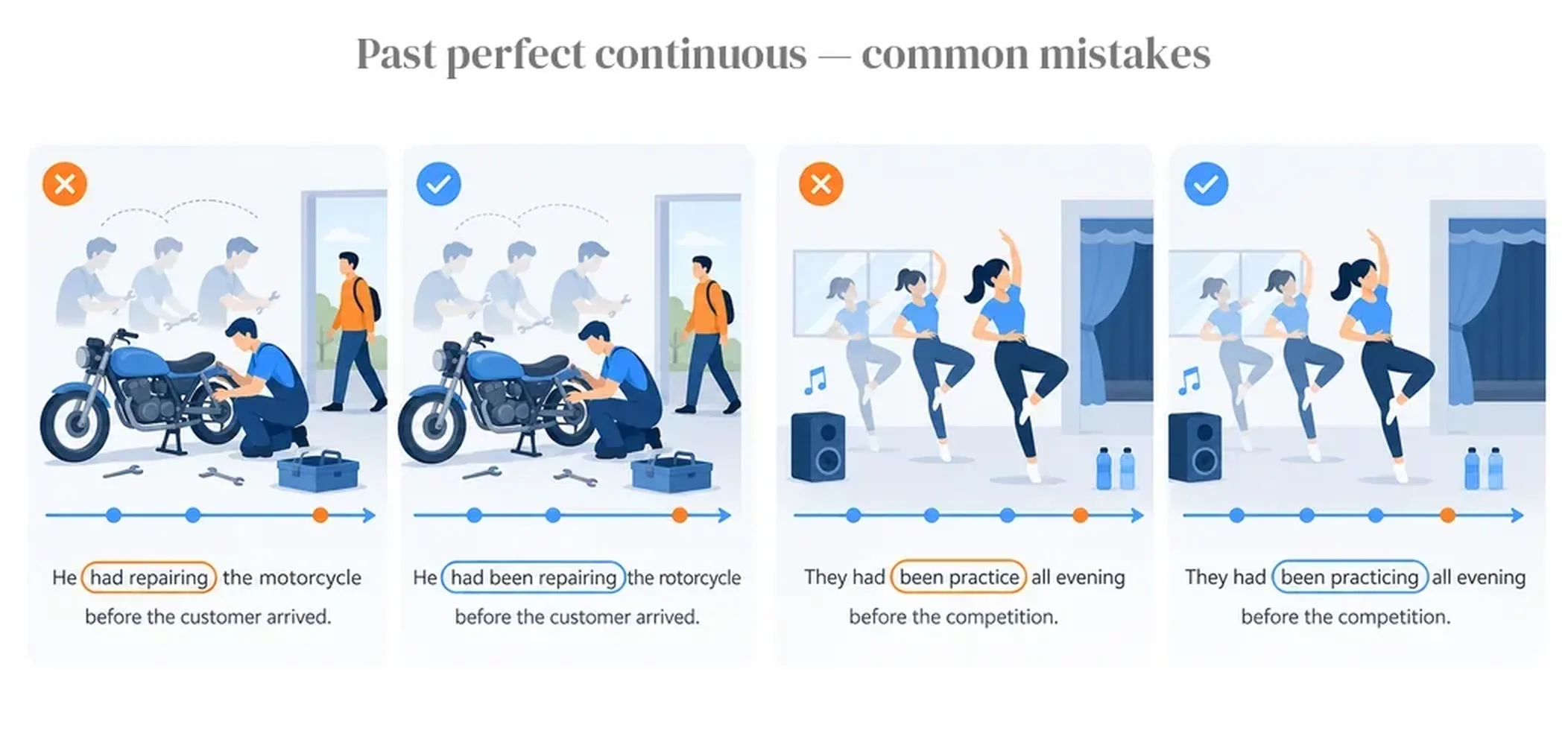
Why C1 Learners Struggle with Past Perfect Continuous
The past perfect continuous (had been + -ing) presents three main pitfalls for advanced learners: confusing it with past perfect simple, mishandling the auxiliary verb 'had', and miscalculating which time reference anchors the action. Unlike simpler tenses, PPCT requires precise understanding of duration, completion, and temporal relationships. These mistakes often stem from interference from learners' L1 or from underestimating the subtle distinctions that distinguish it from nearby tenses.

Past Perfect Continuous vs. Past Perfect Simple — Side-by-Side Comparison
| Dimension | Past Perfect Continuous | Past Perfect Simple |
|---|---|---|
| Form | had + been + verb-ing e.g., had been working |
had + past participle (3rd form) e.g., had worked |
| When to use | To emphasise the duration or ongoing nature of an activity that was in progress before another past event. The action may or may not have been completed. | To emphasise the completion of an action before another past event. The focus is on the result or the fact that it happened, not on how long it took. |
| Focus | Duration / Process — How long something had been going on | Completion / Result — Whether something was finished |
| Positive example | She had been studying for three hours when the power went out. (Emphasises the length of time spent studying.) |
She had studied the whole chapter before the power went out. (Emphasises that the chapter was finished.) |
| Negative example | He hadn't been sleeping well for weeks before he saw the doctor. (Ongoing poor sleep over a period.) |
He hadn't slept at all before the exam started. (No sleep at all — a completed zero.) |
| Question example | How long had you been waiting before the bus arrived? (Asking about duration.) |
Had you already waited an hour before the bus arrived? (Asking whether a specific amount of waiting was completed.) |
| Key signal words | for, since, all day, all morning, how long, the whole time, lately, recently | already, just, by the time, once, never, finally, as soon as, before, after |
| Common mistake | ❌ "I had been finished the report before noon." ✅ Use Past Perfect Simple here: "I had finished the report before noon." |
❌ "She had worked there for ten years when she retired." (acceptable but loses the durational nuance) ✅ More vivid with continuous: "She had been working there for ten years when she retired." |
| Key Difference: Use the Past Perfect Continuous when you want to stress how long an activity had been ongoing before a past point — the duration is the main message. Use the Past Perfect Simple when you want to stress that an action was completed before a past point — the result or the fact of completion is the main message. Ask yourself: "Am I focusing on the length of time (→ continuous) or on the finished result (→ simple)?" | ||
Formula
✔ Positive
Subject
+
had
+
been
+
verb + -ing
+
for/since + time
They had been living in Paris for five years before moving to Berlin.
✖ Negative
Subject
+
had not (hadn't)
+
been
+
verb + -ing
+
for/since + time
She hadn't been attending meetings for weeks when she finally resigned.
? Question
Had
+
Subject
+
been
+
verb + -ing
+
when/before
How long had you been working there before the restructuring occurred?
Examples

By the time she arrived, I had been waiting for over an hour.
C1 · Emphasis on duration before an interrupting past event
①I started waiting
→
②she arrived

The factory had been producing goods continuously since the 1950s until it closed in 2020.
C1 · Extended duration spanning decades, anchored by closure
①factory started producing goods in the 1950s
→
②factory closed in 2020
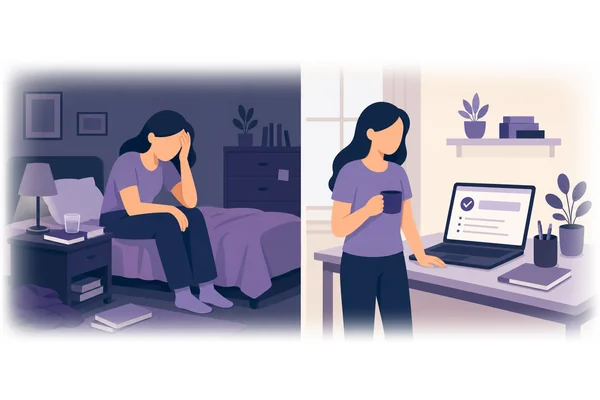
She hadn't been feeling well for days, which made the decision to withdraw from the competition inevitable.
C1 · Negative form showing prolonged state leading to consequence
①She was not feeling well for days
→
②She withdrew from the competition

The negotiations had been proceeding smoothly until the unexpected disagreement emerged.
C1 · Ongoing process interrupted by a turning point
①negotiations proceeding smoothly
→
②unexpected disagreement emerged
Common Mistakes
✕
Wrong
She had written the report for three hours when the meeting started.
✓
Correct
She had been writing the report for three hours when the meeting started.
Past perfect simple emphasizes completion; continuous emphasizes duration and ongoing activity. Use 'had been + -ing' to show the action was in progress.
✕
Wrong
They been working there since 2015 before they retired.
✓
Correct
They had been working there since 2015 before they retired.
The auxiliary 'had' is mandatory in past perfect continuous. Omitting it creates an incomplete verb phrase; 'been' alone is not a finite verb.
✕
Wrong
He had been studying English for five years and then he stopped.
✓
Correct
He had been studying English for five years before he stopped.
Use 'before' to mark the relationship between two past events. 'And then' suggests sequential narrative tense shifts rather than a clear time boundary.
✕
Wrong
We had been living abroad for two years yesterday.
✓
Correct
We had been living abroad for two years before we moved back.
'Yesterday' is a point in time, not a reference event. PPCT requires a past event (main clause) to complete the temporal frame.
✕
Wrong
She wasn't been sleeping well for weeks before the exam.
✓
Correct
She hadn't been sleeping well for weeks before the exam.
The past perfect continuous requires 'hadn't been' not 'wasn't been' to express an ongoing action before a past event.
✕
Wrong
What had you been do when the power cut off?
✓
Correct
What had you been doing when the power cut off?
After 'had been', always use the -ing form (gerund/present participle). 'Do' is the base form and creates an ungrammatical construction.
✕
Wrong
They had been worked on the project for months, which explained the results.
✓
Correct
They had been working on the project for months, which explained the results.
'Work' requires -ing form after 'had been'. The base verb form 'worked' appears only in simple tenses, not in continuous forms.
KEY TAKEAWAYS
What to Remember
- Use past perfect continuous for actions that continued up to a specific past moment, not for completed actions.
- Always include both 'had' and 'been' plus the -ing form; omitting either creates a common structural error.
- Distinguish between past perfect continuous (duration/ongoing) and past perfect simple (completion) based on what the sentence emphasizes.
- The time reference point anchors when the continuous action ended; identify this anchor to use the tense correctly.
- Do not use past perfect continuous for repeated single actions; use past perfect simple instead for that meaning.