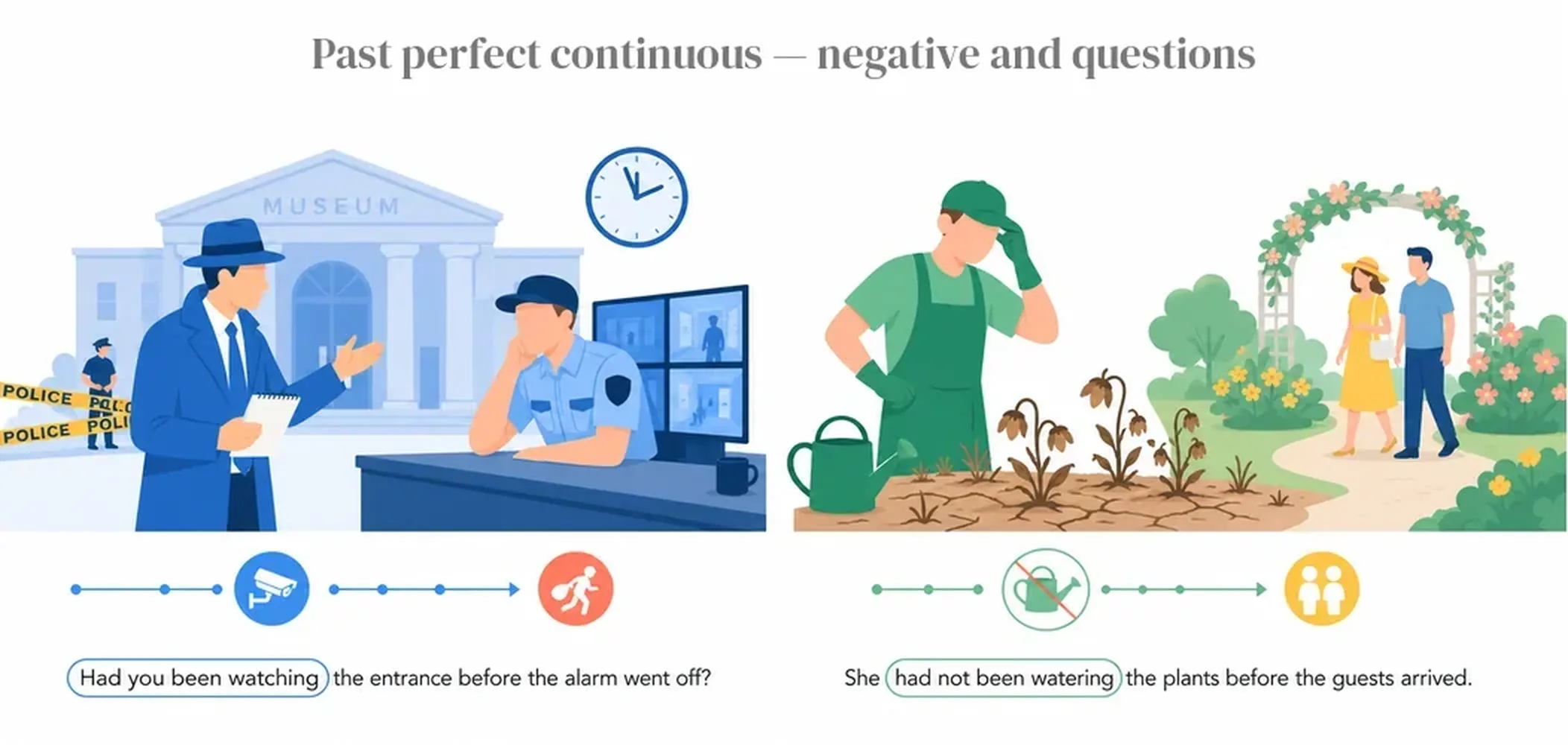
Understanding Past Perfect Continuous in Negative and Question Forms
The past perfect continuous expresses actions or states that continued up to a specific moment in the past, and that had already been happening when another past event occurred. While affirmative sentences follow a straightforward pattern, negatives and questions require careful attention to auxiliary verb placement and the interaction between had, been, and the -ing form. At C1 level, precision in these constructions is essential for sophisticated narrative and analytical writing.

Negative Past Perfect Continuous Examples
Negative constructions negate the entire continuous action in the past. The negation (not / n't) appears immediately after had, and the structure remains fluid and natural at higher proficiency levels.
Question Forms: Past Perfect Continuous
Questions invert the subject and the first auxiliary (had). This form is particularly useful for probing the duration or circumstances of past actions, and is common in interviews, academic discussions, and narrative construction.
Pro Tip: Distinguishing Negatives from Yes/No Questions
A frequent source of confusion at C1 level is the difference between contracted negatives (hadn't been studying) and inverted questions (Had they been studying?). Remember: negation moves after had; inversion moves had before the subject. Both constructions use the same core form (had + been + -ing), but their function and word order differ fundamentally.
Negative and Question Formulas
The past perfect continuous has two main forms in questions and negatives: the standard form and the contracted form (in negatives only).
| Subject | Auxiliary | Past Participle | Example |
|---|---|---|---|
| I / You / He / She / It / We / They | had | been + verb-ing | She had been working all morning. |
| Form | Structure | Example |
|---|---|---|
| Standard | Subject + had + not + been + verb-ing | They had not been sleeping well before the exam. |
| Contracted | Subject + hadn't + been + verb-ing | They hadn't been sleeping well before the exam. |
| Question Type | Structure | Example |
|---|---|---|
| Yes/No Question | Had + Subject + been + verb-ing? | Had she been working all morning? |
| Wh- Question | Question word + had + Subject + been + verb-ing? | What had they been doing before we arrived? |
| Question | Affirmative Answer | Negative Answer |
|---|---|---|
| Had he been studying? | Yes, he had. | No, he hadn't. |
| Had they been waiting? | Yes, they had. | No, they hadn't. |
Examples






What to Remember
- Use had + been + -ing for affirmative; negate by placing not after had in negatives.
- In questions, invert had to the beginning: Had + subject + been + -ing + complement?
- The -ing form never changes; all tense information comes from had and been positioning.
- In negative questions, use hadn't been + -ing to avoid double negation errors.
- Remember the three-part structure is fixed: had/hadn't + been + -ing, with no variations allowed.