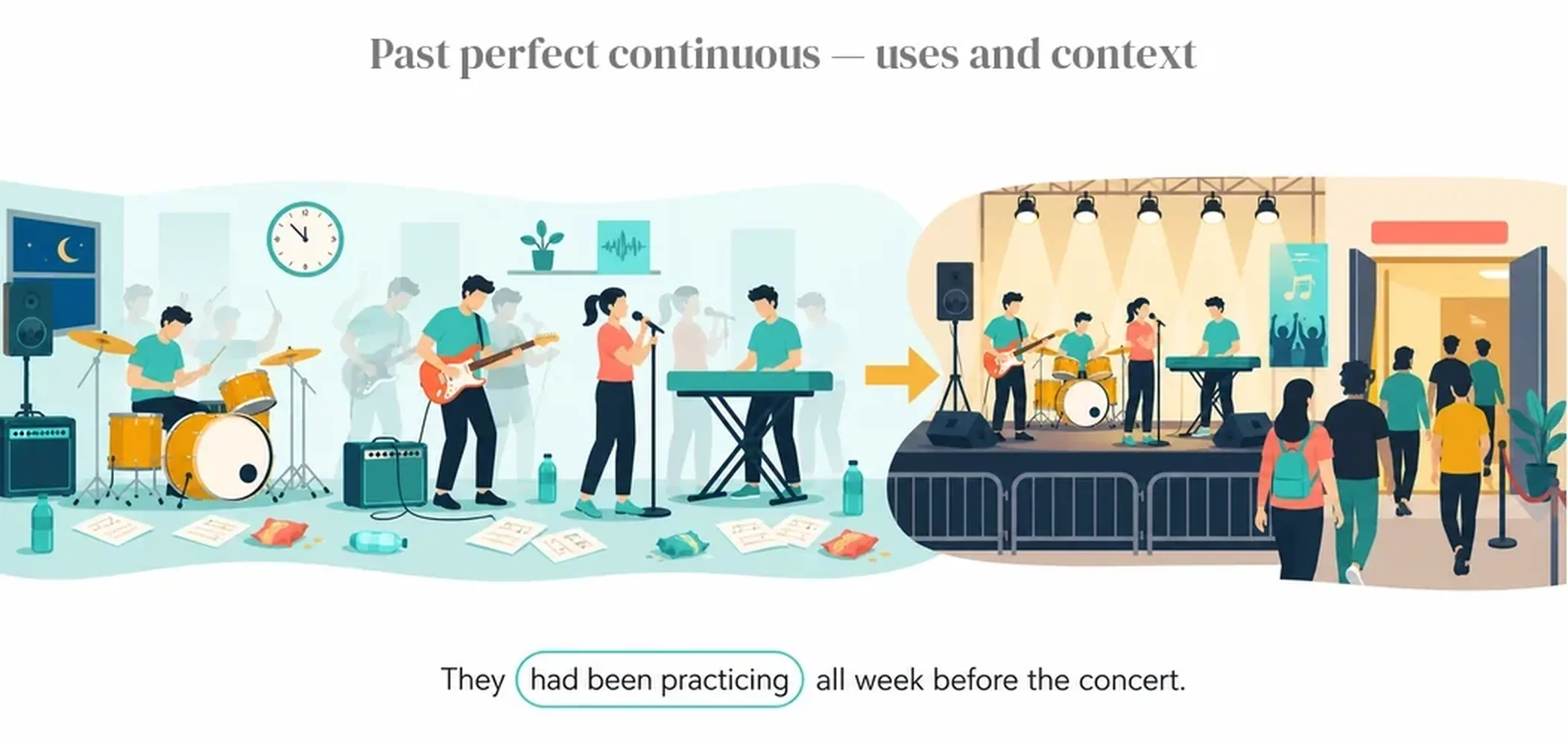
Understanding the Past Perfect Continuous
The past perfect continuous (also called past perfect progressive) describes an action that began in the past, continued for a period of time, and either finished just before another past event or was still ongoing when that event occurred. It emphasizes the duration and continuity of the action rather than its completion. The tense bridges two points in past time, with the past perfect continuous representing the earlier, longer action and a simple past event interrupting or occurring alongside it. This tense is particularly valuable in narrative writing, where establishing temporal relationships between events creates coherence and depth.

Formation
Construct the past perfect continuous using had + been + present participle (-ing form). The auxiliary 'had' carries past tense marking, 'been' is the continuous aspect marker, and the present participle indicates ongoing action. Negation is formed by inserting 'not' after 'had', and questions by inverting 'had' and the subject.
Primary Uses and Contextual Applications
The past perfect continuous serves multiple sophisticated functions in English discourse. First, it establishes temporal relationships by indicating which of two past actions occurred earlier and lasted longer. Second, it expresses cause-and-effect relationships, where the duration of one action explains consequences or circumstances in another. Third, it conveys unfinished actions or states interrupted by specific past events, emphasizing what was happening at the moment of interruption. Finally, it appears in reported speech (indirect speech) when the speaker recounts what someone else had been doing, particularly in academic, journalistic, and literary contexts where precision about temporal sequences is essential.
Subtle Distinctions and Register Considerations
While the past perfect simple (had + past participle) also refers to earlier past events, the past perfect continuous emphasizes duration and is preferred when the length of time matters or when the action's continuation is relevant to understanding consequences. In formal academic and professional writing, this tense demonstrates command of temporal precision and is often expected in sophisticated analysis. In informal speech, native speakers frequently substitute the simple past ('was doing') even when the past perfect continuous would be technically more accurate, particularly in casual narratives. Understanding when to employ the past perfect continuous versus simpler alternatives reflects advanced grammatical awareness and helps writers signal intentionality and temporal sophistication.
Past Perfect Continuous vs. Past Perfect Simple
| Dimension | Past Perfect Continuous | Past Perfect Simple |
|---|---|---|
| Form | had + been + verb‑ing e.g. had been working |
had + past participle e.g. had worked |
| Primary Focus | The duration or ongoing nature of an action that was in progress before a past point or event. Emphasises the process itself. | The completion or result of an action before a past point or event. Emphasises that the action was finished. |
| When to Use |
• To show how long something had been happening up to a past moment. • To explain the cause of a visible past result through an ongoing activity. • To emphasise repeated or continuous effort before a past event. |
• To show that one past action was completed before another past action. • To report the result or achievement of a past action. • With stative verbs (know, own, believe) that cannot normally be used continuously. |
| Time Emphasis | Length of time / ongoing progression up to a past reference point. | Sequence of events / the fact that one action was over before another began. |
| Positive Example | She had been studying for six hours when the power went out. (Focuses on the six‑hour duration of studying.) |
She had studied the entire chapter before the power went out. (Focuses on completing the chapter.) |
| Negative Example | He hadn't been sleeping well for weeks before the doctor's appointment. | He hadn't slept at all by the time the alarm rang. |
| Question Example | How long had they been waiting before the bus arrived? | Had they bought the tickets before the bus arrived? |
| Key Signal Words & Phrases | for, since, all day / week / year, how long, the whole morning, for months | already, just, never, once, by the time, after, before, as soon as |
| Stative Verbs Compatible? | No — stative verbs (know, want, need, own) cannot be used in this form. | Yes — She had known him for years before they met again. |
| Result Visible in Context? | Often yes — the ongoing activity explains a visible past state. His hands were sore because he had been typing all day. |
Focus is on the completed action itself, not necessarily a lingering visible result. He had typed the full report before lunch. |
| Key Difference: The past perfect continuous answers "How long was something happening before a past point?" — it stresses duration, process, and ongoing effort. The past perfect simple answers "Was something already done before a past point?" — it stresses completion, sequence, and result. When you want to highlight the length of an activity, choose the continuous form; when you want to confirm that an action was finished or to sequence two past events, choose the simple form. | ||
Examples
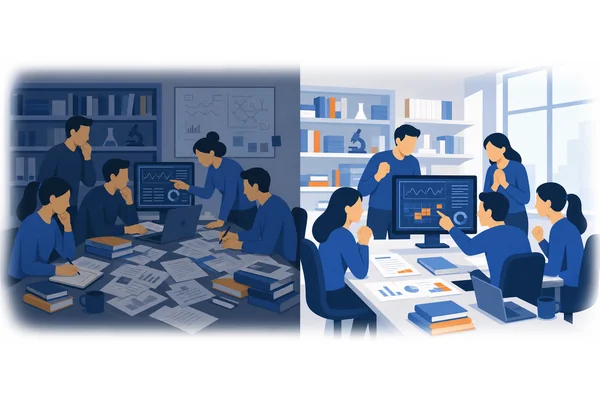
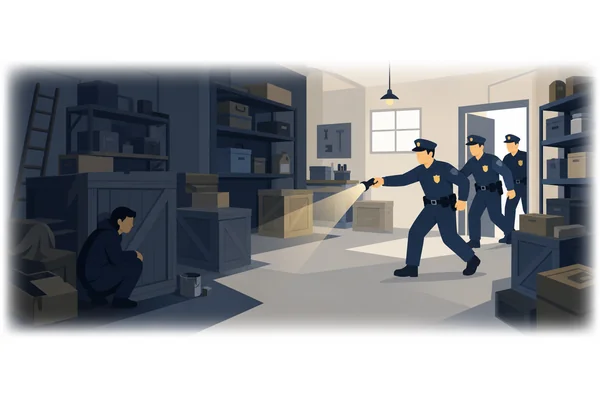
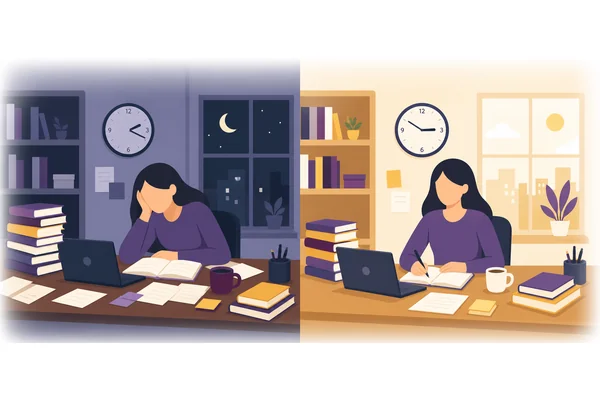



What to Remember
- Use past perfect continuous to show an action's duration before another past event interrupted it.
- The tense emphasizes how long the action continued, not whether it finished or was completed.
- Form it with had been + verb-ing to describe the ongoing action in earlier past time.
- Past perfect continuous often appears with simple past to show which action happened first in narratives.
- Don't use it without a reference point; the tense always relates to another past moment or event.